

Resources Categories
INDUSTRY FACT FILE · TELECOMMUNICATIONS & CONNECTIVITY
Threat Landscape: Top Cyber Threats Facing Telecom and Connectivity Providers
The 18 most relevant cyber threats, attacks and industry challenges for mobile operators, ISPs, enterprise connectivity providers, infrastructure providers and network vendors.
|
In this document 1. The threat picture in numbers 2. Top 18 threats, attacks and challenges 3. Threat relevance by telecom segment 4. Five priority threats in depth 5. Impact on telecom providers and subscribers 6. How regulation turns incidents into business events 7. Questions every leadership team should ask |
1. The threat picture in numbers
|
₹19,813 cr Reported cyber-fraud losses in 2025, all channels (I4C data) |
6 hours Incident reporting under the Telecom Cyber Security Rules |
2024 State-backed intrusions into major US carriers reported |
May 2027 Most DPDP obligations take effect |
Telecom providers face two very different adversaries: nation-state actors seeking long-term access to network infrastructure for espionage, and criminals exploiting SIMs, messaging and subscribers for fraud. Reports based on I4C data put cyber-fraud losses across all channels at about ₹19,813 crore in 2025, much of it enabled by phones and messaging.
In 2024 US authorities reported state-backed intrusions into several major US carriers, and in 2025 a large South Korean operator disclosed a breach of subscriber SIM data—showing that cores, routers and subscriber systems are all in scope.
2. Top 18 threats, attacks and challenges
The list below is a practical assessment framework, not a statistical ranking. Priority varies by business model, technology exposure and existing controls.
|
# |
Threat / attack / challenge |
Typical scenario |
Most exposed |
Potential impact |
|
1 |
Nation-state network intrusion |
Long-term access to routers, cores and lawful-intercept systems |
Mobile operators, ISPs |
Espionage and national-security impact |
|
2 |
Signalling and core attacks |
Abuse of SS7/Diameter or 5G core interfaces |
Mobile operators |
Location tracking, interception, fraud |
|
3 |
SIM-swap fraud |
Fraudulent SIM replacement to capture OTPs |
Mobile operators |
Subscriber financial losses |
|
4 |
Subscriber data theft |
Theft of KYC, CDR or SIM data |
Operators and ISPs |
Privacy harm and regulatory action |
|
5 |
DDoS attacks |
Volumetric and application floods |
ISPs and enterprise connectivity |
Outages for many customers |
|
6 |
BGP and DNS hijacking |
Route leaks and DNS manipulation |
ISPs |
Traffic interception and outages |
|
7 |
Ransomware on IT and OSS/BSS |
Encryption of billing and provisioning |
All providers |
Service and revenue disruption |
|
8 |
Router and CPE compromise |
Exploited edge devices and home routers |
ISPs |
Botnets and persistent access |
|
9 |
Supply-chain and vendor compromise |
Malicious updates or vendor breaches |
All providers |
Network-wide compromise |
|
10 |
Vendor remote-access abuse |
Stolen support credentials |
Operators with outsourced operations |
Disruption and data theft |
|
11 |
Cloud-native core misconfiguration |
Open APIs or weak Kubernetes controls |
5G operators |
Core compromise |
|
12 |
Insider and dealer misuse |
Retail staff misuse access or issue SIMs fraudulently |
Mobile operators |
Fraud and data leakage |
|
13 |
Spam, smishing and fraud calls |
Abuse of messaging and voice services |
Mobile operators |
Subscriber harm |
|
14 |
Physical tampering at sites |
Theft or sabotage at towers and exchanges |
Infrastructure providers |
Outages |
|
15 |
Enterprise customer compromise |
Breach of managed SD-WAN or security services |
Enterprise connectivity |
Customer breaches |
|
16 |
Interconnect and roaming fraud |
Bypass and revenue fraud |
Operators |
Revenue loss |
|
17 |
Weak detection and response |
Limited network telemetry and hunting |
ISPs and smaller providers |
Missed 6-hour reporting |
|
18 |
DR and recovery failure |
Untested recovery of core and IT |
All providers |
Extended outages |
3. Threat relevance by telecom segment
The matrix is a qualitative guide for prioritising the first round of security reviews.
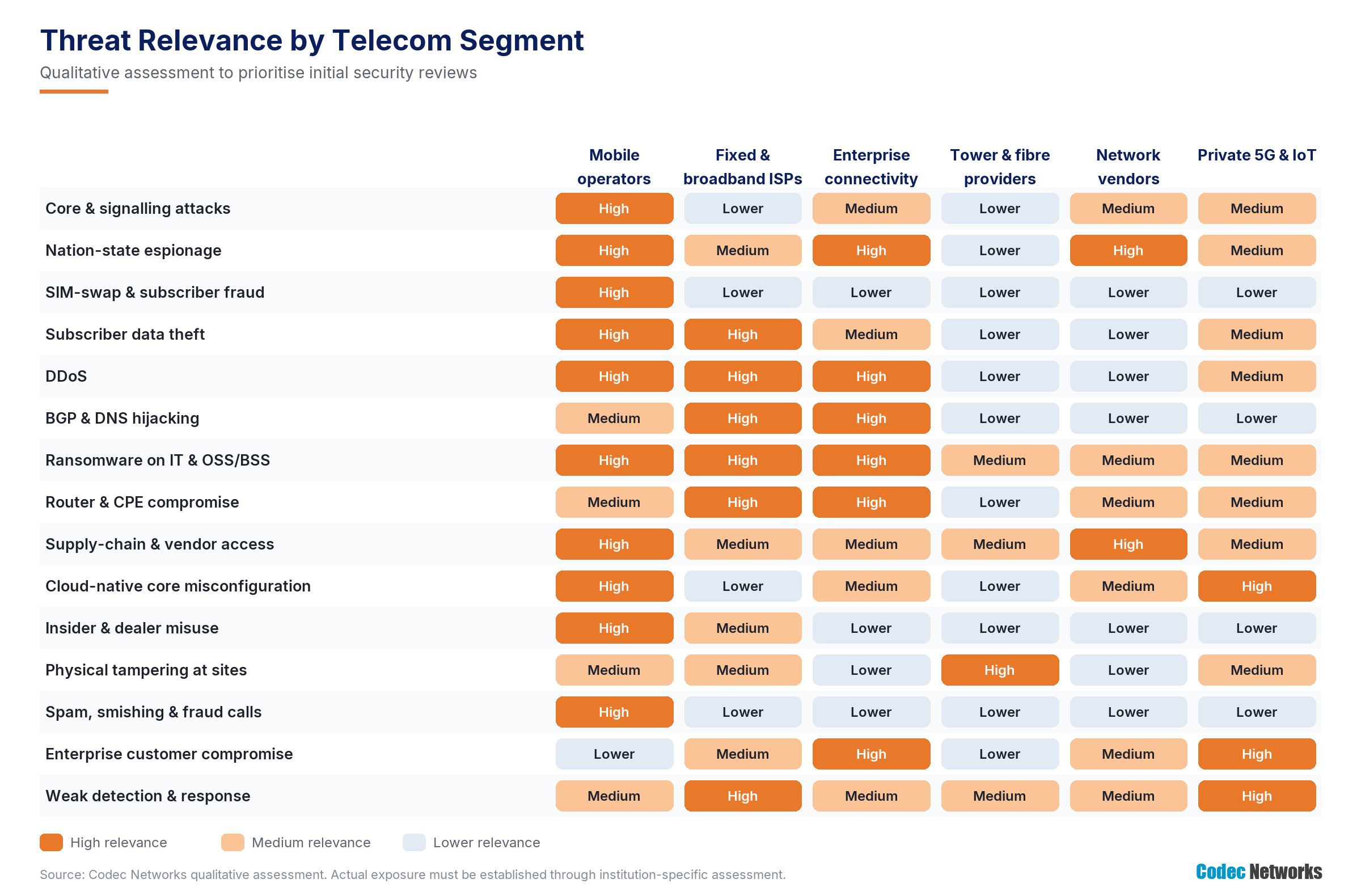
Figure 5: Qualitative threat relevance by telecom segment (Codec Networks assessment).
4. Five priority threats in depth
4.1 Nation-state network intrusion
State-backed groups target routers, cores and management systems for long-term access, often exploiting known vulnerabilities in edge devices and living off the land.
- Questions to test: Are network devices patched and hardened? Are configurations monitored for unauthorised change? Is there active threat hunting on network infrastructure?
- Relevant services: network device hardening, threat hunting, configuration integrity monitoring, red teaming.
4.2 SIM-swap and subscriber fraud
Fraudsters bribe dealers or impersonate subscribers to obtain replacement SIMs, then capture banking OTPs.
- Questions to test: How is identity verified for SIM replacement? Are dealer actions monitored? Are SIM-change signals shared with banks?
- Relevant services: SIM-change process review, dealer monitoring, fraud analytics, insider investigations.
4.3 Cloud-native 5G core
5G standalone cores run as containerised network functions communicating over APIs. Unauthenticated APIs and weak Kubernetes controls expose subscriber and session data.
- Questions to test: Are network function APIs mutually authenticated and authorised? Are clusters hardened? Is core telemetry monitored?
- Relevant services: cloud-native core assessment, Kubernetes review, API testing.
4.4 Vendor and supply-chain access
Network vendors and managed partners often hold standing remote access to element managers. Phished vendor credentials can lead to network-wide disruption.
- Questions to test: Is vendor access brokered, time-bound and recorded? Are vendor products from trusted sources and tested?
- Relevant services: vendor access review, supply-chain assessment, change monitoring.
4.5 Detection and the 6-hour clock
The Telecom Cyber Security Rules require reporting within six hours of becoming aware of a security incident, and CERT-In requires six-hour reporting too.
- Questions to test: Are network, core and IT telemetry centralised and monitored 24x7? Is there a playbook covering both DoT and CERT-In reporting?
- Relevant services: telecom-aware SOC, playbooks, tabletop exercises, IR retainer.
5. Impact on telecom providers and subscribers
|
Player type |
Threats to prioritise |
Main impact |
|
Mobile operators |
Core attacks, SIM-swap, subscriber data theft |
Fraud, privacy harm, licence scrutiny |
|
ISPs |
Router compromise, DDoS, BGP/DNS |
Outages and botnet abuse |
|
Enterprise connectivity |
Managed service compromise |
Customer breaches and SLA penalties |
|
Infrastructure and vendors |
Physical tampering, supply-chain risk |
Network-wide disruption |
|
Subscribers and businesses |
Fraud via SIMs and messaging |
Financial losses |
6. How regulation turns incidents into business events
- DoT: security incidents reported within six hours of becoming aware, with details within 24 hours, under the Telecom Cyber Security Rules, 2024.
- CERT-In: cyber incidents reported within six hours.
- Public interest: the Government may inform the public or direct the entity to do so where disclosure is in the public interest.
- Privacy: subscriber personal data breaches must be intimated to the Data Protection Board once DPDP breach provisions commence in May 2027.
- Enterprise customers: contracts require notification and may trigger SLA penalties.
|
Insight Telecom attackers aim for persistence, not noise. The intrusions that matter most are often quiet ones in routers and cores—found only by hunting, not by waiting for alerts. |
7. Questions every leadership team should ask
- Are we fully aligned to the Telecom Cyber Security Rules, with a policy and CTSO in place?
- Could we detect a quiet intrusion in our routers or 5G core?
- How do we verify identity before replacing a SIM?
- Who can reach our network elements, and is vendor access recorded?
- Could we report an incident to DoT and CERT-In within six hours?
- Are our network products from trusted sources and security-tested?
Talk to Codec Networks
|
Contact Codec Networks Pvt. Ltd. New Delhi: 507, 5th Floor, New Delhi House, Barakhamba Road, Connaught Place, New Delhi – 110001 Gurugram: 707, 7th Floor, Silverton Tower, Golf Course Extension Road, Sector 50, Gurugram – 122018, Haryana Landline: 011 430 496 96 | 011 437 522 99 Mobile: +91 99716 76124 | +91 88007 88220 | +91 88003 31124 Email: mktg@codecnetworks.com Web: www.codecnetworks.com |
Note: Threat descriptions and relevance ratings are general guidance, not findings about any specific organisation. Public incident references are summarised from widely reported events. I4C figures cover all channels.