

Resources Categories
INDUSTRY FACT FILE · RENEWABLE ENERGY & ENERGY STORAGE
Threat Landscape: Top Cyber Threats Facing Renewable and Storage Operators
The 18 most relevant cyber threats, attacks and industry challenges for solar, wind, storage, asset management and smart metering operators.
|
In this document 1. The threat picture in numbers 2. Top 18 threats, attacks and challenges 3. Threat relevance by renewables segment 4. Five priority threats in depth 5. Impact on renewable operators and the grid 6. How regulation turns incidents into business events 7. Questions every leadership team should ask |
1. The threat picture in numbers
|
Feb 2022 Satellite attack cut remote monitoring of ~5,800 wind turbines |
2025 Undocumented devices reported in some imported inverters (US) |
50 MW CEA Regulations threshold (as reported) |
1 Apr 2027 CEA Regulations in force |
Renewable fleets are distributed, remotely managed and dependent on OEM platforms and third-party connectivity. Attackers target vendor portals that can command many sites, exposed controllers with default credentials and update channels for inverters and meters—while supply-chain concerns focus on what equipment contains.
In February 2022, an attack on a satellite provider disrupted remote monitoring of about 5,800 German wind turbines; in 2019, a denial-of-service attack disrupted communications at a US renewable operator; and in 2025, US officials reported undocumented communication devices in some imported inverters.
2. Top 18 threats, attacks and challenges
The list below is a practical assessment framework, not a statistical ranking. Priority varies by business model, technology exposure and existing controls.
|
# |
Threat / attack / challenge |
Typical scenario |
Most exposed |
Potential impact |
|
1 |
Vendor cloud and remote fleet control |
OEM portal accounts abused to command many sites |
Solar, wind and storage fleets |
Curtailment and generation loss |
|
2 |
Inverter and controller firmware flaws |
Exploitable vulnerabilities in field devices |
Solar and storage |
Device compromise |
|
3 |
Undocumented communication modules |
Hidden radios or functions in equipment |
Solar and storage |
Firewall bypass and remote control |
|
4 |
Default credentials and exposed services |
Web interfaces reachable from the internet |
All site types |
Unauthorised access |
|
5 |
Remote connectivity disruption |
Loss of cellular, satellite or VPN links |
Wind and remote solar |
Loss of monitoring and control |
|
6 |
Ransomware on asset management IT |
Encryption of portfolio platforms |
Asset managers and O&M |
Loss of visibility and billing |
|
7 |
BMS and EMS compromise |
Manipulated charge or safety settings |
Storage operators |
Safety and availability risk |
|
8 |
Smart meter and head-end attacks |
Malicious commands or data manipulation |
AMI providers |
Supply disruption and billing errors |
|
9 |
Phishing and credential theft |
Staff and contractors targeted |
All operators |
Initial access |
|
10 |
Supply-chain and equipment risk |
Tampered or insecure equipment |
All operators |
Persistent compromise |
|
11 |
Unsigned firmware updates |
Malicious updates to devices or meters |
Solar, storage, AMI |
Fleet-wide impact |
|
12 |
Physical access to remote sites |
Tampering at unmanned sites |
Solar and wind |
Device manipulation |
|
13 |
Forecast and meter data manipulation |
Altered generation or meter data |
Asset managers, AMI |
Penalties and disputes |
|
14 |
O&M contractor misuse |
Contractors with broad, shared access |
All operators |
Unauthorised changes |
|
15 |
Flat site networks |
No separation between IT, OT and vendor links |
All site types |
Easy lateral movement |
|
16 |
Grid-interface attacks |
Manipulation of scheduling or control signals |
Large operators |
Compliance and grid issues |
|
17 |
Weak OT detection and response |
No monitoring of fleets |
Most operators |
Missed 6-hour reporting |
|
18 |
Recovery failure |
No backups of controller configurations |
All operators |
Extended outages |
3. Threat relevance by renewables segment
The matrix is a qualitative guide for prioritising the first round of security reviews.
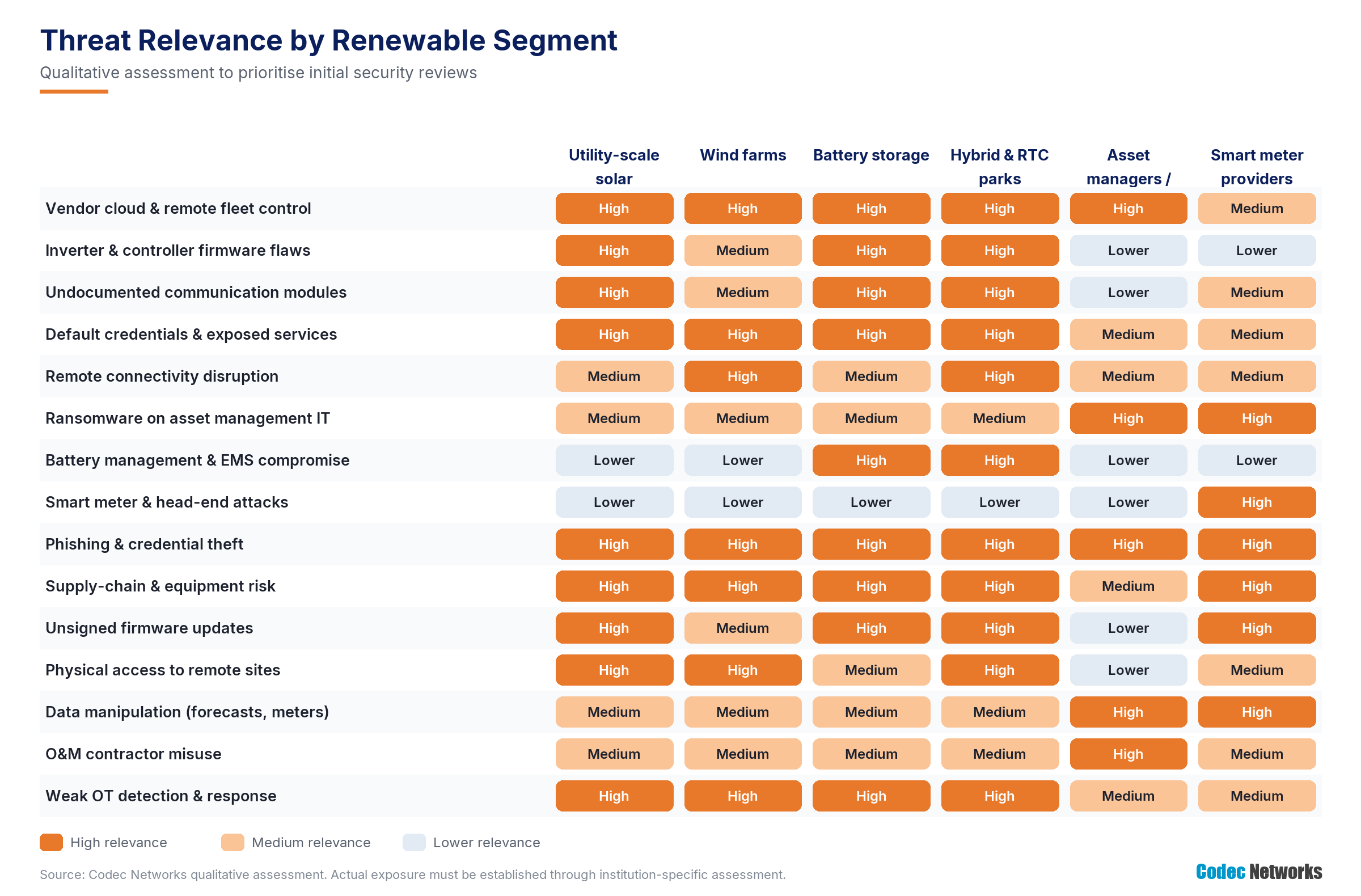
Figure 5: Qualitative threat relevance by renewables segment (Codec Networks assessment).
4. Five priority threats in depth
4.1 Vendor clouds and fleet control
OEM portals let operators—and anyone with their credentials—adjust output across many plants. Shared logins without MFA are common.
- Questions to test: Does every user have a named account with MFA? Are fleet-wide commands approved and monitored? Has the OEM cloud been assessed?
- Relevant services: vendor cloud review, access controls, command monitoring.
4.2 Equipment and supply chain
Concerns about undocumented communication modules and insecure firmware make equipment inspection part of procurement.
- Questions to test: Is equipment inspected before deployment? Are communications allow-listed at sites? Do contracts include security requirements?
- Relevant services: equipment inspection, supply-chain assessment, site network allow-listing.
4.3 Exposed controllers and BMS
Site controllers, EMS and BMS interfaces are sometimes reachable from the internet with default credentials.
- Questions to test: Is external exposure scanned regularly? Are default credentials removed? Are safety interlocks independent of networked controls?
- Relevant services: exposure scanning, EMS/BMS testing, hardening.
4.4 Connectivity resilience
Remote sites depend on third-party links. Losing them removes monitoring and control.
- Questions to test: Are links diverse? Can sites operate safely without telemetry? Are connectivity providers assessed?
- Relevant services: connectivity resilience review, third-party assessment, resilience exercises.
4.5 Detection, reporting and the CEA Regulations
As reported, covered entities must report incidents to CSIRT-Power and CERT-In within six hours and run a 24-hour Information Security Division.
- Questions to test: Is the fleet monitored 24x7? Is there a crisis management plan with drills?
- Relevant services: fleet monitoring, playbooks, crisis plan and drills.
5. Impact on renewable operators and the grid
|
Player type |
Threats to prioritise |
Main impact |
|
Solar operators |
Vendor portal abuse, exposed inverters |
Curtailment and revenue loss |
|
Wind operators |
Connectivity loss, controller access |
Loss of remote operations |
|
Storage operators |
EMS/BMS compromise |
Safety and availability risk |
|
Asset managers and O&M |
Ransomware, contractor misuse |
Portfolio-wide disruption |
|
Smart meter providers |
Head-end and update attacks |
Supply and billing disruption |
6. How regulation turns incidents into business events
- CSIRT-Power and CERT-In: incidents reported within six hours under the CEA Regulations (as reported) and CERT-In Directions.
- CEA: covered entities must maintain crisis plans, audits and governance that incidents will test.
- Grid operators: incidents affecting scheduled generation require coordination.
- Offtakers and lenders: PPAs and financing agreements may require notification.
- Consumers: metering incidents involving personal data trigger DPDP obligations once breach provisions commence in May 2027.
|
Insight In renewables, the control plane is often a vendor's cloud. Treat OEM portal access with the same rigour as access to the plant itself. |
7. Questions every leadership team should ask
- Are we covered by the CEA Regulations, and are we ready for 1 April 2027?
- Who can send commands to our fleet through OEM portals, and is MFA enforced?
- Have we inspected our inverters and controllers for undocumented communications?
- Are any site controllers, EMS or BMS interfaces reachable from the internet?
- Could our sites operate safely if remote connectivity were lost?
- Could we report an incident to CSIRT-Power and CERT-In within six hours?
Talk to Codec Networks
|
Contact Codec Networks Pvt. Ltd. New Delhi: 507, 5th Floor, New Delhi House, Barakhamba Road, Connaught Place, New Delhi – 110001 Gurugram: 707, 7th Floor, Silverton Tower, Golf Course Extension Road, Sector 50, Gurugram – 122018, Haryana Landline: 011 430 496 96 | 011 437 522 99 Mobile: +91 99716 76124 | +91 88007 88220 | +91 88003 31124 Email: mktg@codecnetworks.com Web: www.codecnetworks.com |
Note: Threat descriptions and relevance ratings are general guidance, not findings about any specific organisation. Public incident references are summarised from widely reported events. CEA Regulation details are as reported.