

Resources Categories
INDUSTRY FACT FILE · POWER & ELECTRICITY
Threat Landscape: Top Cyber Threats Facing Power Utilities
The 18 most relevant cyber threats, attacks and industry challenges for generators, transmission utilities, grid operators, DISCOMs and traders.
|
In this document 1. The threat picture in numbers 2. Top 18 threats, attacks and challenges 3. Threat relevance by power segment 4. Five priority threats in depth 5. Impact on utilities and consumers 6. How regulation turns incidents into business events 7. Questions every leadership team should ask |
1. The threat picture in numbers
|
2015–16 Cyberattacks caused power outages in Ukraine |
2021–22 State-linked activity against Indian load dispatch centres reported |
6 hours Incident reporting (CEA Regulations, as reported) |
1 Apr 2027 CEA Regulations in force |
Power utilities face state-backed actors seeking access to grid control systems, criminals deploying ransomware against corporate IT, and the everyday risk of insecure vendor access and legacy control systems. Because the grid is interconnected, incidents at one utility can have wider effects.
Cyberattacks caused power outages in Ukraine in 2015 and 2016, and threat intelligence firms reported state-linked intrusion activity against Indian load dispatch centres in 2021 and 2022.
2. Top 18 threats, attacks and challenges
The list below is a practical assessment framework, not a statistical ranking. Priority varies by business model, technology exposure and existing controls.
|
# |
Threat / attack / challenge |
Typical scenario |
Most exposed |
Potential impact |
|
1 |
Nation-state OT intrusion |
Long-term access to SCADA, EMS or plant systems |
Grid operators, transmission, generators |
Espionage and potential disruption |
|
2 |
Ransomware spreading to OT |
IT ransomware reaching control networks |
Generators and DISCOMs |
Outages and safety shutdowns |
|
3 |
Insecure vendor remote access |
Permanent OEM tunnels to substations and plants |
All utilities |
Unauthorised control |
|
4 |
Substation and protection manipulation |
Changed relay settings or commands |
Transmission and DISCOMs |
Tripping and outages |
|
5 |
SCADA/EMS compromise |
Attacks on control centres |
Grid operators and DISCOMs |
Loss of visibility or control |
|
6 |
Smart meter and head-end attacks |
Mass disconnect or data manipulation |
DISCOMs |
Supply disruption and revenue loss |
|
7 |
Phishing and credential theft |
Engineers and staff targeted |
All utilities |
Initial access |
|
8 |
Supply-chain and equipment compromise |
Tampered equipment or software |
All utilities |
Persistent compromise |
|
9 |
Legacy and unpatched control systems |
Outdated OS and firmware |
Generators and transmission |
Easy exploitation |
|
10 |
Flat IT/OT networks |
No separation between IT and OT |
Generators and DISCOMs |
Rapid spread |
|
11 |
Billing and revenue fraud |
Manipulated metering or billing data |
DISCOMs |
Revenue loss |
|
12 |
Insider misuse |
Staff or contractors misuse access |
All utilities |
Sabotage or fraud |
|
13 |
DDoS on market and consumer platforms |
Floods against portals and trading platforms |
Exchanges and DISCOMs |
Service disruption |
|
14 |
Physical-cyber attacks on sites |
Unauthorised access to substations |
Transmission and DISCOMs |
Tampering |
|
15 |
Removable media malware |
USB drives in plant environments |
Generators |
OT infection |
|
16 |
Renewable and DER integration risk |
Insecure connections from new assets |
Grid operators and DISCOMs |
New attack paths |
|
17 |
Weak OT detection and response |
No OT monitoring |
Most utilities |
Missed 6-hour reporting |
|
18 |
OT recovery failure |
No tested OT backups or restoration plans |
All utilities |
Extended outages |
3. Threat relevance by power segment
The matrix is a qualitative guide for prioritising the first round of security reviews.
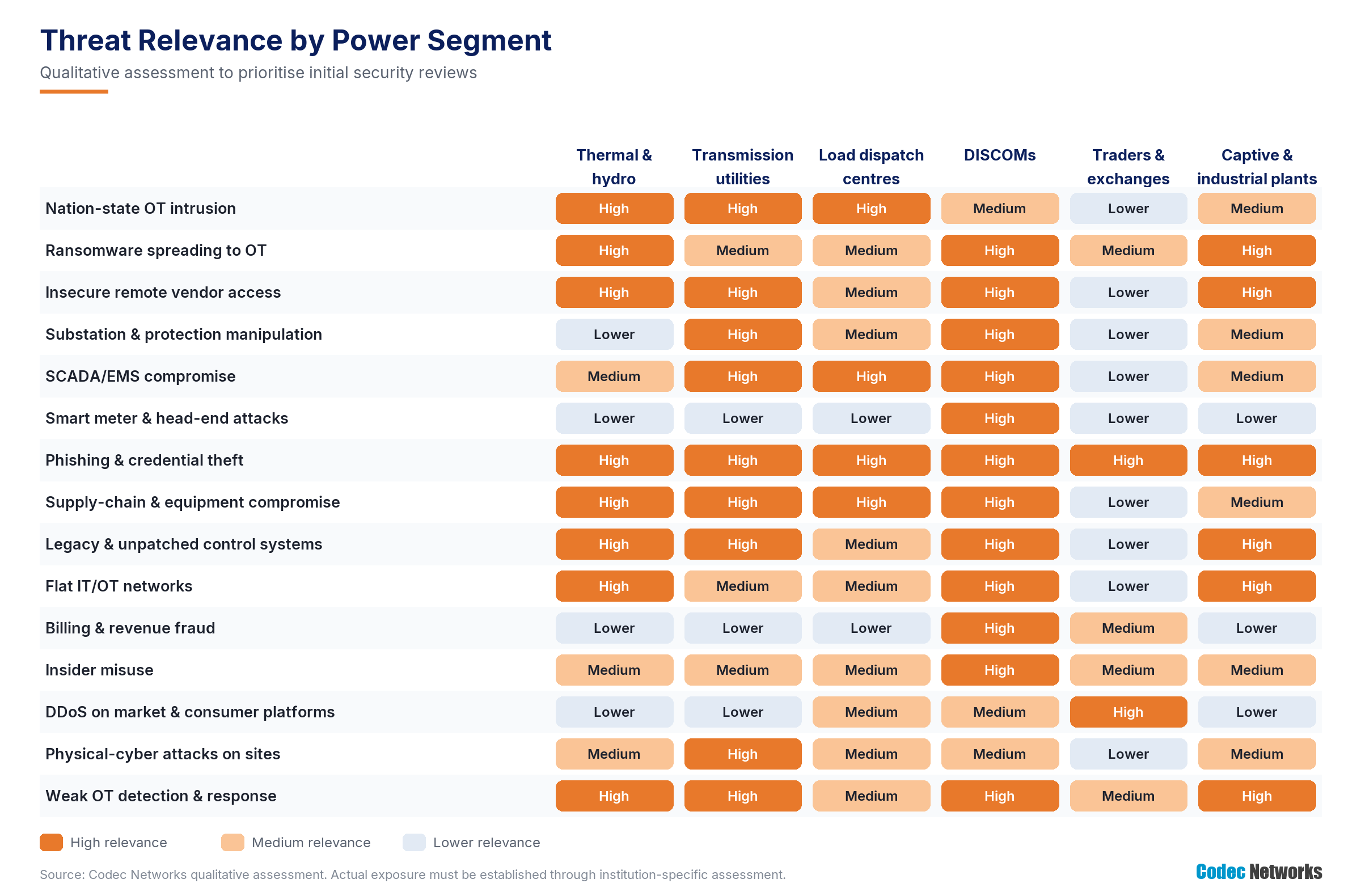
Figure 5: Qualitative threat relevance by power segment (Codec Networks assessment).
4. Five priority threats in depth
4.1 Nation-state OT intrusion
State-linked groups seek quiet, long-term access to grid control systems, often entering through corporate IT or partner networks and probing for paths to SCADA.
- Questions to test: Is SCADA/EMS strictly separated from IT? Is OT traffic monitored? Is there threat hunting for state-actor tradecraft?
- Relevant services: OT segmentation review, OT monitoring, threat hunting, red teaming.
4.2 Ransomware and IT-to-OT spread
Ransomware typically starts in corporate IT. Dual-homed systems, shared credentials and flat networks let it reach plant and distribution control systems.
- Questions to test: Is there an IT/OT DMZ? Are dual-homed systems removed? Are OT backups offline and tested?
- Relevant services: IT/OT segmentation, EDR and SOC, OT backup and recovery testing.
4.3 Vendor remote access
OEMs often keep permanent remote connections to substations and plants. Stolen vendor credentials can lead to direct control of equipment.
- Questions to test: Is vendor access brokered, time-bound and recorded? Is MFA enforced? Are configuration changes monitored?
- Relevant services: remote access review, vendor assessments, configuration monitoring.
4.4 Smart metering
Head-end systems can send commands to millions of meters. Weak admin controls could allow mass disconnection.
- Questions to test: Are bulk commands approved and rate-limited? Is the head-end tested and monitored?
- Relevant services: head-end security testing, approval controls, monitoring.
4.5 Detection, reporting and the CEA Regulations
As reported, the CEA Regulations require incident reporting to CSIRT-Power and CERT-In within six hours, a 24-hour Information Security Division and annual mock drills.
- Questions to test: Is OT monitored 24x7? Is the crisis management plan current and tested?
- Relevant services: IT/OT SOC, crisis plan and drills, IR retainer.
5. Impact on utilities and consumers
|
Player type |
Threats to prioritise |
Main impact |
|
Generators |
Ransomware into DCS, removable media |
Generation loss and safety risk |
|
Transmission utilities |
Relay manipulation, vendor access |
Outages across regions |
|
Grid operators |
Nation-state intrusion |
Loss of grid visibility |
|
DISCOMs |
Ransomware, smart meter attacks |
Supply and revenue disruption |
|
Consumers and economy |
Outages |
Economic and safety impact |
6. How regulation turns incidents into business events
- CSIRT-Power and CERT-In: incidents reported within six hours under the CEA Regulations (as reported) and CERT-In Directions.
- CEA: covered entities must maintain crisis management plans, audits and governance, which incidents will test.
- NCIIPC: incidents affecting notified critical information infrastructure involve NCIIPC coordination.
- Grid operators: incidents affecting grid operations require coordination with load dispatch centres.
- Consumers: DISCOM incidents affecting personal data trigger DPDP obligations once breach provisions commence in May 2027.
|
Insight In power, the incidents that matter most are those that cross from IT into OT. Segmentation, vendor access control and OT monitoring are the controls that keep an IT incident from becoming an outage. |
7. Questions every leadership team should ask
- Are we ready for the CEA Regulations coming into force on 1 April 2027?
- Is our SCADA/EMS strictly separated from corporate IT?
- Which vendors can reach our substations and plants, and is their access recorded?
- Could a single command from our smart meter head-end disconnect large numbers of consumers?
- Is our OT monitored 24x7, and could we report to CSIRT-Power and CERT-In within six hours?
- When did we last run a cyber crisis mock drill?
Talk to Codec Networks
|
Contact Codec Networks Pvt. Ltd. New Delhi: 507, 5th Floor, New Delhi House, Barakhamba Road, Connaught Place, New Delhi – 110001 Gurugram: 707, 7th Floor, Silverton Tower, Golf Course Extension Road, Sector 50, Gurugram – 122018, Haryana Landline: 011 430 496 96 | 011 437 522 99 Mobile: +91 99716 76124 | +91 88007 88220 | +91 88003 31124 Email: mktg@codecnetworks.com Web: www.codecnetworks.com |
Note: Threat descriptions and relevance ratings are general guidance, not findings about any specific organisation. Public incident references are summarised from widely reported events. CEA Regulation details are as reported.