

Resources Categories

INDUSTRY FACT FILE · PHARMACEUTICALS & LIFE SCIENCES
Threat Landscape: Top Cyber Threats Facing Pharma and Life Sciences
The 18 most relevant cyber threats, attacks and industry challenges for drug manufacturers, biotech firms, CROs, laboratories and CDMOs.
|
In this document 1. The threat picture in numbers 2. Top 18 threats, attacks and challenges 3. Threat relevance by pharma segment 4. Five priority threats in depth 5. Impact on pharma organisations, partners and patients 6. How regulation turns incidents into business events 7. Questions every leadership team should ask |
1. The threat picture in numbers
|
2017 NotPetya disrupted a major global drugmaker's operations |
Oct 2020 A leading Indian pharma company hit by a cyberattack |
6 hours To report incidents to CERT-In |
May 2027 Most DPDP obligations take effect |
Pharma faces three kinds of attacker: criminals seeking ransom by stopping plants, state-backed and competitive actors seeking research IP, and insiders taking formulations when they leave. Weak IT/OT boundaries and legacy lab systems add data integrity risk that regulators inspect.
Widely reported incidents—the 2017 NotPetya disruption of a major global drugmaker, a 2020 cyberattack on a leading Indian pharmaceutical company and pandemic-era advisories on state-backed targeting of vaccine research—show the scale of impact.
2. Top 18 threats, attacks and challenges
The list below is a practical assessment framework, not a statistical ranking. Priority varies by business model, technology exposure and existing controls.
|
# |
Threat / attack / challenge |
Typical scenario |
Most exposed |
Potential impact |
|
1 |
Ransomware and plant disruption |
Encryption spreading from IT into MES and SCADA |
Manufacturers and CDMOs |
Production stops and supply delays |
|
2 |
IP theft and espionage |
Theft of formulations, processes and research |
Biotech and R&D-led firms |
Loss of competitive advantage |
|
3 |
Insider data exfiltration |
Departing staff copy research files |
R&D and process teams |
IP loss and litigation |
|
4 |
Data integrity failures |
Shared logins, disabled audit trails, altered results |
QC labs and manufacturers |
Inspection findings and market access risk |
|
5 |
OT and SCADA compromise |
Attacks on control systems |
Plants |
Safety and quality impact |
|
6 |
Clinical data leakage |
Exposure of trial participant data |
CROs and sites |
Privacy harm and sponsor disputes |
|
7 |
Phishing and credential theft |
Targeted phishing of researchers and staff |
All organisations |
Initial access |
|
8 |
Third-party and partner compromise |
Breach at CROs, CDMOs or vendors |
Sponsors and manufacturers |
Downstream exposure |
|
9 |
Cloud and collaboration exposure |
Misconfigured shared drives and SaaS |
Research and clinical teams |
Data exposure |
|
10 |
BEC and payment fraud |
Fake supplier bank changes |
Procurement and exporters |
Financial loss |
|
11 |
Counterfeit and supply-chain fraud |
Fake products and tampered logistics data |
Distributors and exporters |
Patient risk and brand damage |
|
12 |
Legacy lab and plant systems |
Unsupported operating systems on instruments and HMIs |
Labs and plants |
Easy exploitation |
|
13 |
Vendor remote access to OT |
Always-on equipment vendor connections |
Plants |
Unauthorised access |
|
14 |
Regulatory dossier tampering |
Altered submission or quality documents |
Regulatory affairs |
Compliance risk |
|
15 |
Clinical data tampering |
Manipulation of trial data |
CROs and sites |
Study integrity risk |
|
16 |
Cold-chain monitoring attacks |
Manipulated temperature data |
Biologics distribution |
Product quality risk |
|
17 |
Weak detection and response |
Limited IT and OT monitoring |
MSME manufacturers |
Missed 6-hour reporting |
|
18 |
Backup and recovery failure |
No offline copies of batch records and OT configurations |
Manufacturers |
Extended outages |
3. Threat relevance by pharma segment
The matrix is a qualitative guide for prioritising the first round of security reviews.
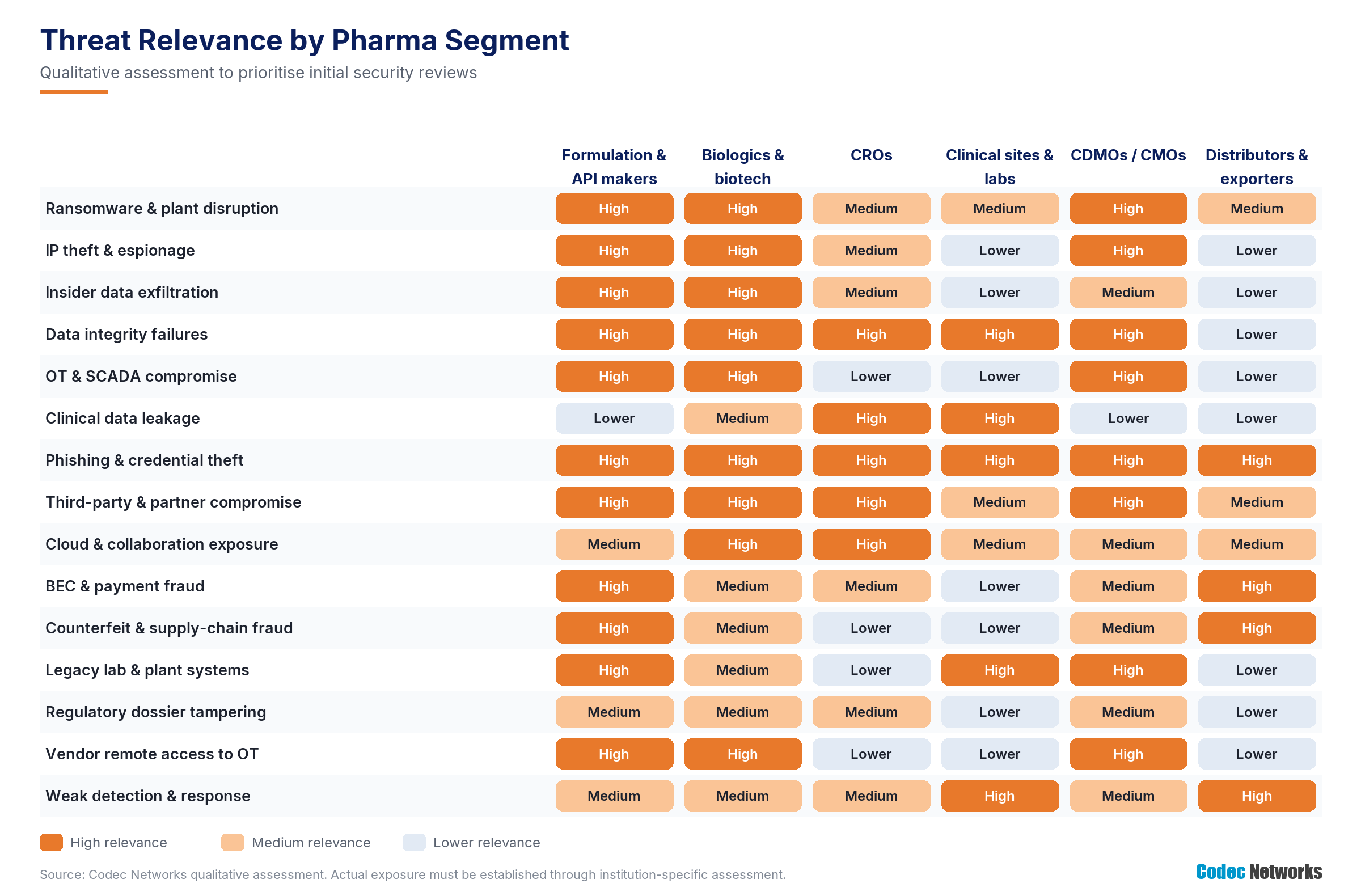
Figure 5: Qualitative threat relevance by pharma segment (Codec Networks assessment).
4. Five priority threats in depth
4.1 Ransomware and plant disruption
Dual-homed engineering workstations, shared credentials and flat networks let ransomware spread from IT into MES and SCADA, stopping production and batch release.
- Questions to test: Is there an IT/OT DMZ? Are dual-homed systems eliminated? Are OT assets inventoried and monitored? Are MES and batch records backed up offline?
- Relevant services: OT assessment and segmentation, OT monitoring, backup testing, OT incident exercises.
4.2 IP theft and insiders
Research data and process knowledge are valuable to competitors and state actors. Departing scientists and targeted phishing are common routes.
- Questions to test: Is research data classified? Are exports, uploads and USB use monitored? Are leavers' activities reviewed?
- Relevant services: IP protection programme, DLP, UEBA, forensic investigations.
4.3 Data integrity
Shared logins, disabled audit trails and unreviewed changes in LIMS and chromatography systems are both security weaknesses and inspection findings.
- Questions to test: Does every user have a unique account? Are audit trails enabled and reviewed? Are configurations controlled?
- Relevant services: computerised system and data integrity assessments, access reviews.
4.4 Clinical data and CROs
Trial data moves between sponsors, CROs and sites through EDC, CTMS and exports. Laptops, shared drives and weak CRO controls expose participant data.
- Questions to test: Does data stay in validated systems? Are endpoints encrypted? Do sponsors assess CRO security?
- Relevant services: clinical platform testing, CRO assessments, privacy programme.
4.5 Detection and the 6-hour clock
CERT-In requires reporting within six hours of noticing an incident. OT and lab environments are often unmonitored.
- Questions to test: Are IT and OT monitored 24x7? Is there a playbook covering production, quality and regulatory notifications?
- Relevant services: managed SOC for IT and OT, playbooks, tabletop exercises.
5. Impact on pharma organisations, partners and patients
|
Player type |
Threats to prioritise |
Main impact |
|
Manufacturers |
Ransomware into OT, data integrity |
Supply disruption and inspection risk |
|
Biotech and R&D |
Espionage, insider theft |
Loss of IP and competitive position |
|
CROs and sites |
Clinical data leakage and tampering |
Sponsor disputes and privacy harm |
|
CDMOs |
Client data exposure, OT disruption |
Client loss |
|
Patients |
Supply shortages, counterfeit products |
Health impact |
6. How regulation turns incidents into business events
- CERT-In: incidents reported within six hours of noticing them.
- Drug regulators: incidents affecting quality data or batch records may need assessment under GMP and may be examined in inspections by CDSCO or export-market regulators.
- Clinical trials: incidents affecting trial data may require notification to sponsors and ethics committees.
- Privacy: personal data breaches must be intimated to the Data Protection Board once DPDP breach provisions commence in May 2027.
- Partners: sponsors, clients and licensors may audit after incidents.
|
Insight In pharma, the security question and the inspection question are often the same: who can change this record, and would we know if they did? |
7. Questions every leadership team should ask
- Could ransomware on an office PC reach our MES or SCADA?
- Are any systems connected to both IT and OT networks?
- Does every lab user have a unique account with audit trails enabled and reviewed?
- Would we detect a scientist copying research files before leaving?
- How do we assess the security of our CROs and CDMOs?
- Could we report an incident to CERT-In within six hours while protecting production?
Talk to Codec Networks
|
Contact Codec Networks Pvt. Ltd. New Delhi: 507, 5th Floor, New Delhi House, Barakhamba Road, Connaught Place, New Delhi – 110001 Gurugram: 707, 7th Floor, Silverton Tower, Golf Course Extension Road, Sector 50, Gurugram – 122018, Haryana Landline: 011 430 496 96 | 011 437 522 99 Mobile: +91 99716 76124 | +91 88007 88220 | +91 88003 31124 Email: mktg@codecnetworks.com Web: www.codecnetworks.com |
Note: Threat descriptions and relevance ratings are general guidance, not findings about any specific organisation. Public incident references are summarised from widely reported events.