

Resources Categories

INDUSTRY FACT FILE · PAYMENTS & TRANSACTION PROCESSING
Main Products and Services in Payments and Transaction Processing
What corporate and enterprise companies in the sector sell, the systems that deliver each offering, and where those systems create cybersecurity and compliance exposure.
|
In this document 1. How the sector earns its money 2. Products and services by player type 3. Payment products in detail 4. Lending, data and embedded-finance services 5. The systems behind the products 6. Product trends that change the attack surface 7. Mapping products to Codec Networks engagements |
1. How the sector earns its money
Payments and fintech companies monetise speed, reach and convenience. Their revenue comes from a mix of transaction fees, merchant services, software subscriptions and—through regulated lending partners—credit products. Understanding the revenue model matters for security: whatever generates revenue is also what an attacker, a regulator or a partner bank will look at first.
|
Revenue stream |
How it works |
Security relevance |
|
Merchant discount and platform fees |
Fees charged to merchants for collecting card, net-banking, wallet and other payments; value-added platform fees |
Checkout, payment-page and API integrity directly protect this revenue |
|
Interchange and issuer income |
Card and PPI issuers earn a share of transaction fees |
Account takeover and fraud losses erode issuer margins |
|
Software and SaaS fees |
Subscription billing, payouts, reconciliation, invoicing and risk tools sold to businesses |
Multi-tenant platforms concentrate many clients' data and credentials |
|
Lending economics (through regulated lenders) |
Interest, processing fees and service fees on loans originated through LSPs and DLAs |
Borrower data, KYC documents and bank statements are high-value targets |
|
Float and settlement services |
Escrow-based settlement, payouts and cash-management services |
Settlement-file and escrow integrity are critical controls |
|
Zero-MDR products Merchant discount rate (MDR) on RuPay debit cards and BHIM-UPI transactions has been set at zero since January 2020. Because UPI carries most retail transaction volume but earns little direct fee income, companies tend to fund security from adjacent revenue lines—which makes efficient, well-prioritised security spending especially important. |
2. Products and services by player type
|
Player type |
Main products |
Main services |
|
Payment aggregators (PA-O / PA-P / PA-CB) |
Online checkout, payment links, payment pages, QR and soundbox acceptance, POS and SoftPOS acceptance, cross-border collections |
Merchant onboarding and KYC, settlement through escrow, payouts, refunds and dispute handling, reconciliation, risk and fraud tools |
|
Payment gateways |
Gateway APIs and SDKs, hosted payment pages, routing engines |
Transaction routing, tokenised card handling for merchants, integration support |
|
PPI issuers and wallets |
Full-KYC and small PPIs, wallets, prepaid and gift cards, transit (NCMC) cards |
Loading, P2P and P2M transfers, merchant payments, UPI interoperability for full-KYC PPIs, customer grievance handling |
|
UPI apps (TPAPs) and PSP banks |
Consumer and merchant UPI apps, UPI Lite, UPI AutoPay mandates, UPI 123PAY for feature phones, UPI Circle |
P2P and P2M payments, mandate management, credit lines and RuPay credit cards on UPI, dispute resolution |
|
Payment system operators |
UPI, IMPS, RuPay, NACH, AePS, NETC FASTag, BBPS, card networks, ATM networks, TReDS |
Switching, clearing and settlement, dispute frameworks, fraud-risk services, certification of participants |
|
Processors and switch providers |
Card issuing and acquiring processing, UPI switches, tokenisation and HSM services |
Processing as a service, BIN sponsorship programmes with banks, reconciliation and settlement processing |
|
Digital lending platforms |
Personal, consumer-durable, MSME and merchant loans; credit lines; multi-lender marketplaces |
Lead generation, underwriting support, KYC, collections support and servicing as LSPs for banks and NBFCs |
|
Account Aggregators |
Consent manager platform for financial information sharing |
Consent collection and data-flow orchestration between FIPs and FIUs |
|
Cross-border and remittance players |
Inward and outward collections, export payments, inward remittances |
FX conversion through AD banks, compliance screening, settlement |
|
Fintech infrastructure providers |
KYC, V-CIP, e-sign, bank-statement analysis, fraud and identity APIs, banking-as-a-service platforms |
API access, managed onboarding, data enrichment and risk scoring |
3. Payment products in detail
3.1 UPI and real-time payments
UPI is the backbone of Indian retail payments, processing 24.51 billion transactions worth ₹29.82 lakh crore in August 2026 according to NPCI data. Products built on UPI include person-to-person and person-to-merchant payments, QR-code acceptance, UPI Lite for small-value payments, AutoPay mandates for recurring payments, UPI 123PAY for feature phones, credit lines and RuPay credit cards linked to UPI, and UPI Circle for delegated payments. IMPS remains important for instant account-to-account transfers.
3.2 Card products
Debit, credit and prepaid cards run on domestic and international card networks. Since 1 October 2022, online merchants and aggregators may not store customers' actual card data; card-on-file tokenisation replaces stored card numbers with tokens. RBI's 2025 PA Master Direction reinforces that card credentials must not be stored in any database or server accessible to the merchant, and that merchant infrastructure must comply with PCI DSS and PCI SSF where applicable.
3.3 Prepaid payment instruments
PPIs include wallets, prepaid cards and gift instruments issued by banks and authorised non-banks. Full-KYC PPIs can interoperate through UPI and card networks. The 2021 PPI Master Directions (as updated) remain in force; RBI released a draft replacement Master Direction on 22 April 2026 for consultation, which proposes simplified categories and tighter controls. Issuers should track the final text closely.
3.4 Bills, mandates and transit
Bharat Bill Payment System (BBPS) operating units collect utility, education, insurance and loan repayments. NACH and e-mandates support recurring collections. NETC FASTag and NCMC-based cards serve tolls and transit. These products depend on high availability and reliable reconciliation, so outages and settlement errors quickly become customer-facing incidents.
3.5 Merchant acceptance and value-added services
Aggregators and gateways compete on acceptance breadth and merchant tooling: payment links, subscription billing, payouts, smart routing, dynamic QR, soundboxes, POS terminals, SoftPOS on smartphones, reconciliation dashboards, chargeback management and risk scoring. Each tool adds an interface—and an attack surface—to the merchant relationship.
4. Lending, data and embedded-finance services
Fintech lending in India is delivered through regulated entities (banks and NBFCs) working with lending service providers and digital lending apps. The RBI (Digital Lending) Directions, 2025, effective 8 May 2025, consolidate the rules: lenders must report the DLAs they use on RBI's CIMS portal (from 15 June 2025), and LSPs operating multi-lender platforms must display all matching offers transparently (from 1 November 2025).
- Digital loans: personal, consumer-durable, education, MSME and merchant working-capital loans originated through apps and partner platforms.
- Credit lines and embedded credit: pre-approved credit lines, pay-later-style offerings by regulated lenders and credit on UPI.
- Account Aggregator-based underwriting: consented access to bank statements and financial records for faster credit decisions.
- Embedded finance and banking-as-a-service: APIs that let non-financial platforms offer payments, accounts, cards or loans with a regulated partner.
- Supply-chain finance: invoice discounting for MSMEs on TReDS platforms and partner-lender programmes.
5. The systems behind the products
Every product rests on a stack of systems. Mapping products to systems is the first step in scoping any security assessment, because it shows which applications, interfaces and suppliers carry the most business risk.
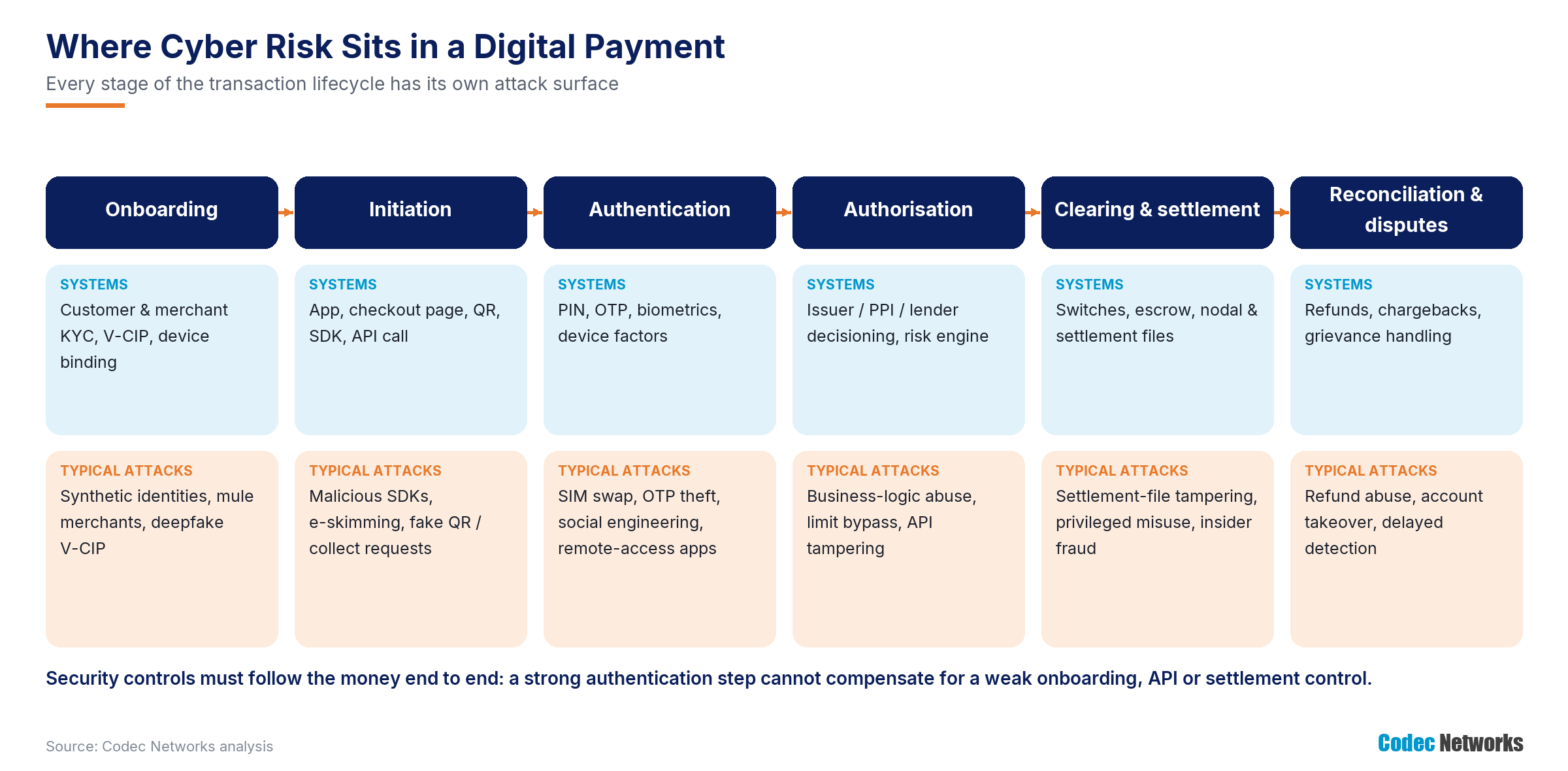
Figure 2: The digital payment lifecycle — systems involved at each stage and the attacks that typically target them.
|
Product / service |
Systems that deliver it |
Key cyber and compliance touchpoints |
|
Online checkout and payment links |
Hosted payment pages, merchant plug-ins, gateway APIs, tokenisation vault, risk engine |
PCI DSS (incl. payment-page script controls), PA baseline technology recommendations, VAPT |
|
UPI app |
Mobile app, device-binding service, PSP bank integration, NPCI interfaces, fraud engine |
Mobile app security, authentication rules, RBI 2024 mobile-security controls, NPCI guidelines |
|
Wallet / PPI |
Wallet ledger, KYC and V-CIP stack, load and transfer services, card issuing processor |
PPI directions, cooling periods after loading, fraud monitoring, data localisation |
|
POS / SoftPOS acceptance |
Terminals, terminal management system, acquiring host, key management |
PCI-PTS and PCI-P2PE validated terminals (RBI 2024 directions), PCI DSS |
|
Settlement and payouts |
Escrow management, settlement engine, bank APIs, reconciliation system |
Escrow rules under the PA Master Direction, privileged-access control, file integrity |
|
Digital lending app |
DLA, LSP platform, lender LOS/LMS integrations, AA connector, KFS generator |
Digital Lending Directions, DPDP Act, API security, data minimisation |
|
Account Aggregator flows |
Consent manager, FIP and FIU gateways, encryption and key services |
Consent integrity, encryption, API security, audit trails |
|
Cross-border collections |
PA-CB platform, FX and AD-bank integrations, screening tools |
PA-CB requirements, PMLA/FIU-IND reporting, third-party risk |
6. Product trends that change the attack surface
|
Trend |
What is changing |
Security implication |
|
New authentication factors |
RBI's Authentication Directions, 2025 (effective 1 April 2026) require two factors with at least one dynamic factor, and allow alternatives to SMS OTP such as biometrics and device-bound tokens |
Authentication flows must be re-tested; device-binding and biometric integrity become critical controls |
|
Tokenisation everywhere |
Card-on-file, device and in-app tokens replace stored card numbers |
Token vaults, HSMs and token-provisioning APIs become high-value targets |
|
Credit on UPI and embedded credit |
Credit lines and RuPay credit cards linked to UPI; lending embedded in commerce apps |
Account takeover now exposes credit limits, not just balances |
|
SoftPOS and app-based acceptance |
Smartphones replace dedicated terminals for small merchants |
Mobile device security and app attestation replace hardware tamper resistance |
|
AI in onboarding, credit and fraud |
AI-driven KYC checks, underwriting and fraud scoring |
Model manipulation, deepfake-assisted V-CIP and data-leakage risks need specialist testing |
|
Cloud-native platforms and open APIs |
Microservices, Kubernetes and partner APIs at every layer |
Misconfiguration, secrets exposure and broken authorisation dominate real-world findings |
7. Mapping products to Codec Networks engagements
|
If the company offers… |
Recommended starting engagement |
|
Online checkout, payment pages or SDKs |
Payment-page security and PCI DSS readiness, web and API VAPT, e-skimming monitoring |
|
A UPI or wallet app |
Mobile application security testing, authentication and device-binding review, fraud-scenario testing |
|
Merchant acquiring (online or physical) |
Merchant onboarding controls review, settlement and escrow process audit, CERT-In empanelled cyber audit |
|
Network, switch or processing services |
Resilience and DR assessment, SOC maturity review, privileged-access audit, red teaming |
|
Digital lending or AA-based services |
API security testing, DPDP privacy programme, data-flow mapping, rogue-app and brand monitoring |
|
Cross-border payments |
Third-party and partner assessments, logging and monitoring assurance, transaction-monitoring controls review |
|
Fintech infrastructure or SaaS |
Secure SDLC and DevSecOps review, SOC 2 / ISO 27001 readiness, tenant-isolation testing |
Talk to Codec Networks
|
Contact Codec Networks Pvt. Ltd. New Delhi: 507, 5th Floor, New Delhi House, Barakhamba Road, Connaught Place, New Delhi – 110001 Gurugram: 707, 7th Floor, Silverton Tower, Golf Course Extension Road, Sector 50, Gurugram – 122018, Haryana Landline: 011 430 496 96 | 011 437 522 99 Mobile: +91 99716 76124 | +91 88007 88220 | +91 88003 31124 Email: mktg@codecnetworks.com Web: www.codecnetworks.com |
Note: Product descriptions are general and based on public information available as of October 2026. Product availability, limits and features are governed by RBI directions and NPCI rules, which change frequently. Confirm current requirements against official circulars.