

Resources Categories

INDUSTRY FACT FILE · MEDICAL DEVICES & MEDTECH
Threat Landscape: Top Cyber Threats Facing Connected Medical Devices
The 18 most relevant cyber threats, attacks and industry challenges for connected device manufacturers, diagnostic equipment vendors and remote monitoring platforms.
|
In this document 1. The threat picture in numbers 2. Top 18 threats, attacks and challenges 3. Threat relevance by medtech segment 4. Five priority threats in depth 5. Impact on device makers, hospitals and patients 6. How regulation turns incidents into business events 7. Questions every leadership team should ask |
1. The threat picture in numbers
|
~465,000 Pacemakers covered by a 2017 FDA-announced firmware update |
Jan 2025 US warning on a patient monitor with a hidden data function |
Mar 2023 FDA cyber-device requirements in effect |
May 2027 Most DPDP obligations take effect |
Medical devices face threats at every layer: firmware flaws and hard-coded credentials, insecure wireless pairing, unsigned updates, exposed debug ports, vulnerable components and cloud platforms that aggregate patient data. Because devices stay in service for years, unpatched vulnerabilities persist across fleets.
Public examples include the 2017 FDA-announced firmware update for about 465,000 pacemakers and the January 2025 US warning about a patient monitor with a hidden function sending data to a hard-coded address—showing both safety and supply-chain dimensions.
2. Top 18 threats, attacks and challenges
The list below is a practical assessment framework, not a statistical ranking. Priority varies by business model, technology exposure and existing controls.
|
# |
Threat / attack / challenge |
Typical scenario |
Most exposed |
Potential impact |
|
1 |
Firmware vulnerabilities |
Memory-safety and logic flaws in embedded code |
All connected devices |
Device compromise or malfunction |
|
2 |
Hard-coded credentials and backdoors |
Built-in passwords or hidden functions |
Devices with third-party modules |
Unauthorised access |
|
3 |
Insecure wireless and pairing |
Weak BLE or Wi-Fi security |
Wearables, home devices, implantables |
Data interception or control |
|
4 |
Unsigned or insecure updates |
Firmware accepted without verification |
All updatable devices |
Malicious firmware |
|
5 |
Exposed debug interfaces |
JTAG or UART enabled in production |
Embedded devices |
Firmware and key extraction |
|
6 |
Vulnerable third-party components |
Known flaws in libraries, RTOS or stacks |
All products |
Fleet-wide exposure |
|
7 |
Cloud API and platform flaws |
Weak authorisation in monitoring platforms |
Remote monitoring |
Mass patient data exposure |
|
8 |
Mobile companion app flaws |
Insecure storage or API keys in apps |
Home and wearable devices |
Account and data compromise |
|
9 |
Patient data exposure |
Unencrypted data on devices or in transit |
All products |
Privacy harm |
|
10 |
Legacy operating systems |
Outdated OS on imaging and lab workstations |
Imaging and lab equipment |
Ransomware and exploitation |
|
11 |
Service tool and field access misuse |
Service credentials or tools abused |
Hospital equipment |
Unauthorised changes |
|
12 |
Supply-chain and manufacturing compromise |
Tampered components or provisioning |
OEMs and contract manufacturers |
Persistent compromise |
|
13 |
Shared device keys |
One key used across all units |
Connected devices |
Cloning and impersonation |
|
14 |
AI model manipulation |
Adversarial inputs or tampered models |
AI-enabled devices and SaMD |
Incorrect outputs |
|
15 |
Ransomware via hospital networks |
Devices disrupted by network-borne malware |
Hospital-connected devices |
Clinical disruption |
|
16 |
Denial of service |
Devices crash under malformed traffic |
Networked devices |
Loss of function |
|
17 |
Weak vulnerability handling |
No disclosure or patch process |
Smaller manufacturers |
Prolonged exposure |
|
18 |
Insufficient regulatory evidence |
Missing threat models, SBOMs or test reports |
Exporting manufacturers |
Delayed approvals |
3. Threat relevance by medtech segment
The matrix is a qualitative guide for prioritising the first round of security reviews.
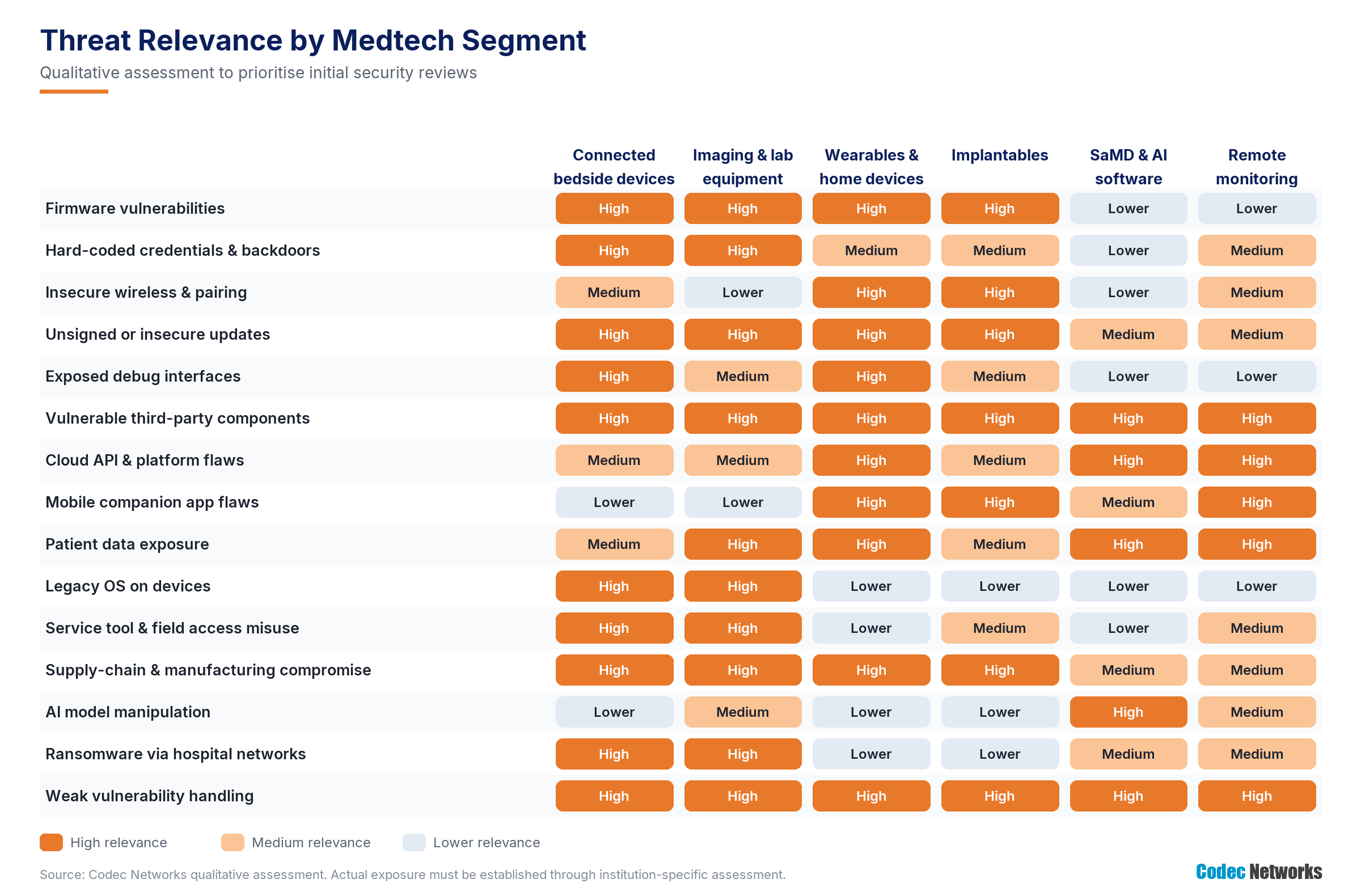
Figure 5: Qualitative threat relevance by medtech segment (Codec Networks assessment).
4. Five priority threats in depth
4.1 Firmware and hidden functions
Embedded firmware and third-party modules can contain vulnerabilities, hard-coded credentials or undocumented functions that customers cannot see.
- Questions to test: Has firmware been analysed for secrets and unexpected behaviour? Is every third-party component listed in an SBOM? Do suppliers commit to security requirements?
- Relevant services: firmware analysis, SBOM and component analysis, supplier assessments.
4.2 Update integrity
Update mechanisms are powerful: whoever controls them controls the fleet. Unsigned updates or poorly protected update servers allow malicious firmware.
- Questions to test: Is firmware cryptographically signed and verified at boot? Is the update server hardened and monitored? Can updates be staged and rolled back?
- Relevant services: secure update review, infrastructure testing, product incident planning.
4.3 Hardware and debug interfaces
Debug ports left enabled and keys shared across units let researchers—or attackers—extract firmware and clone devices.
- Questions to test: Are debug interfaces locked in production? Does each device have a unique identity and protected key storage?
- Relevant services: hardware security testing, provisioning review.
4.4 Wireless, apps and cloud
Wearables and home devices rely on BLE, apps and cloud platforms. Weak pairing, embedded API keys and missing authorisation expose patients' data at scale.
- Questions to test: Is pairing authenticated? Are app secrets protected? Does the platform enforce per-device and per-patient authorisation?
- Relevant services: wireless, mobile app, API and cloud testing.
4.5 Regulatory evidence and post-market
Regulators expect threat models, SBOMs, testing and vulnerability management. Weak evidence delays approvals, and weak post-market processes leave fleets exposed.
- Questions to test: Is there a threat model traceable to risk files? Is there a coordinated disclosure process and patch plan?
- Relevant services: threat modelling, submission evidence, PSIRT and disclosure programme.
5. Impact on device makers, hospitals and patients
|
Player type |
Threats to prioritise |
Main impact |
|
Bedside and imaging device makers |
Firmware flaws, legacy OS, service access |
Clinical disruption and field actions |
|
Wearable and home device makers |
Wireless and app flaws |
Patient data exposure and recalls |
|
Implantable device makers |
Wireless and update risks |
Safety concerns and regulatory action |
|
Platform providers |
API and identity flaws |
Mass patient data exposure |
|
Hospitals and patients |
Vulnerable devices in care |
Safety and privacy harm |
6. How regulation turns incidents into business events
- Device regulators: vulnerabilities affecting safety may require field safety corrective actions and regulator communication under CDSCO, FDA or EU rules.
- CERT-In: cyber incidents affecting companies and platforms reported within six hours.
- Privacy: personal data breaches from platforms must be intimated to the Data Protection Board once DPDP breach provisions commence in May 2027.
- Hospitals: customers expect security advisories and patches under procurement terms.
- Researchers: coordinated disclosure affects reputation and timelines.
|
Insight A device vulnerability is a fleet vulnerability. Secure updates and an SBOM are what turn a frightening disclosure into a routine patch. |
7. Questions every leadership team should ask
- Do we have a complete SBOM for every product and version in the field?
- Is our firmware signed and verified at boot, and is our update server hardened?
- Are debug interfaces locked and keys unique per device?
- Does our platform enforce per-device and per-patient authorisation?
- Do we have a coordinated vulnerability disclosure and patch process?
- Is our cybersecurity evidence ready for FDA, EU and CDSCO reviews?
Talk to Codec Networks
|
Contact Codec Networks Pvt. Ltd. New Delhi: 507, 5th Floor, New Delhi House, Barakhamba Road, Connaught Place, New Delhi – 110001 Gurugram: 707, 7th Floor, Silverton Tower, Golf Course Extension Road, Sector 50, Gurugram – 122018, Haryana Landline: 011 430 496 96 | 011 437 522 99 Mobile: +91 99716 76124 | +91 88007 88220 | +91 88003 31124 Email: mktg@codecnetworks.com Web: www.codecnetworks.com |
Note: Threat descriptions and relevance ratings are general guidance, not findings about any specific product. Public examples are summarised from widely reported regulator communications.