

Resources Categories
INDUSTRY FACT FILE · MARITIME, PORTS & SHIPPING
Threat Landscape: Top Cyber Threats Facing Maritime, Ports and Shipping
The 18 most relevant cyber threats, attacks and industry challenges for ports, terminal operators, shipping companies, shipyards and waterway operators, and the impact each one has on trade, safety, revenue and customers.
|
In this document 1. The threat picture in numbers 2. Top 18 threats, attacks and challenges 3. Threat relevance by maritime and port segment 4. Five priority threats in depth 5. Impact on ports, shipping companies, cargo owners and crews 6. How regulation turns incidents into business events 7. Questions every leadership team should ask |
1. The threat picture in numbers
|
US$250–300 m Maersk's estimated losses from NotPetya (2017) |
30,000 Containers stranded when DP World Australia shut four terminals (Nov 2023) |
2 days Container operations halted at the Port of Nagoya by ransomware (Jul 2023) |
6 hours To report incidents to CERT-In |
Ports and shipping companies attract ransomware groups because cargo cannot wait and the pressure to pay is public; state-backed actors because ports are strategic infrastructure and shipyards hold naval designs; fraudsters because delivery orders, truck nominations and settlements move high-value goods and money; and opportunists because ships, cranes and gates run legacy systems reachable through OEM links. The attack surface spans terminal OT, TOS and PCS integrations, customer portals, ship bridge and engine-room systems, satcom and the office IT that connects them all.
Landmark incidents show the pattern. NotPetya (2017) destroyed Maersk's network and cost US$250–300 million. Shahid Rajaee (2020) saw road and shipping queues after a cyber attack. Nagoya (2023) lost two days of container operations to LockBit ransomware delivered through its unified terminal system. DP World Australia (2023) disconnected four terminals and stranded about 30,000 containers after data theft. Seattle (2024) refused a US$6 million Rhysida ransom while airport and marina systems were down. A suspected ransomware incident at a Jawaharlal Nehru Port terminal in 2022 forced vessel diversions, and UKMTO advisories in 2025 reported GNSS interference across the Gulf and Red Sea.
2. Top 18 threats, attacks and challenges
The list below is a practical assessment framework, not a statistical ranking. Priority varies by business model, technology exposure and existing controls.
|
# |
Threat / attack / challenge |
Typical scenario |
Most exposed |
Potential impact |
|
1 |
Ransomware halting terminals |
TOS, gate, billing and office systems encrypted |
All operators |
Cargo stops, ships divert, recovery costs |
|
2 |
Terminal OT and crane intrusion |
Unauthorised access to crane, RTG, gate or SCADA networks |
Terminal operators, ports |
Safety incidents, equipment damage, stoppages |
|
3 |
OEM and vendor remote access abuse |
Standing links and shared vendor accounts hijacked |
All operators |
Direct path to OT and cargo systems |
|
4 |
TOS and cargo platform attacks |
Exploitation or outage of TOS, PCS or portal integrations |
Ports, terminals, lines |
Yard blindness, documentation failures |
|
5 |
Container release and manifest fraud |
Altered delivery orders, truck nominations or manifests |
Terminals, forwarders, lines |
Cargo theft, smuggling exposure |
|
6 |
Ship system compromise |
Malware or remote access affecting ECDIS, engine or cargo control |
Shipping lines, managers |
Safety and detention risk |
|
7 |
GNSS, AIS and communications interference |
Spoofing and jamming of navigation and tracking |
Ships in chokepoints |
Groundings, collisions, tracking loss |
|
8 |
Phishing and credential theft |
Staff, agents, crew and vendor accounts targeted |
All operators |
Initial access |
|
9 |
Business email compromise |
Fraudulent freight, bunker or settlement payment changes |
Lines, agents, ports |
Direct financial loss |
|
10 |
Flat IT/OT and terminal networks |
No separation between office IT, TOS and control networks |
Older terminals |
Office malware reaching cranes |
|
11 |
Legacy SCADA and controllers |
Unpatched PLCs and operator stations |
Ports, bulk terminals, yards |
Easy exploitation, no vendor fixes |
|
12 |
Customer, crew and cargo data breaches |
Shipper, driver, seafarer and manifest data exposed |
Lines, ports, platforms |
DPDP exposure, trust loss |
|
13 |
State-backed sabotage and espionage |
Persistent intrusions into ports, fleets and shipyards |
Major ports, shipyards |
Strategic loss, disruption |
|
14 |
Supply chain and software compromise |
Malicious updates or compromised service providers |
All operators |
Fleet-wide or port-wide impact |
|
15 |
Insider misuse |
Employees, agents or contractors abuse access |
All operators |
Theft, fraud, sabotage |
|
16 |
Dredging and construction contractors |
Temporary networks and devices on port estates |
Ports under expansion |
Malware, unauthorised access |
|
17 |
Weak detection and response |
No visibility into terminals, ships or OEM sessions |
Most operators |
Long dwell time; missed 6-hour reporting |
|
18 |
Backup and recovery failure |
No tested restores of TOS, PLC configurations or ERP |
All operators |
Days to weeks of stoppage |
3. Threat relevance by maritime and port segment
The matrix is a qualitative guide for prioritising the first round of security reviews.
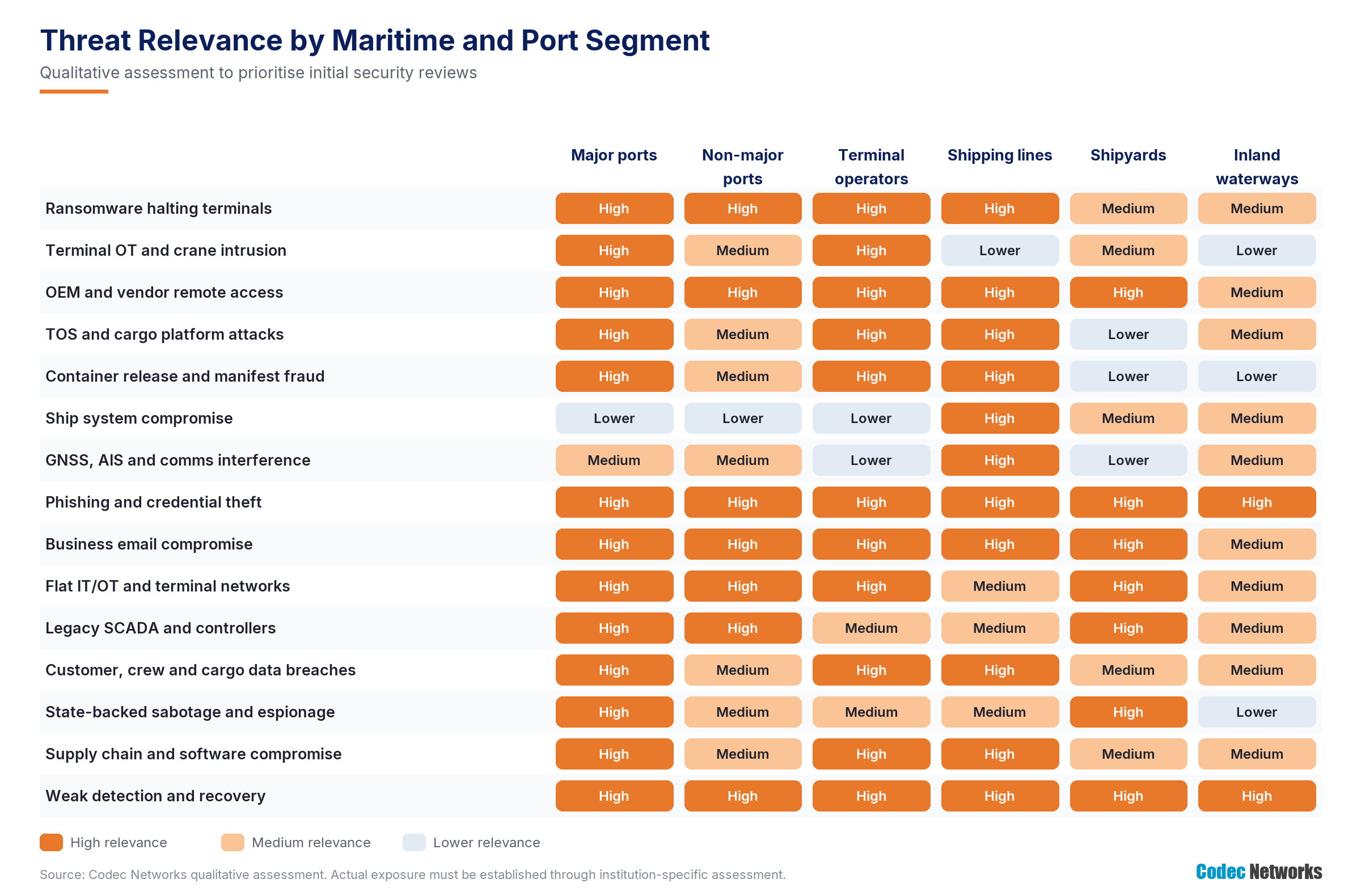
Figure 5: Qualitative threat relevance by maritime and port segment (Codec Networks assessment).
4. Five priority threats in depth
4.1 Ransomware and the terminal that cannot see its yard
Nagoya and DP World Australia show that when the cargo system goes, the terminal stops even with every crane intact. Backups on the same network and untested restores turn hours into weeks.
- Questions to test: Are TOS, gate and OT networks separated from office IT? Are backups immutable and restore times proven? Are EDR alerts watched 24x7? Is there a manual yard and gate playbook?
- Relevant services: segmentation, backup and recovery testing, continuity playbooks, EDR and SOC.
4.2 OEMs, vendors and remote access
Crane, gate and navigation OEMs keep standing links with shared credentials; integrators and dredging contractors bring devices onto port networks; ships receive updates by satcom and USB.
- Questions to test: Which vendors can reach OT and cargo systems, and is access brokered and recorded? Are contractor devices scanned and segmented? Are ship updates controlled?
- Relevant services: remote access brokering, third-party programme, device controls, access recertification.
4.3 Cargo platforms and release fraud
PCS and TOS portals, delivery orders and truck nominations are the keys to high-value cargo. Weak authentication and missing anomaly checks make theft look like a normal release.
- Questions to test: Do all trade users have MFA? Are APIs tested for authorisation flaws? Are delivery-order changes and nominations monitored? Is high-value release verified?
- Relevant services: portal and API testing, fraud analytics, release verification, partner awareness.
4.4 Ships, navigation and the IMO regime
GNSS spoofing in the Gulf and Red Sea, malware on bridge and engine-room systems and remote access from shore make ship cyber a safety matter that flag, class and charterers now inspect.
- Questions to test: Does each ship's SMS address cyber risk as MSC.428(98) requires? Are newbuilds specified to UR E26/E27? Are GNSS integrity checks and degraded-navigation drills in place?
- Relevant services: ship cyber risk assessments, UR E26/E27 readiness, bridge procedures and drills.
4.5 Detection, reporting and the 6-hour clock
CERT-In requires reporting within six hours; NCIIPC expects protected-system owners to report; listed groups disclose quarterly; customers and customs expect answers. Terminals, ships and OEM sessions are usually unmonitored.
- Questions to test: Are terminals, ports and fleets monitored 24x7? Do we see OEM sessions? Is there a playbook combining safety decisions, manual operation, CERT-In reporting, customer and customs communication?
- Relevant services: IT/OT SOC, playbooks, joint drills with operations, customers and customs.
5. Impact on ports, shipping companies, cargo owners and crews
|
Player type |
Threats to prioritise |
Main impact |
|
Ports and port authorities |
Ransomware, shared-system outages, sabotage |
Trade disruption, national impact, inquiries |
|
Terminal operators |
TOS and OT compromise, release fraud, OEM access abuse |
Stoppages, service credits, cargo theft |
|
Shipping lines and managers |
Fleet IT outages, ship system compromise, BEC |
Delays, detentions, financial loss |
|
Shipyards |
Espionage, design theft, subcontractor compromise |
Lost contracts, customer penalties |
|
Cargo owners, crews and drivers |
Delays, data exposure, safety incidents |
Supply chain cost, personal harm |
6. How regulation turns incidents into business events
- CERT-In: incidents reported within six hours of noticing them.
- NCIIPC: incidents affecting notified protected systems require coordination and reporting.
- DG Shipping, flag and class: ship incidents affecting safety management engage ISM audits, port state control and class surveys; port facility incidents engage ISPS plans.
- Customs and customers: cargo release and documentation incidents trigger customs inquiries and contractual notifications.
- SEBI LODR: listed operators disclose cyber incidents quarterly.
- DPDP and insurers: customer, crew and driver data incidents trigger breach intimation from May 2027; insurers and P&I clubs require prompt notice.
|
Insight The most dangerous maritime incidents cross boundaries—from an OEM link into the crane, from office IT into the TOS, from a portal login into the gate, and from a spoofed signal onto the bridge. Strong boundaries, tested recovery, fraud-aware platforms and visibility across terminal and ship are the best defence. |
7. Questions every leadership team should ask
- If our TOS and gate systems went dark, could we run the yard and release cargo safely?
- Which OEMs, contractors and ships can reach our control and cargo networks, and is that access brokered and recorded?
- Could a stolen portal login release a container to the wrong truck?
- Does every ship's safety management system address cyber risk, and are our newbuilds specified to UR E26/E27?
- Do we have offline backups of TOS, PLC configurations and ERP with proven restore times?
- Could we detect, contain and report an incident within six hours while keeping ships, crews and terminals safe?
Talk to Codec Networks
|
Contact Codec Networks Pvt. Ltd. New Delhi: 507, 5th Floor, New Delhi House, Barakhamba Road, Connaught Place, New Delhi – 110001 Gurugram: 707, 7th Floor, Silverton Tower, Golf Course Extension Road, Sector 50, Gurugram – 122018, Haryana Landline: 011 430 496 96 | 011 437 522 99 Mobile: +91 99716 76124 | +91 88007 88220 | +91 88003 31124 Email: mktg@codecnetworks.com Web: www.codecnetworks.com |
Note: Threat descriptions and relevance ratings are general guidance, not findings about any specific organisation. Public incident references are summarised from widely reported events and company disclosures.