

Resources Categories
INDUSTRY FACT FILE · INSURANCE INTERMEDIARIES
Threat Landscape: Top Cyber Threats Facing Insurance Intermediaries and Insurtechs
The 18 most relevant cyber threats, attacks and industry challenges for brokers, corporate agents, web aggregators, TPAs, repositories and digital insurance platforms in India.
|
In this document 1. The threat picture in numbers 2. Top 18 threats, attacks and challenges 3. Threat relevance by intermediary segment 4. Five priority threats in depth 5. Impact on intermediaries, insurers and customers 6. How regulation turns incidents into business events 7. Questions every leadership team should ask |
1. The threat picture in numbers
|
₹19,813 cr Reported cyber-fraud losses in 2025, all channels (I4C data) |
6 hours To report incidents to CERT-In |
6-monthly External PT under IRDAI 2026 |
May 2027 Most DPDP obligations take effect |
Intermediaries combine valuable data with direct connections into insurers' systems. Attackers target their APIs and portals for mass data theft, their finance teams for premium diversion, their distributor networks for credentials and their claims platforms for ransomware. Reports based on I4C data put cyber-fraud losses across all channels at about ₹19,813 crore in 2025.
IRDAI's 2026 guidelines bring intermediaries under audits by CERT-In empanelled auditors and six-monthly external testing, while insurers increasingly assess intermediaries as third parties.
2. Top 18 threats, attacks and challenges
The list below is a practical assessment framework, not a statistical ranking. Priority varies by business model, technology exposure and existing controls.
|
# |
Threat / attack / challenge |
Typical scenario |
Most exposed |
Potential impact |
|
1 |
Customer data leakage |
Exposure of KYC, contact, proposal and policy data |
All intermediaries |
DPDP exposure, insurer action, customer harm |
|
2 |
Broken API authorisation |
APIs return other customers' quotes, policies or claims |
Aggregators, insurtechs, TPAs |
Mass data exposure |
|
3 |
Health and claims data exposure |
Leakage of medical records and bills |
TPAs and health-focused brokers |
Sensitive data harm and regulatory reporting |
|
4 |
Phishing and brand impersonation |
Fake sites, apps and messages using the intermediary's brand |
Aggregators, corporate agents, insurtechs |
Customer losses and brand damage |
|
5 |
Customer account takeover |
Phished credentials used on portals and apps |
Aggregators, repositories, insurtechs |
Unauthorised changes and data exposure |
|
6 |
Premium and payment diversion |
Payments redirected to fraudsters' accounts |
Brokers and platforms collecting premiums |
Financial loss and lapsed cover |
|
7 |
Business email compromise |
Impersonation of executives, insurers or clients |
Brokers and corporate agents |
Fraudulent payments and data loss |
|
8 |
Ransomware and extortion |
Encryption of claims and servicing systems and data theft |
TPAs, brokers, repositories |
Service outages for several insurers |
|
9 |
Distributor and POSP credential theft |
Phished or sold distributor logins |
Corporate agents and platforms with distributor networks |
Data downloads and fake policies |
|
10 |
Insider misuse |
Staff or distributors misuse access to customer data |
All intermediaries |
Data theft and mis-selling |
|
11 |
Lead-data scraping and resale |
Automated harvesting of lead and quote data |
Web aggregators and insurtechs |
Spam, scams and DPDP exposure |
|
12 |
Cloud misconfiguration |
Public storage or excessive permissions |
Cloud-native platforms |
Data exposure |
|
13 |
Claims and document fraud |
Forged documents and manipulated bills |
TPAs |
Claims leakage for insurers |
|
14 |
Third-party and SaaS compromise |
Breach at CRM, KYC, payment or messaging providers |
All intermediaries |
Downstream exposure |
|
15 |
AI assistant misuse |
Prompt injection and data leakage through chatbots |
Insurtechs and aggregators |
Data exposure and misleading advice |
|
16 |
Weak detection and response |
Limited logging and monitoring |
Smaller intermediaries |
Missed 6-hour reporting |
|
17 |
Unpatched internet-facing systems |
Exploitable VPNs, gateways and web servers |
Intermediaries with lean IT |
Initial access for ransomware |
|
18 |
Backup and recovery failure |
Backups reachable or untested |
TPAs and repositories |
Extended outages |
3. Threat relevance by intermediary segment
The matrix is a qualitative guide for prioritising the first round of security reviews.
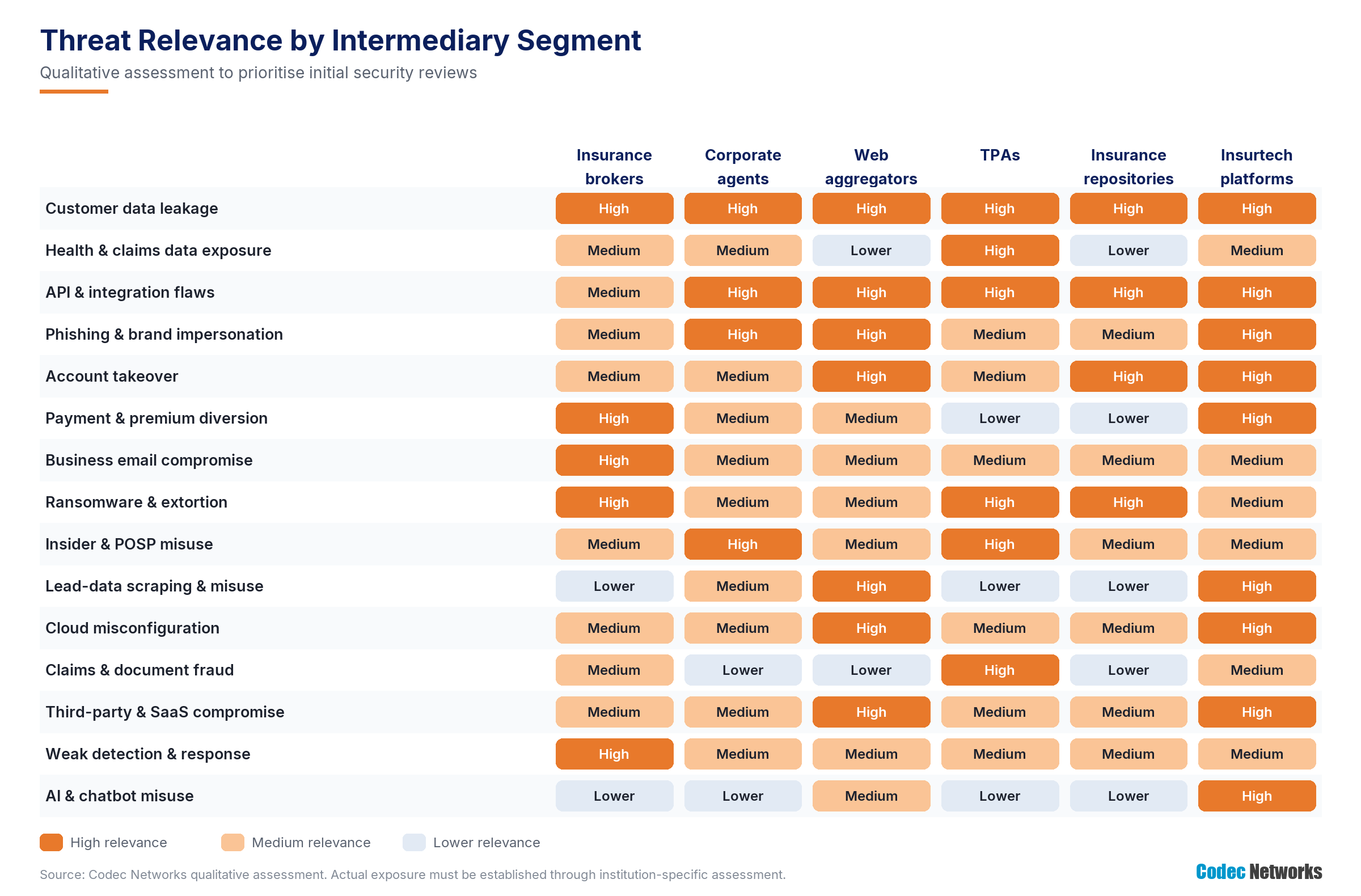
Figure 5: Qualitative threat relevance by intermediary segment (Codec Networks assessment).
4. Five priority threats in depth
4.1 Broken API authorisation
Quote, policy and claims APIs often check that a user is logged in but not that the record belongs to them. A single flaw can expose every customer, and the data often includes health and vehicle details.
- Questions to test: Is object-level authorisation enforced on every API? Are enumeration and bulk access detected and blocked? Do responses return only the data needed?
- Relevant services: API security testing, code review, rate limiting and anomaly detection.
4.2 Premium diversion and BEC
Brokers handle large group-health and commercial premiums. Attackers compromise mailboxes, study payment cycles and send clients 'changed bank details' letters.
- Questions to test: Is MFA enforced on email? Are mailbox rules monitored? Are bank-detail changes verified by call-back on a known number? Is DMARC enforced?
- Relevant services: email security review, BEC simulation, finance-process testing, SOC monitoring.
4.3 Ransomware at TPAs
A TPA outage stops cashless approvals for several insurers at once. Unpatched remote-access systems and reachable backups are common root causes.
- Questions to test: Are internet-facing systems tested every six months? Are backups isolated and restorable? Is there 24x7 monitoring and a playbook covering every insurer client?
- Relevant services: external PT, managed SOC, backup testing, BCP/DR drills, incident response.
4.4 Distributor credentials and impersonation
Distributor and POSP logins are phished and sold, while fake sites and messages use intermediaries' brands to target customers.
- Questions to test: Are distributor logins protected by MFA and device controls? Are downloads monitored? Is the brand monitored for fakes?
- Relevant services: access reviews, anomaly detection, brand monitoring and takedown, awareness.
4.5 Vendors, cloud and the 6-hour clock
Intermediaries rely heavily on cloud, CRM, KYC and messaging vendors. The 2026 guidelines set cloud and vendor requirements, and CERT-In requires reporting within six hours.
- Questions to test: Do vendor contracts include right-to-audit? Are CSPs MeitY-empanelled? Are logs retained for 180 days and monitored?
- Relevant services: vendor risk programme, cloud review, managed SOC, IR retainer.
5. Impact on intermediaries, insurers and customers
|
Player type |
Threats to prioritise |
Main impact |
|
Insurance brokers |
BEC, premium diversion, ransomware |
Client losses and disputes |
|
Corporate agents |
Insider misuse, distributor credential theft |
Customer harm and insurer action |
|
Web aggregators |
API exposure, scraping, impersonation |
Mass data exposure and lost partnerships |
|
TPAs |
Ransomware, medical data leakage, claims fraud |
Cashless claims disruption across insurers |
|
Repositories and insurtechs |
Account takeover, cloud and AI exposure |
Trust, investor and partner concerns |
6. How regulation turns incidents into business events
- CERT-In: incidents reported within six hours of noticing them.
- IRDAI: incidents and remediation are examined in cyber security audits and compliance reports under the 2026 guidelines.
- Insurers: partner contracts typically require prompt notification and may trigger audits or suspension of integrations.
- Privacy: once DPDP breach provisions commence in May 2027, personal data breaches must be intimated to the Data Protection Board, with a detailed report within 72 hours.
- Clients and banks: corporate clients and bank partners may review controls after an incident.
|
Insight For insurers, an intermediary breach is a third-party breach of their own customers' data. Intermediaries that can show audit evidence, tested APIs and a working SOC win and keep insurer partnerships. |
7. Questions every leadership team should ask
- When was our last cyber audit by a CERT-In empanelled auditor, and are all findings closed?
- Has external PT been performed in the last six months?
- Could any of our APIs return another customer's data?
- Could we report an incident to CERT-In within six hours and notify every insurer partner?
- Would a 'changed bank details' email to a client be caught before payment?
- Which vendors hold our customers' data, and do our contracts allow us to audit them?
Talk to Codec Networks
|
Contact Codec Networks Pvt. Ltd. New Delhi: 507, 5th Floor, New Delhi House, Barakhamba Road, Connaught Place, New Delhi – 110001 Gurugram: 707, 7th Floor, Silverton Tower, Golf Course Extension Road, Sector 50, Gurugram – 122018, Haryana Landline: 011 430 496 96 | 011 437 522 99 Mobile: +91 99716 76124 | +91 88007 88220 | +91 88003 31124 Email: mktg@codecnetworks.com Web: www.codecnetworks.com |
Note: Threat descriptions and relevance ratings are general guidance, not findings about any specific intermediary. IRDAI requirements are summarised from reported sources; confirm against the official circular. I4C figures cover all channels.