

Resources Categories
INDUSTRY FACT FILE · INSURANCE
Threat Landscape: Top Cyber Threats Facing Insurers and Reinsurers
The 18 most relevant cyber threats, attacks and industry challenges for life, general and health insurers and reinsurers in India.
|
In this document 1. The threat picture in numbers 2. Top 18 threats, attacks and challenges 3. Threat relevance by insurance segment 4. Five priority threats in depth 5. Impact on insurers and policyholders 6. How regulation turns incidents into business events 7. Questions every leadership team should ask |
1. The threat picture in numbers
|
₹19,813 cr Reported cyber-fraud losses in 2025, all channels (I4C data) |
6 hours To report incidents to CERT-In, with copies to IRDAI |
6-monthly External PT required under IRDAI 2026 |
May 2027 Most DPDP obligations take effect |
Insurers face a combination of data-driven threats (ransomware and theft of health and personal data), fraud (forged claims and payout diversion) and scams that misuse insurers' brands to defraud policyholders. Reports based on I4C data put cyber-fraud losses across all channels at about ₹19,813 crore in 2025.
IRDAI's 2026 guidelines respond with quarterly governance, independent audits, six-monthly external testing and 6-hour incident reporting.
2. Top 18 threats, attacks and challenges
The list below is a practical assessment framework, not a statistical ranking. Priority varies by business model, technology exposure and existing controls.
|
# |
Threat / attack / challenge |
Typical scenario |
Most exposed |
Potential impact |
|
1 |
Ransomware and data extortion |
Encryption of policy and claims systems and theft of medical data |
All insurers, especially health |
Claims and servicing outages, extortion, data exposure |
|
2 |
Health and personal data leakage |
Exposure of medical records, proposals and KYC data |
Health and life insurers |
DPDP exposure, policyholder harm, regulatory action |
|
3 |
Claims fraud with cyber elements |
Forged documents, manipulated bills and insider collusion |
General and health insurers |
Claims leakage and fraud losses |
|
4 |
Policyholder scams and fake helplines |
Impersonation of insurers to collect fees or KYC details |
Life and health insurers |
Policyholder losses and brand damage |
|
5 |
Payout and surrender diversion |
Payout details changed and surrender value redirected |
Life insurers |
Losses and compensation |
|
6 |
Customer account takeover |
Phished credentials used on policyholder portals |
Insurers with digital servicing |
Unauthorised changes and data exposure |
|
7 |
Business email compromise |
Impersonation of executives, reinsurers or partners |
All insurers and reinsurers |
Fraudulent payments |
|
8 |
TPA and hospital interface compromise |
Breach of TPA portals or hospital systems connected to insurers |
Health insurers |
Medical data exposure and fraudulent claims |
|
9 |
Partner API exposure |
Weak APIs with banks, brokers and aggregators |
Insurers with digital distribution |
Mass data exposure |
|
10 |
Insider and agent misuse |
Staff, agents or vendor users misuse access |
All insurers |
Data theft and fraud |
|
11 |
Cloud misconfiguration |
Public storage or excessive permissions |
Insurers adopting cloud |
Data exposure |
|
12 |
Legacy policy systems |
Unsupported systems and patching gaps |
Long-established insurers |
Compromise and outages |
|
13 |
Third-party and vendor compromise |
Breach at policy, claims or IT vendors |
All insurers |
Downstream exposure |
|
14 |
Deepfake and AI-enabled fraud |
Synthetic identities and impersonation in claims or onboarding |
General and life insurers |
Fraudulent policies and claims |
|
15 |
DDoS on digital channels |
Floods against portals and payment interfaces |
Insurers with high digital volumes |
Service disruption |
|
16 |
Weak detection and response |
Gaps in logging and monitoring |
Smaller insurers |
Missed 6-hour reporting |
|
17 |
Supply-chain compromise |
Malicious updates in insurance software |
Users of common platforms |
Widespread exposure |
|
18 |
Backup and recovery failure |
BCP/DR not tested against real scenarios |
All insurers |
Extended outages |
3. Threat relevance by insurance segment
The matrix is a qualitative guide for prioritising the first round of security reviews.
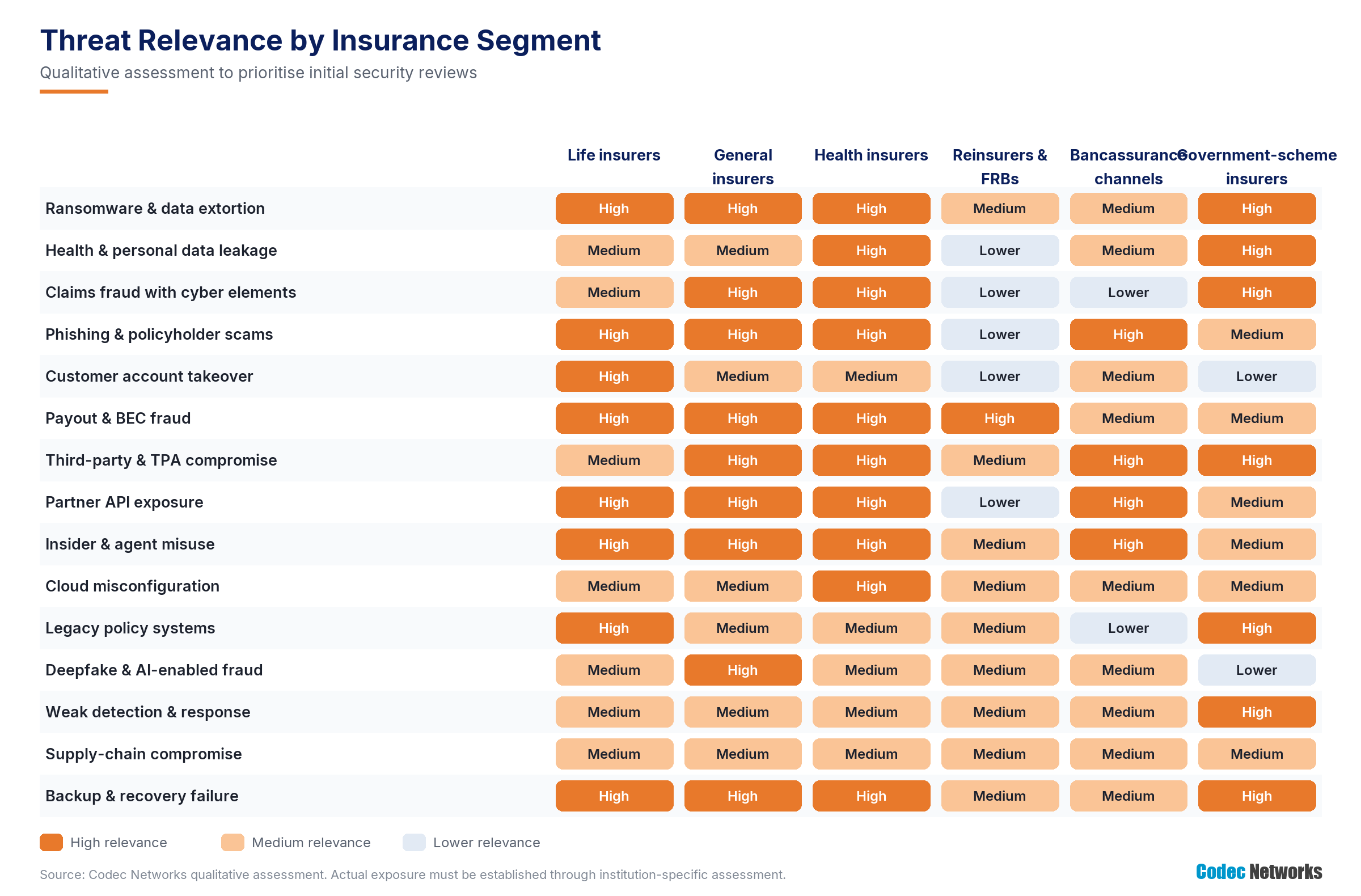
Figure 5: Qualitative threat relevance by insurance segment (Codec Networks assessment).
4. Five priority threats in depth
4.1 Ransomware and health data
Health insurers and their TPAs hold large volumes of medical data and run time-critical cashless claims. Ransomware groups target them for both disruption and extortion.
- Questions to test: Are claims and medical data segmented? Are backups isolated and restorable? Has BCP/DR been tested against a ransomware scenario as IRDAI's 2026 guidelines expect?
- Relevant services: managed SOC, ransomware simulation, segmentation and backup testing, BCP/DR drills, incident response.
4.2 Claims fraud with cyber elements
Organised claims fraud increasingly combines forged digital documents, manipulated bills and help from insiders at hospitals, garages or TPAs.
- Questions to test: Are documents checked for tampering? Are claimants, providers and bank accounts linked analytically? Is partner and insider access monitored?
- Relevant services: claims-fraud analytics, document-forensics checks, insider monitoring, forensic audits.
4.3 Policyholder scams and payout diversion
Fake helplines and 'KYC update' messages trick policyholders into revealing credentials or paying fees; fraudsters then change payout details and redirect surrenders or refunds.
- Questions to test: Are payout-detail changes subject to cooling periods and alerts? Are surrenders verified? Is the brand monitored for fake helplines and sites?
- Relevant services: payout-flow testing, brand monitoring and takedown, policyholder awareness.
4.4 Partners, TPAs and vendors
Brokers, banks, aggregators, TPAs and IT vendors connect to insurers' systems. IRDAI's 2026 guidelines require right-to-audit and sub-outsourcing approval in vendor contracts and supervised privileged access.
- Questions to test: Which partners have access to policyholder data? Are their APIs and portals tested? Do contracts include the required clauses?
- Relevant services: third-party risk management, partner API testing, contract review.
4.5 Detection and the 6-hour clock
The 2026 guidelines require incidents to be reported to CERT-In within six hours of detection, with copies to IRDAI—only achievable with continuous monitoring and rehearsed playbooks.
- Questions to test: Are all critical systems feeding the SOC? Is there a tested escalation path to CERT-In and IRDAI reporting?
- Relevant services: managed SOC, playbooks, tabletop exercises, IR retainer.
5. Impact on insurers and policyholders
|
Player type |
Threats to prioritise |
Main impact |
|
Life insurers |
Payout diversion, scams, legacy systems |
Policyholder losses and trust |
|
General insurers |
Claims fraud, partner compromise |
Claims leakage and partner disputes |
|
Health insurers |
Ransomware, medical data leakage, TPA compromise |
Cashless claims disruption, DPDP exposure |
|
Reinsurers and FRBs |
BEC, confidential data theft |
Financial loss and confidentiality breaches |
|
Government-scheme insurers |
Large beneficiary data, partner networks |
Public trust and scheme disruption |
6. How regulation turns incidents into business events
- CERT-In and IRDAI: incidents reported to CERT-In within six hours of detection, with copies to IRDAI and other relevant regulators.
- Audit: incidents and remediation are examined in the annual independent audit, whose report goes to IRDAI.
- Governance: the ISRMC reviews incidents and exceptions at least quarterly.
- Privacy: once DPDP breach provisions commence in May 2027, personal data breaches must be intimated to the Data Protection Board, with a detailed report within 72 hours.
- Partners: reinsurers, banks and corporate clients may review the insurer's controls after an incident.
|
Insight Insurance incidents often start outside the insurer—at a TPA, hospital, partner or vendor. The 2026 guidelines' vendor and cloud requirements exist because the insurer remains accountable for data wherever it travels. |
7. Questions every leadership team should ask
- Are we fully aligned to IRDAI's 2026 guidelines, and when is our next independent audit?
- Has external PT been performed in the last six months by an empanelled auditor?
- Could we report an incident to CERT-In and IRDAI within six hours?
- Which TPAs, hospitals and partners hold our policyholders' data, and when were they assessed?
- Would we stop a fraudulent payout-detail change before a surrender is paid?
- Has BCP/DR been tested against a realistic ransomware scenario this year?
Talk to Codec Networks
|
Contact Codec Networks Pvt. Ltd. New Delhi: 507, 5th Floor, New Delhi House, Barakhamba Road, Connaught Place, New Delhi – 110001 Gurugram: 707, 7th Floor, Silverton Tower, Golf Course Extension Road, Sector 50, Gurugram – 122018, Haryana Landline: 011 430 496 96 | 011 437 522 99 Mobile: +91 99716 76124 | +91 88007 88220 | +91 88003 31124 Email: mktg@codecnetworks.com Web: www.codecnetworks.com |
Note: Threat descriptions and relevance ratings are general guidance, not findings about any specific insurer. IRDAI requirements are summarised from reported sources; confirm against the official circular. I4C figures cover all channels.