

Resources Categories

INDUSTRY FACT FILE · HEALTHCARE & HEALTHTECH
Industry Overview: Healthcare and Healthtech in India
Who delivers care and digital health services, how they are regulated, who buys cybersecurity inside them and why each needs a distinct approach.
|
In this document 1. Why healthcare cybersecurity matters now 2. The ecosystem at a glance 3. Categories of healthcare and healthtech organisations 4. The regulatory framework at a glance 5. Government, public and private participants 6. Who buys cybersecurity inside a healthcare organisation 7. Why each organisation type needs a different approach 8. How Codec Networks works with healthcare organisations |
|
Sector scope Sector: healthcare and healthtech — hospital chains, diagnostic networks, telemedicine providers and digital health platforms. Primary service proposition: patient data protection, hospital application VAPT, SOC, ransomware readiness and medical IoT security. Pharmaceutical firms and medical device manufacturers are covered in separate fact files. |
1. Why healthcare cybersecurity matters now
Hospitals, diagnostic networks and health platforms hold medical histories, test results, images, prescriptions and payment details—among the most sensitive personal data there is. They also run systems that patient care cannot do without: registration, electronic medical records, labs, imaging and connected medical devices.
|
Nov 2022 Ransomware attack disrupted AIIMS New Delhi systems |
6 hours To report cyber incidents to CERT-In |
180 days ICT logs to be kept in India |
May 2027 Most DPDP obligations take effect |
That combination makes healthcare a prime ransomware target. The November 2022 ransomware attack on AIIMS New Delhi disrupted hospital systems for days and forced manual operations, and the February 2024 attack on a major US health-payment processor showed how one compromise can disrupt claims across an entire country.
The DPDP Act, 2023 and DPDP Rules, 2025 set obligations for personal data, with most taking effect in May 2027. CERT-In's Directions require six-hour incident reporting, the Ayushman Bharat Digital Mission (ABDM) sets a consent-based model for health data exchange, and the Telemedicine Practice Guidelines govern teleconsultations.
|
Key takeaway In healthcare, cybersecurity is patient safety. Protecting data matters, but keeping clinical systems available through an attack matters just as much. |
2. The ecosystem at a glance
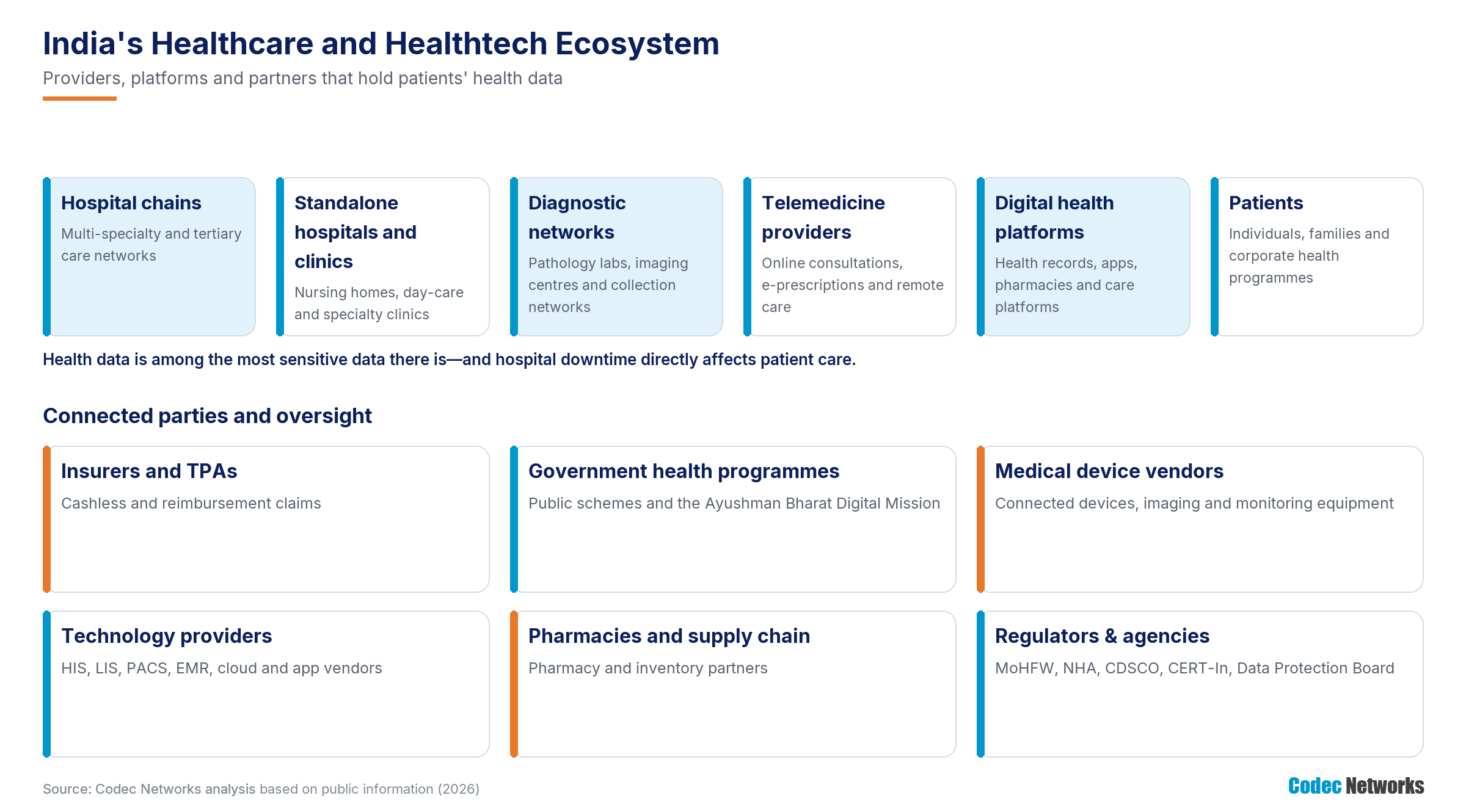
Figure 1: India's healthcare and healthtech ecosystem.
3. Categories of healthcare and healthtech organisations
|
Category |
Who they are |
Typical ownership |
Key regulatory basis |
|
Hospital chains |
Multi-specialty and tertiary care across cities |
Private groups, trusts and public hospitals |
Clinical establishment rules; DPDP; CERT-In; accreditation |
|
Standalone hospitals and clinics |
Nursing homes, specialty and day-care clinics |
Doctors, trusts and small groups |
Clinical establishment rules; DPDP; CERT-In |
|
Diagnostic networks |
Pathology, imaging and sample collection |
Listed chains and regional labs |
Laboratory accreditation; DPDP; CERT-In |
|
Telemedicine providers |
Online consultations and e-prescriptions |
Platforms and hospital tele-services |
Telemedicine Practice Guidelines; DPDP |
|
Digital health platforms |
Health records, apps, online pharmacy and care platforms |
Start-ups and technology companies |
ABDM framework where integrated; DPDP; IT Act |
|
Government health programmes |
Public hospitals, schemes and digital health infrastructure |
Central and state governments |
Government IT security policies; ABDM; CERT-In |
|
Healthcare technology vendors |
HIS, EMR, LIS, PACS and cloud providers |
Indian and global vendors |
Customer contracts; CDSCO for regulated software |
4. The regulatory framework at a glance
|
Instrument |
Key requirements |
|
DPDP Act 2023 and DPDP Rules 2025 |
Lawful processing, notice and consent, reasonable security safeguards, breach intimation and data principal rights for personal data, including health data; most obligations from May 2027 |
|
IT Act and SPDI Rules 2011 |
Medical records are classified as sensitive personal data, with reasonable security practices required, until replaced as DPDP provisions commence |
|
CERT-In Directions (28 April 2022) |
Cyber incidents reported within six hours; ICT logs kept for a rolling 180 days in India |
|
Ayushman Bharat Digital Mission (ABDM) |
Consent-based exchange of health records through the national digital health ecosystem, with data management policies for participants |
|
Telemedicine Practice Guidelines (March 2020) |
Standards for teleconsultations, including patient identification, records and privacy |
|
Medical Devices Rules 2017 (CDSCO) |
Regulation of medical devices and medical device software used in care |
|
Verify applicability Requirements vary by organisation type, state rules and ABDM participation. Confirm against the official instruments. |
5. Government, public and private participants
- The Ministry of Health and Family Welfare sets health policy; the National Health Authority runs ABDM and public health insurance schemes.
- CDSCO regulates medical devices and drugs; state authorities register clinical establishments.
- CERT-In handles cyber incident reporting and advisories for the sector.
- Accreditation bodies such as NABH and NABL set quality standards that include information management.
- Private hospital chains, diagnostics and healthtech start-ups drive much of digital adoption.
6. Who buys cybersecurity inside a healthcare organisation
|
Stakeholder |
What they care about |
What they buy |
|
Board and management |
Patient safety, reputation, continuity |
Board advisory, crisis exercises |
|
CIO / CISO |
Ransomware, data protection, incidents |
VAPT, SOC, ransomware readiness |
|
Medical director and clinical leads |
Safe care during outages |
Downtime planning, device security |
|
Biomedical engineering |
Connected device safety and security |
Medical IoT assessments |
|
Quality and accreditation |
Accreditation evidence |
Policies, audits and evidence packs |
|
Data protection lead |
Patient data and consent |
DPDPA programme |
|
Procurement and vendor management |
HIS, device and cloud vendors |
Vendor risk assessments |
7. Why each organisation type needs a different approach
|
Organisation type |
Highest-consequence risk |
Starting point for assurance |
|
Hospital chain |
Ransomware across many sites; medical IoT |
Segmentation, SOC, ransomware drills |
|
Standalone hospital |
Legacy systems and limited IT staff |
VAPT, backups, managed SOC |
|
Diagnostic network |
Report portal leakage and LIS outages |
Portal and API testing, availability planning |
|
Telemedicine provider |
App and SDK data leakage |
Mobile app and privacy testing |
|
Digital health platform |
Consent misuse and cloud exposure |
Consent-flow testing, cloud review |
|
Government programme |
Large-scale data and availability |
Red teaming, SOC, resilience testing |
8. How Codec Networks works with healthcare organisations
Codec Networks is a CERT-In empanelled information security auditing organisation certified to ISO 9001:2015, ISO/IEC 27001:2022 and ISO/IEC 20000-1:2018. For healthcare organisations we deliver patient data protection programmes, hospital application VAPT, managed SOC, ransomware readiness assessments and medical IoT security—planned to avoid disrupting care.
Talk to Codec Networks
|
Contact Codec Networks Pvt. Ltd. New Delhi: 507, 5th Floor, New Delhi House, Barakhamba Road, Connaught Place, New Delhi – 110001 Gurugram: 707, 7th Floor, Silverton Tower, Golf Course Extension Road, Sector 50, Gurugram – 122018, Haryana Landline: 011 430 496 96 | 011 437 522 99 Mobile: +91 99716 76124 | +91 88007 88220 | +91 88003 31124 Email: mktg@codecnetworks.com Web: www.codecnetworks.com |
Note: This document is general industry guidance based on public information available as of October 2026. It is not legal or clinical advice. Confirm obligations against the official MeitY, MoHFW, NHA, CDSCO and CERT-In instruments and applicable state rules.