

Resources Categories
INDUSTRY FACT FILE · FINTECH
Threat Landscape: Top Cyber Threats Facing Fintech Companies
The 18 most relevant cyber threats, attacks and industry challenges for fintech and digital financial services companies in India, and their impact.
|
In this document 1. The threat picture in numbers 2. Top 18 threats, attacks and challenges 3. Threat relevance by fintech segment 4. Five priority threats in depth 5. Impact on fintechs and their partners 6. How regulation turns incidents into business events 7. Questions every leadership team should ask |
1. The threat picture in numbers
|
₹19,813 cr Reported cyber-fraud losses in 2025, all channels (I4C data) |
500 mn+ AA consents fulfilled—each one a data flow to protect |
6 hours To report specified incidents to CERT-In |
180 days ICT log retention required in India |
Fintechs concentrate large volumes of sensitive financial and identity data in API-driven, cloud-hosted platforms connected to many partners. Reports based on Indian Cybercrime Coordination Centre (I4C) data put cyber-fraud losses across all channels at about ₹19,813 crore in 2025, and fraud rings increasingly use synthetic identities, deepfakes and mule accounts against digital onboarding.
The most damaging fintech incidents in recent years worldwide have rarely required sophisticated exploits: they typically involved a broken API authorisation check, an exposed storage bucket, a leaked credential or a compromised third-party component.
2. Top 18 threats, attacks and challenges
The list below is a practical assessment framework, not a statistical ranking. Priority varies by business model, technology exposure and existing controls.
|
# |
Threat / attack / challenge |
Typical scenario |
Most exposed |
Potential impact |
|
1 |
Broken API authorisation |
APIs trust IDs sent by the client and return other customers' records |
All API-first fintechs |
Mass data exposure, partner and regulatory consequences |
|
2 |
Excessive data exposure |
APIs and webhooks return far more data than the caller needs |
Lending, AA FIUs, API providers |
Larger breach impact, DPDP liability |
|
3 |
Leaked keys and secrets |
Credentials committed to repositories, embedded in apps or written to logs |
Cloud-native fintechs |
Unauthorised access to cloud and partner systems |
|
4 |
Cloud misconfiguration |
Public storage, wildcard IAM policies, exposed dashboards |
All cloud-hosted platforms |
Exposure of KYC files and financial data |
|
5 |
Insecure webhooks and callbacks |
Unsigned or unauthenticated partner callbacks accepted as genuine |
Lending platforms, BaaS, embedded finance |
Forged approvals, disbursements or status changes |
|
6 |
Account takeover |
Credential stuffing, SIM swap, session hijacking and malware |
Consumer apps, embedded finance, P2P |
Customer losses and complaints |
|
7 |
Synthetic identity and deepfake KYC |
AI-generated faces and injected video defeat liveness and V-CIP |
Lending technology, KYC providers, P2P |
Fraudulent onboarding and credit losses |
|
8 |
Mule accounts and fraud rings |
Coordinated fraudulent accounts used to borrow or launder funds |
Lending and P2P platforms |
Losses and AML exposure |
|
9 |
Consent abuse and over-collection |
Broad or long-duration consents; data used beyond purpose |
AA FIUs, lending and wealth apps |
DPDP and partner consequences, loss of trust |
|
10 |
Malicious or vulnerable SDKs |
Third-party SDKs and libraries introduce malicious or vulnerable code |
Mobile-first fintechs |
Token theft, data leakage, app-store action |
|
11 |
CI/CD and supply-chain compromise |
Build pipelines or dependencies are tampered with |
Fintech SaaS and API providers |
Compromise of many clients at once |
|
12 |
Business-logic abuse |
Abusing limits, retries, referral rewards or loan workflows |
Lending, embedded finance, P2P |
Silent financial leakage |
|
13 |
Fake apps and brand abuse |
Look-alike apps and sites impersonate the fintech |
Consumer lending and wealth apps |
Customer harm and reputational damage |
|
14 |
Insider and support-access misuse |
Staff or vendor support tools used to view or export customer data |
API providers, SaaS, AAs |
Data theft and partner loss |
|
15 |
Ransomware and data extortion |
Encryption or theft of data with threats to publish |
All fintechs, especially SaaS vendors |
Outages and extortion |
|
16 |
AI and LLM abuse |
Prompt injection, data leakage and unsafe agent actions in AI features |
Fintechs deploying AI assistants and agents |
Data exposure and unauthorised actions |
|
17 |
Partner and vendor compromise |
A KYC vendor, cloud service or partner is breached |
All fintechs |
Downstream exposure and contract disputes |
|
18 |
Weak logging and detection |
Missing API and cloud audit logs; no 24x7 monitoring |
Early and growth-stage fintechs |
Missed 6-hour reporting, slow containment |
3. Threat relevance by fintech segment
The matrix is a qualitative guide for prioritising the first round of security reviews.
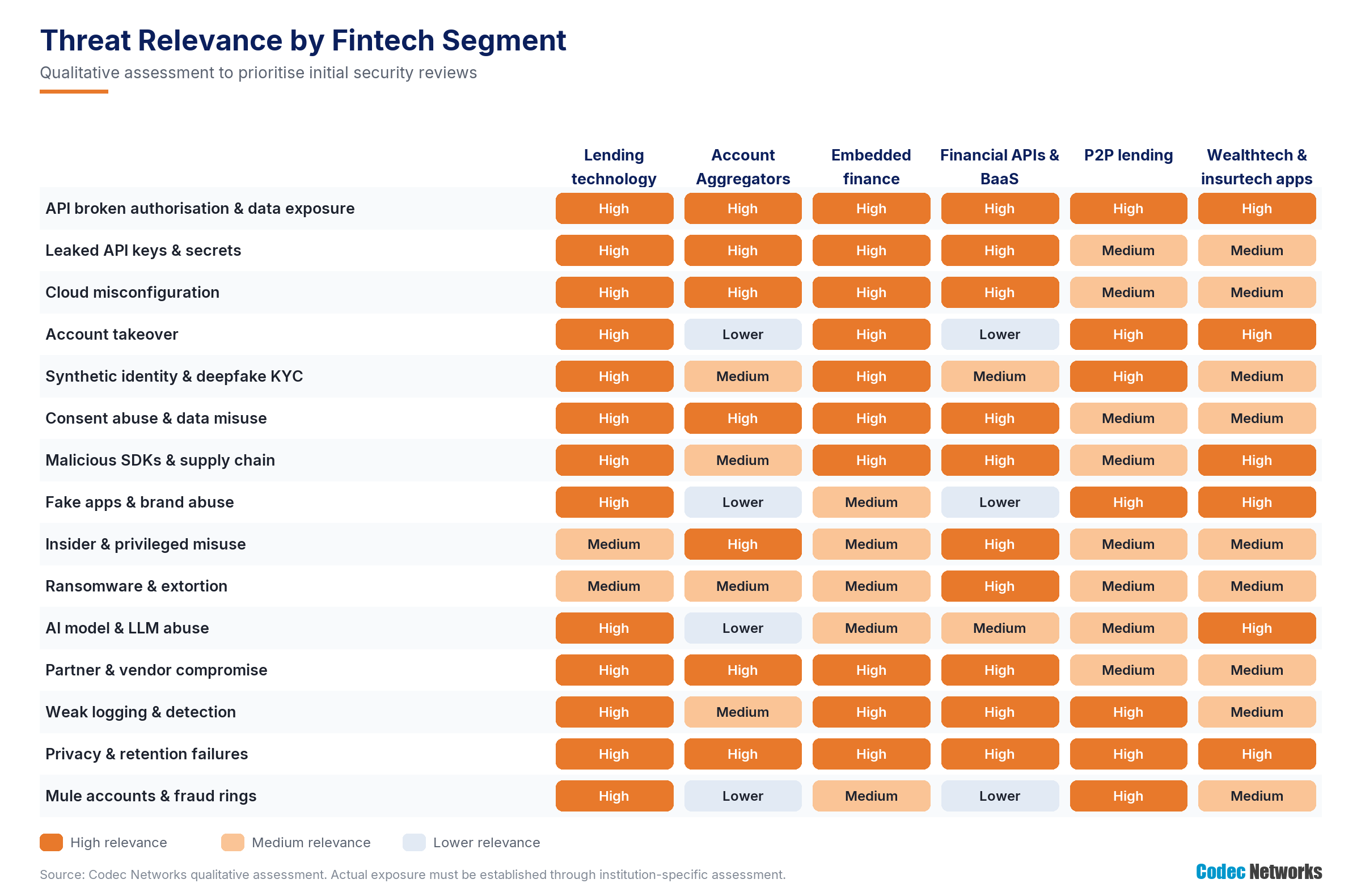
Figure 5: Qualitative threat relevance by fintech segment (Codec Networks assessment).
4. Five priority threats in depth
4.1 Broken API authorisation and data exposure
Object-level authorisation failures top the OWASP API Security Top 10 for good reason: they let an authenticated user access any record by changing an identifier. Combined with responses that return full records, a single flaw can expose an entire customer base.
- Questions to test: Is every endpoint tested for object- and function-level authorisation in each release? Do responses return only the fields required? Are partner APIs inventoried with clear owners?
- Relevant services: API security testing, secure code review, API gateway assessment, DevSecOps integration.
4.2 Secrets and cloud misconfiguration
Cloud keys committed to code, tokens embedded in mobile apps and public storage buckets are among the most common causes of fintech exposure. Automated scanners find leaked credentials within hours.
- Questions to test: Is secrets scanning enforced in CI/CD and repositories? Are credentials short-lived and vaulted? Is public exposure monitored continuously?
- Relevant services: cloud posture assessment, secrets management review, continuous cloud assurance, SOC monitoring of cloud audit logs.
4.3 Synthetic identity and deepfake onboarding
AI-generated faces and video-injection attacks can defeat weak liveness checks, enabling fraud rings to open many accounts or take many loans quickly. Regulated lender partners expect fintechs to prove onboarding controls work.
- Questions to test: Is liveness resistant to injected video? Are device attestation and velocity checks applied? Has onboarding been tested with realistic deepfakes?
- Relevant services: AI-powered deepfake testing, onboarding fraud simulation, device-linkage analytics, AI security review.
4.4 Consent and data misuse
Account Aggregator flows and DPDP obligations both centre on purpose-bound consent. Over-broad consents, long retention and wide internal or vendor access turn useful data into a liability.
- Questions to test: Are consent purposes and durations minimised? Is AA data deleted when the purpose ends? Who—including vendors—can access raw financial data?
- Relevant services: DPDPA programme, consent-flow review, data discovery and retention review, DLP.
4.5 Third-party SDKs and the software supply chain
Fintech apps and platforms depend on hundreds of open-source libraries and SDKs. A compromised or vulnerable component can steal tokens or data from inside the app.
- Questions to test: Is there an SBOM? Are SDKs reviewed and versions pinned? Is outbound traffic from apps and servers monitored?
- Relevant services: software composition analysis, SDK and supply-chain review, CI/CD security, runtime monitoring.
5. Impact on fintechs and their partners
|
Player type |
Threats to prioritise |
Main impact |
|
Lending technology / LSP |
API exposure, forged callbacks, synthetic identities |
Lender partner exits, fraud losses, Digital Lending scrutiny |
|
Account Aggregator |
Consent integrity, key management, partner API abuse |
Licence and ecosystem trust |
|
Embedded finance |
Account takeover, SDK risk, data sharing |
Partner and customer trust, platform reputation |
|
API / BaaS provider |
Tenant isolation, secrets, supply chain |
Simultaneous impact on many regulated clients |
|
P2P lending |
Platform breach, fund-flow abuse, fraud rings |
Investor and borrower trust, RBI scrutiny |
|
Fintech SaaS |
CI/CD compromise, support-access misuse |
Client audits, contract losses |
6. How regulation turns incidents into business events
- CERT-In: specified incidents—including data breaches and leaks—reported within six hours; ICT logs retained for 180 days in India.
- Licensed entities: NBFC-AAs and NBFC-P2Ps report cyber incidents to RBI on DAKSH within six hours under the 2026 NBFC Directions.
- Partners: banks and NBFCs must report incidents affecting them and will invoke contractual audit rights over fintech partners.
- Privacy: once DPDP breach provisions commence in May 2027, breaches must be intimated to the Data Protection Board, with a detailed report within 72 hours.
- Funding: investors and acquirers routinely review incidents and remediation in due diligence.
|
Insight Fintech breaches are usually simple flaws at scale: one API check, one key, one bucket. Continuous, automated testing in the release pipeline—backed by periodic expert testing—catches most of them before attackers do. |
7. Questions every leadership team should ask
- Would every customer-facing API pass an object-level authorisation test today?
- Do we know every secret, key and token in our code, apps and pipelines?
- Could we prove to a bank partner, with evidence, that our onboarding resists deepfakes?
- Is consented financial data deleted when its purpose ends?
- Which SDKs and libraries run inside our app, and who reviews them?
- Could we report a data leak to CERT-In within six hours?
Talk to Codec Networks
|
Contact Codec Networks Pvt. Ltd. New Delhi: 507, 5th Floor, New Delhi House, Barakhamba Road, Connaught Place, New Delhi – 110001 Gurugram: 707, 7th Floor, Silverton Tower, Golf Course Extension Road, Sector 50, Gurugram – 122018, Haryana Landline: 011 430 496 96 | 011 437 522 99 Mobile: +91 99716 76124 | +91 88007 88220 | +91 88003 31124 Email: mktg@codecnetworks.com Web: www.codecnetworks.com |
Note: Threat descriptions and relevance ratings are general guidance, not findings about any specific company. I4C figures cover all channels. Confirm regulatory obligations against official instruments.