

Resources Categories
INDUSTRY FACT FILE · EDUCATION, EDTECH & RESEARCH
Threat Landscape: Top Cyber Threats Facing Education, Edtech and Research
The 18 most relevant cyber threats, attacks and industry challenges for universities, school chains, coaching and edtech platforms, examination bodies and research organisations, and the impact each one has on students, examinations and research.
|
In this document 1. The threat picture in numbers 2. Top 18 threats, attacks and challenges 3. Threat relevance by education segment 4. Five priority threats in depth 5. Impact on institutions, platforms, students and research partners 6. How regulation turns incidents into business events 7. Questions every leadership team should ask |
1. The threat picture in numbers
|
~22 m Unacademy accounts offered for sale after a 2020 breach |
US$1.14 m Ransom paid by UCSF to NetWalker operators (2020) |
2024 NEET-UG leak confirmed at Hazaribagh and Patna; UGC-NET cancelled |
6 hours To report incidents to CERT-In |
Education attracts ransomware groups because institutions cannot stop in term time and often hold weak backups; data brokers and fraudsters because student, parent and candidate records are plentiful and poorly protected; cheating networks because question banks and results are worth money; and state actors because research and faculty accounts are a door into government and industry. The attack surface is unusually wide and unusually exposed: internet-facing portals for lakhs of users, learning platforms used by children, campus networks full of personal devices, vendors with remote access, and laboratories sharing data across borders.
Recent events show the pattern. About 22 million Unacademy records were offered for sale in 2020; a misconfigured Byju's server exposed student and loan data in 2023; the NEET-UG 2024 leak, confirmed by the Supreme Court at Hazaribagh and Patna, led to CBI chargesheets, the cancellation of UGC-NET June 2024 after cybercrime inputs, and a new criminal law; Cisco Talos reported Transparent Tribe spear-phishing students at Indian universities with CrimsonRAT in 2022. Abroad, UCSF paid US$1.14 million in 2020, Lincoln College closed in 2022 after a cyberattack compounded pandemic losses, the Blackbaud breach of 2020 touched thousands of universities and non-profits through one vendor, and the PowerSchool breach of December 2024 exposed tens of millions of student and teacher records.
2. Top 18 threats, attacks and challenges
The list below is a practical assessment framework, not a statistical ranking. Priority varies by business model, technology exposure and existing controls.
|
# |
Threat / attack / challenge |
Typical scenario |
Most exposed |
Potential impact |
|
1 |
Ransomware halting operations |
ERP, LMS, file servers and backups encrypted during term time |
All institutions, edtech |
Admissions, classes and results stop; extortion of students |
|
2 |
Student and parent data breaches |
Portals, apps or databases exposing records at scale |
Edtech, coaching, schools |
Privacy harm, DPDP breach intimation, loss of trust |
|
3 |
Examination and paper compromise |
Question papers or banks leaked through people, printers or systems |
Examination bodies, boards, universities |
Cancelled examinations, criminal liability |
|
4 |
LMS and exam platform vulnerabilities |
Unpatched LMS, test engines and proctoring tools exploited |
Universities, coaching, edtech |
Grade tampering, question exposure |
|
5 |
Account takeover |
Phished or reused credentials on student, faculty and admin accounts |
All institutions |
Data access, fraud, lateral movement |
|
6 |
Phishing and fee or scholarship fraud |
Fake fee links, admission and scholarship scams in the institution's name |
Schools, universities, coaching |
Financial loss to families, reputational damage |
|
7 |
Research IP theft and espionage |
State-backed or competitor intrusions into labs and faculty accounts |
Research organisations, universities |
Lost IP, sponsor and national-security consequences |
|
8 |
Cloud and app misconfiguration |
Open storage buckets, exposed databases, weak API authorisation |
Edtech, coaching, vendors |
Mass exposure found by researchers or criminals |
|
9 |
Children's data misuse and tracking |
SDKs, analytics and advertising profiling minors without consent |
K-12 edtech, schools, coaching |
DPDP violations, parental backlash |
|
10 |
Insider misuse and record tampering |
Staff or students altering grades, attendance or certificates |
Universities, boards, schools |
Integrity failures, legal disputes |
|
11 |
Vendor and SaaS compromise |
ERP, LMS or hosting provider breached, affecting many institutions |
All institutions |
Multi-institution exposure through one supplier |
|
12 |
Proctoring and centre manipulation |
Remote-access tools, impersonation and device tampering at CBT centres |
Examination bodies, testing providers |
Unfair results, cancelled sessions |
|
13 |
Defacement and DDoS at peak times |
Websites and result portals attacked during admissions or results |
Universities, boards, examination bodies |
Outages, embarrassment, public anxiety |
|
14 |
Campus Wi-Fi and BYOD exposure |
Flat networks with thousands of unmanaged personal devices |
Universities, research campuses |
Malware spread, lateral movement to servers |
|
15 |
Legacy and unpatched systems |
Old servers, self-hosted portals and lab workstations without updates |
Universities, research labs, boards |
Easy exploitation, long dwell time |
|
16 |
Credential and certificate fraud |
Forged degrees, marksheets and verification letters |
Universities, boards |
Reputational damage, employer distrust |
|
17 |
Weak detection and response |
No monitoring of campus, cloud or examination systems |
Most institutions |
Late discovery; missed 6-hour reporting |
|
18 |
Backup and recovery failure |
Backups online, untested or encrypted with the systems |
All institutions |
Weeks of disruption, lost records |
3. Threat relevance by education segment
The matrix is a qualitative guide for prioritising the first round of security reviews.
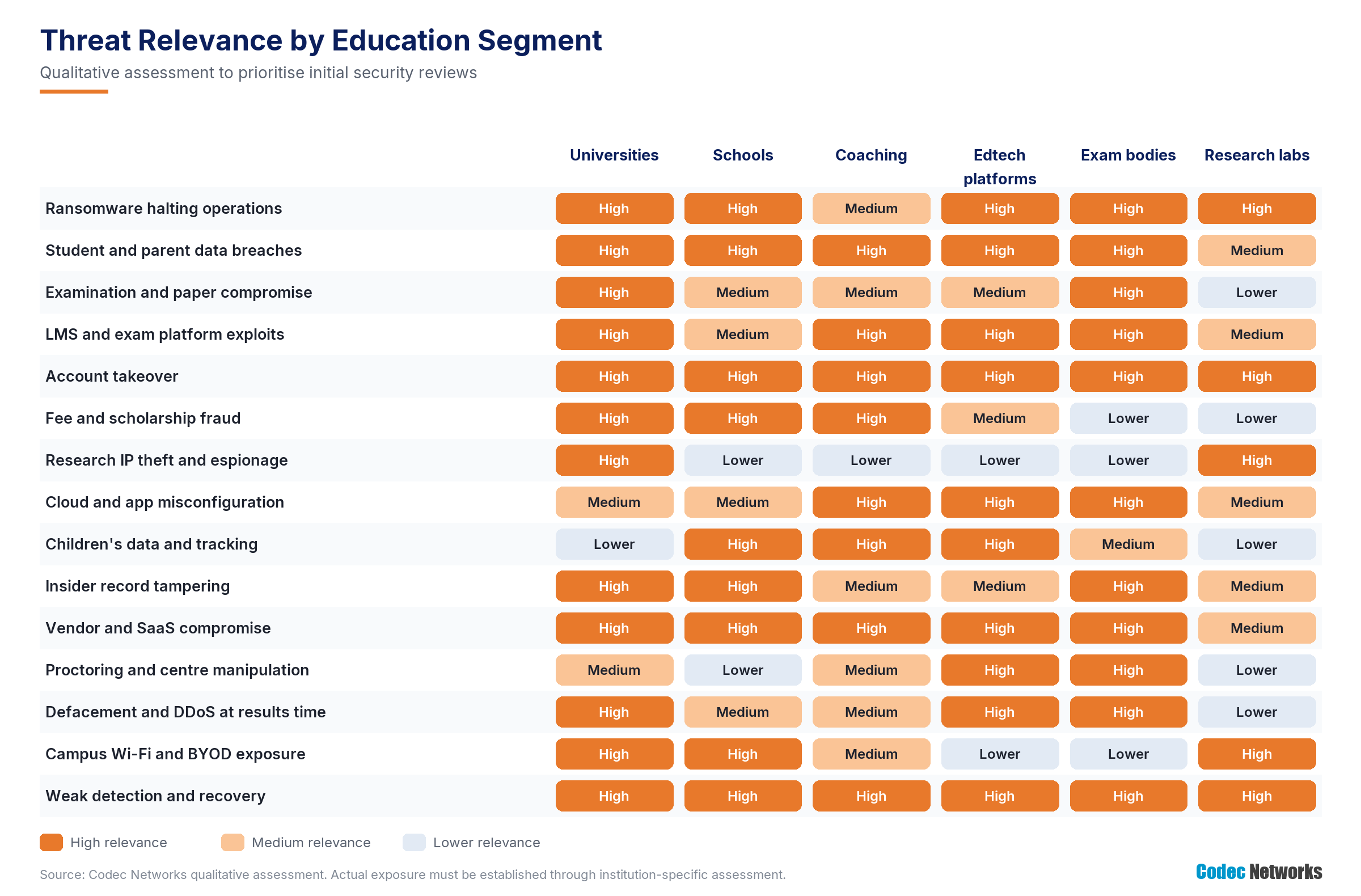
Figure 5: Qualitative threat relevance by education segment (Codec Networks assessment).
4. Five priority threats in depth
4.1 Student and children's data at scale
Institutions and platforms hold names, contact details, identity documents, photographs, fee and loan records and, for children, location and behavioural data—often across ERP, apps, vendors and spreadsheets. The Unacademy and Byju's incidents show how a single exposed system reaches millions of records.
- Questions to test: Where does student and parent data live, including vendors and apps? Do we have consent and parental verification? Are APIs and storage tested for exposure? Could we intimate affected parties and the Data Protection Board within the required time?
- Relevant services: DPDP gap assessment, data mapping, portal and API testing, cloud posture review, breach workflows.
4.2 Examination integrity
The 2024 crisis showed that leaks come through people, printing and transport as much as through systems, and that the law now treats them as crimes. Reforms push encrypted digital delivery, biometric verification and computer-based testing, which moves the risk into software, centres and vendors.
- Questions to test: Who can reach question banks and result databases, and is every access logged? Are CBT platforms, proctoring tools and centre machines tested before each cycle? Are vendors bound by security and reporting duties? Is there a rehearsed leak playbook?
- Relevant services: examination-system assessment, role and integrity audits, vendor assurance, surge monitoring, crisis drills.
4.3 Ransomware in term time
Institutions rarely segment campus networks, often keep backups online and run on small IT teams; attackers time intrusions for admissions or examinations when pressure to pay is highest. UCSF paid, Lincoln College closed.
- Questions to test: Which processes stop if ERP and LMS go dark? Are backups immutable and restores tested? Would EDR and a SOC catch the intrusion before encryption? Is there a manual plan for admissions, fees and examinations?
- Relevant services: segmentation, backup and recovery testing, EDR validation, managed SOC, crisis exercises.
4.4 Research and espionage
Faculty accounts, shared VPNs and collaboration drives give persistent actors a path to data sets, drafts and sponsor information. Transparent Tribe's targeting of Indian university students shows that even low-value accounts are useful stepping stones.
- Questions to test: Is research data classified and segmented from the general campus? Are faculty and lab accounts protected by MFA and monitored for bulk transfers? Do collaboration agreements cover security? Can we detect a slow exfiltration?
- Relevant services: research data classification, segmented lab networks, threat hunting, collaborator agreements, awareness.
4.5 Detection, reporting and the 6-hour clock
CERT-In requires reporting within six hours of noticing an incident, DPDP will require breach intimation and listed companies disclose quarterly. Most campuses and schools have no monitoring, so incidents are discovered by students, researchers or the press.
- Questions to test: Are campus, cloud and examination systems monitored 24x7? Do we see account takeover, scraping and bulk downloads? Is there a playbook covering containment, student and parent communication, CERT-In reporting and disclosure?
- Relevant services: managed SOC, playbooks, incident records, tabletop exercises with leadership and examination teams.
5. Impact on institutions, platforms, students and research partners
|
Player type |
Threats to prioritise |
Main impact |
|
Universities and colleges |
Ransomware, LMS exploits, research theft, account takeover |
Term disruption, integrity disputes, lost funding |
|
School chains and boards |
Children's data breaches, fee fraud, board-exam leaks |
Parental backlash, DPDP consequences, cancelled examinations |
|
Coaching and edtech platforms |
App and cloud breaches, children's tracking, account takeover |
Loss of subscribers, investor and customer consequences, disclosure |
|
Examination bodies and providers |
Paper and data leaks, platform tampering, results-day outages |
Cancelled examinations, criminal liability, public anger |
|
Research organisations and sponsors |
Espionage, data destruction, insider leaks |
Lost IP, broken collaborations, security reviews |
|
Students, parents and candidates |
Identity misuse, scams, lost examinations |
Financial loss, anxiety, lost opportunity |
6. How regulation turns incidents into business events
- CERT-In: incidents reported within six hours of noticing them; logs available for investigation.
- DPDP: breaches of student, parent or children's data trigger intimation to affected persons and the Data Protection Board once provisions commence in May 2027.
- Public Examinations Act: leaks and unfair means are cognisable offences with liability for examination authorities' service providers; investigations follow immediately.
- UGC, AICTE and boards: incidents affecting examinations or records draw regulator and board scrutiny and may affect affiliation and accreditation.
- SEBI LODR: listed education and edtech companies disclose cyber incidents and data loss in the quarterly corporate governance report.
- Sponsors, collaborators and customers: grant and contract clauses require notification and may suspend funding or contracts.
|
Insight The most damaging education incidents cross boundaries—from an app into children's homes, from a vendor into every institution it serves, from a faculty mailbox into a laboratory, and from one centre into a national examination. Strong boundaries, tested recovery, monitored systems and trained people are the best defence. |
7. Questions every leadership team should ask
- Do we know where every student's and child's data lives, including apps and vendors, and who can see it?
- Could someone reach our question banks or results without being detected?
- If ERP and LMS went dark in admissions week, how would we run the institution?
- Could a researcher's compromised account walk out with our data sets and drafts?
- Are backups immutable, tested and separate from the systems they protect?
- Could we detect, contain and report an incident within six hours while keeping students informed?
Talk to Codec Networks
|
Contact Codec Networks Pvt. Ltd. New Delhi: 507, 5th Floor, New Delhi House, Barakhamba Road, Connaught Place, New Delhi – 110001 Gurugram: 707, 7th Floor, Silverton Tower, Golf Course Extension Road, Sector 50, Gurugram – 122018, Haryana Landline: 011 430 496 96 | 011 437 522 99 Mobile: +91 99716 76124 | +91 88007 88220 | +91 88003 31124 Email: mktg@codecnetworks.com Web: www.codecnetworks.com |
Note: Threat descriptions and relevance ratings are general guidance, not findings about any specific organisation. Public incident references are summarised from widely reported events, court records and official statements.