

Resources Categories
INDUSTRY FACT FILE · DRONES, ROBOTICS & AUTONOMOUS SYSTEMS
Main Products and Services in Drones, Robotics and Autonomous Systems
What India's drone and component makers, drone operators, robotics and warehouse automation firms, autonomous delivery businesses and fleet software providers deliver, the systems behind each, and where those systems create cyber and compliance exposure.
|
In this document 1. How drone and robotics businesses create value 2. Products and services by organisation type 3. The aerial layer: drones, links, navigation and ground control 4. The ground layer: robots, warehouses and fleet platforms 5. The systems behind the products and services 6. Trends that change the attack surface 7. Mapping operations to Codec Networks engagements |
1. How drone and robotics businesses create value
|
Revenue stream |
How it works |
Security relevance |
|
Drone and component sales |
Sale of airframes, flight controllers, payloads and spares to enterprises, government and service providers |
Firmware integrity, supply chain, product vulnerability handling |
|
Drone services |
Survey, mapping, inspection, spraying and monitoring sold per hectare, per kilometre or per project |
Ground station security, imagery protection, pilot accounts |
|
Delivery and logistics services |
Per-flight or contract fees for medical, parcel and remote-area delivery |
Link and navigation resilience, fleet console and API security |
|
Robotics systems and integration |
Robot cells, AMR fleets and warehouse automation sold as projects or robots-as-a-service |
OT segmentation, vendor access, fleet server resilience |
|
Software subscriptions |
Fleet management, mission planning, analytics and traffic management platforms |
Multi-tenant isolation, cloud security, API abuse |
|
Training and support |
Remote pilot training, maintenance contracts and remote support |
Training records integrity, remote support tunnels, insider risk |
2. Products and services by organisation type
|
Organisation type |
Main products and services |
Key systems |
|
Drone manufacturers |
Agricultural, survey, logistics and surveillance drones, with ground control apps and update services |
Flight controllers, firmware, build and signing pipelines, update servers |
|
Component and payload makers |
Flight controllers, radios, cameras, LiDAR, thermal and multispectral sensors |
Embedded firmware, SDKs, calibration tools, supplier portals |
|
Survey and inspection operators |
Mapping, corridor and asset inspection, digital twins and reports |
Ground control stations, imagery storage, processing software, client portals |
|
Agricultural drone services |
Spraying, seeding and crop monitoring for farmers and FPOs |
Pilot phones and apps, booking platforms, spray and field records |
|
Delivery and autonomous inspection fleets |
Scheduled and on-demand flights, docked drones and remote operations |
Fleet cloud, LTE or satellite links, docks, remote operations centres |
|
Robotics and warehouse automation firms |
Robot cells, AMRs, sorters, goods-to-person and service robots |
Robot controllers, ROS, fleet managers, WMS integrations, vendor access |
|
Fleet and traffic software providers |
Mission planning, fleet management, analytics and traffic tools |
Multi-tenant cloud, mission APIs, identity, data pipelines |
3. The aerial layer: drones, links, navigation and ground control
A drone mission starts long before take-off. Operators plan routes in a ground control app on a laptop, tablet or phone, check airspace zones and permissions on Digital Sky, load missions and geofences, and update firmware and maps, often from a manufacturer's cloud. In flight, the drone relies on its flight controller, inertial sensors, compass and satellite navigation to know where it is, and on radio links to send telemetry and video and receive commands; longer-range and beyond-visual-line-of-sight operations add LTE or satellite connectivity and remote operations centres. Every one of those elements is software and every link is a potential entry point: weak pairing or unencrypted links can be intercepted, an unmanaged ground station can be infected, and an update package that is not signed and verified can change how every drone behaves.
Satellite navigation deserves particular attention. DGCA's 2023 advisory circular describes jamming as interference that can cause loss of position information and spoofing as interference using false position signals, and the government's December 2025 reply to Parliament confirmed spoofing near Delhi's airport and interference reports from six other major airports. Drones that rely heavily on satellite positioning need cross-checks with other sensors, integrity monitoring and fail-safes that bring them down safely when position becomes unreliable. Testing those defences is legitimate only when it is authorised and carried out in controlled environments, coordinated with the customer and any required regulatory permissions, because generating interference outside such conditions is unlawful and dangerous. Imagery is the other high-value asset: survey and inspection flights capture power stations, pipelines, plants, rooftops and people, and the files often move through shared folders, laptops and client portals with less protection than the drone itself.
4. The ground layer: robots, warehouses and fleet platforms
On the ground, robotics firms deliver industrial robot cells, autonomous mobile robots, sorters and goods-to-person systems, and service robots for hospitals, hotels and offices. A typical warehouse deployment connects robots over Wi-Fi to a fleet manager that assigns tasks, which in turn talks to the customer's warehouse management system; vendors often keep remote support access to tune and maintain the fleet. Industrial robot cells connect robot controllers, programmable logic controllers, safety systems and engineering laptops. Many robots run on middleware such as ROS, whose first generation had no built-in authentication or encryption and whose security extensions in ROS 2 depend on careful configuration. The 2025 Bluetooth setup flaw disclosed in several commercial quadruped and humanoid robots showed how a single design shortcut, hard-coded keys, can expose a whole product line to nearby attackers.
Fleet and traffic software ties these worlds together. Cloud platforms plan missions for many operators, push updates, stream telemetry and video, store imagery and integrate with customers' systems and with Digital Sky. That makes them highly efficient and highly concentrated: a broken authorisation check in one API, a leaked administrator credential or an exposed storage bucket can affect every tenant at once, and an attacker who controls a fleet console may be able to change missions, geofences or updates. These platforms also hold the evidence that regulators, insurers and customers ask for after an incident, such as flight logs, permissions and telemetry, so their integrity and retention matter as much as their availability.
|
Highest-risk moments Releasing a new firmware version or update server, onboarding a new component or SDK supplier, moving to beyond-visual-line-of-sight, docked or delivery operations, connecting a robot fleet to a customer's warehouse systems, opening vendor remote support, launching a new fleet platform release or API, responding to tender security questionnaires, preparing for type certification, peak seasons for spraying, delivery and fulfilment, and staff exits from engineering or operations roles are where drone and robotics incidents typically begin or escalate. |
5. The systems behind the products and services
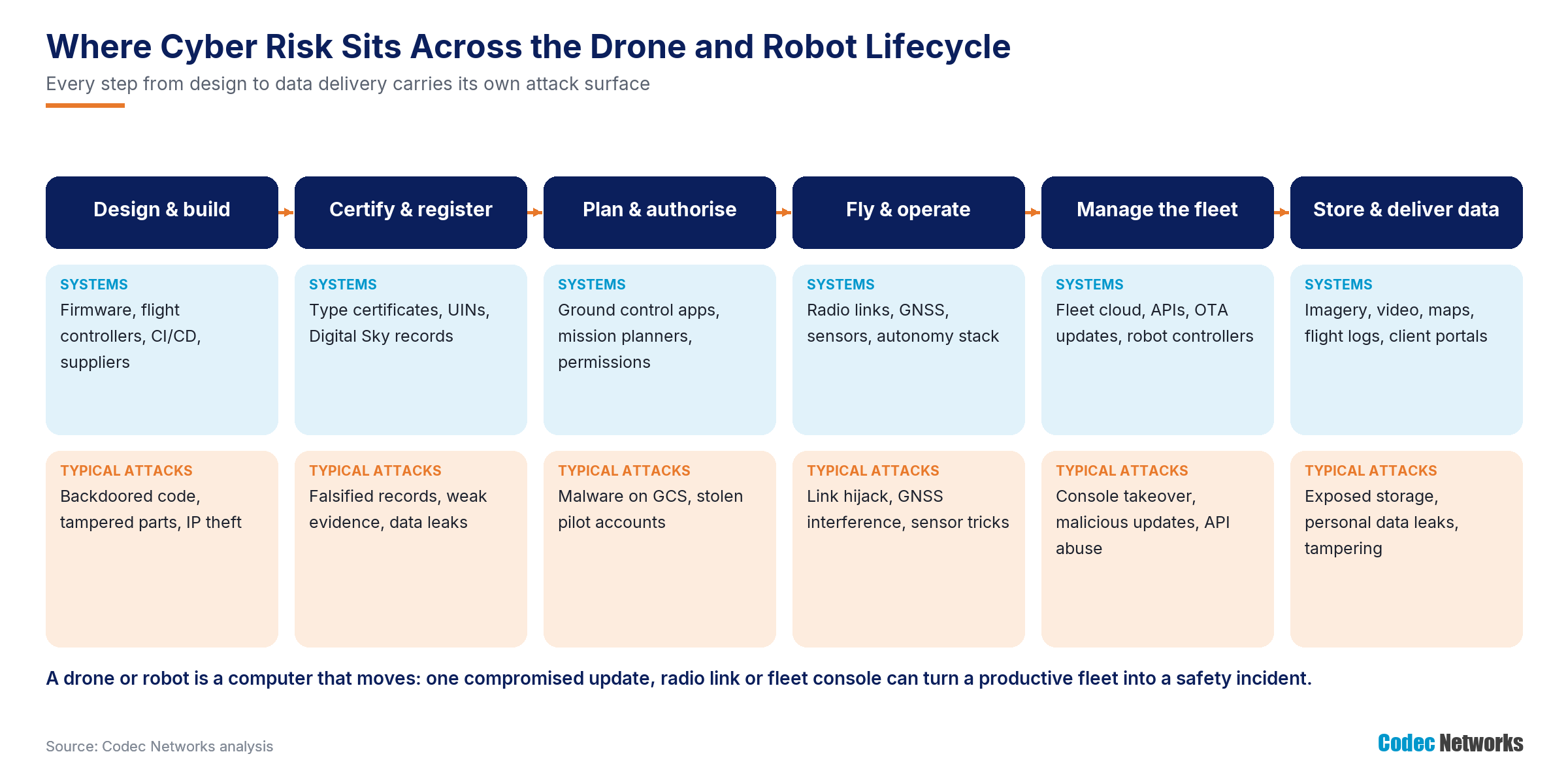
Figure 2: Where cyber risk sits across the drone and robot lifecycle.
|
Product / service |
Systems that deliver it |
Key cyber and compliance touchpoints |
|
Design and build |
Firmware source, build servers, signing keys, component suppliers |
Secure SDLC, code signing, SBOMs, supplier provenance |
|
Certification and registration |
Type certification evidence, UINs, Digital Sky accounts |
Record integrity, account security, evidence handling |
|
Mission planning |
Ground control apps, laptops, tablets, pilot accounts |
Device hardening, app testing, MFA, shared account removal |
|
Flight and operation |
Flight controller, radio links, GNSS and sensors, autonomy software |
Link security, navigation cross-checks, tested fail-safes |
|
Fleet and robot management |
Fleet cloud, OTA updates, robot controllers, fleet managers, vendor access |
Cloud and API testing, segmentation, remote access control |
|
Data and reporting |
Imagery, video, maps, flight logs, client portals |
Access control, DPDP minimisation, retention and log integrity |
6. Trends that change the attack surface
|
Trend |
What is changing |
Security implication |
|
Beyond visual line of sight and docks |
Remote operations centres run drones from docks over LTE or satellite links |
Fleet consoles and links become safety-critical |
|
GNSS interference near airports and borders |
Reports of spoofing and interference at Indian airports in 2025 |
Navigation cross-checks and authorised resilience testing needed |
|
Trusted supply chains |
Buyers and other countries restrict components and drones on security grounds |
Provenance evidence and SBOMs become selling points |
|
Robots-as-a-service |
Vendors run and support robot fleets remotely for customers |
Vendor access and fleet server security matter more |
|
Autonomy and AI perception |
Drones and robots navigate and decide with machine learning models |
Model integrity, data quality and safe fallbacks |
|
Product security regulation abroad |
EU CRA and RED requirements reach connected products sold in Europe |
Vulnerability handling and secure updates become obligations |
7. Mapping operations to Codec Networks engagements
|
If the organisation operates… |
Recommended starting engagement |
|
A drone or component manufacturing business |
Firmware and update security review, build pipeline and signing key review, supply chain provenance assessment |
|
Survey, inspection or agricultural drone services |
Ground control and pilot device testing, imagery storage review, DPDP data handling review |
|
Delivery or autonomous inspection fleets |
Fleet cloud and API VAPT, link security testing, authorised navigation resilience testing, SOC |
|
Robot cells or warehouse automation |
OT and robot cell assessment aligned with IEC 62443, AMR fleet and vendor access review |
|
A fleet, ground control or traffic software platform |
Multi-tenant API and cloud testing, secure SDLC review, vulnerability disclosure process |
|
Products sold into export markets |
EU CRA and RED readiness review, product security incident response, SBOM programme |
Talk to Codec Networks
|
Contact Codec Networks Pvt. Ltd. New Delhi: 507, 5th Floor, New Delhi House, Barakhamba Road, Connaught Place, New Delhi – 110001 Gurugram: 707, 7th Floor, Silverton Tower, Golf Course Extension Road, Sector 50, Gurugram – 122018, Haryana Landline: 011 430 496 96 | 011 437 522 99 Mobile: +91 99716 76124 | +91 88007 88220 | +91 88003 31124 Email: mktg@codecnetworks.com Web: www.codecnetworks.com |
Note: Descriptions are general and based on public information available as of October 2026. Systems and exposures differ by organisation, product, operation, permissions and agreements in force. Navigation resilience testing is described only as authorised testing in controlled environments, coordinated with the customer and any required regulatory permissions.