

Resources Categories
INDUSTRY FACT FILE · CONGLOMERATES, HOLDING COMPANIES & INVESTMENT GROUPS
Threat Landscape: Top Cyber Threats Facing Groups and Investment Firms
The 18 most relevant cyber threats, attacks and industry challenges for business groups, holding companies, CICs, family offices, PE and VC firms, portfolio companies and shared-services centres, and the impact each has.
|
In this document 1. The threat picture in numbers 2. Top 18 threats, attacks and challenges 3. Threat relevance by group and investment segment 4. Five priority threats in depth 5. Impact on groups, investment firms and the companies they own 6. How regulation turns incidents into business events 7. Questions every leadership team should ask |
1. The threat picture in numbers
|
5,000+ UK organisations affected by the JLR attack (CMC) |
339 m Guest records in Marriott's inherited Starwood breach |
US$25 m Lost by Arup in a 2024 deepfake video call fraud |
US$250–300 m Maersk's estimated cost of NotPetya (2017) |
Groups and investment firms face attackers with different aims. Ransomware groups target operating companies, shared-services centres and IT outsourcers because one foothold can encrypt systems used by many entities, and the pressure on a group to restore operations is high. Fraudsters target treasury desks, family offices and finance teams in group companies, impersonating chairmen, CFOs, promoters, advisers and suppliers by email, phone and now cloned video. Information thieves target deal teams, data rooms and advisers, because price-sensitive information about acquisitions and results is valuable. Opportunistic attackers find the weakest company in a portfolio, often a recent acquisition or a small investee, and move from there. And many problems are self-inflicted: integrations rushed to meet a Day-1 deadline, privileged accounts shared with outsourcers, and Boards that see only the controls of the parent.
Public reporting shows how these risks have played out. NotPetya in June 2017 spread through connected group networks, costing Maersk an estimated US$250–300 million and leading Mondelez to claim more than US$100 million of losses. Marriott acquired Starwood in 2016 with attackers already inside Starwood's reservation systems; about 339 million guest records were affected and the UK regulator later fined Marriott £18.4 million. Verizon cut its Yahoo price by US$350 million in 2017 after breach disclosures. In 2024 Arup confirmed a loss of about US$25 million after a deepfake video call. In September 2025 an attack halted Jaguar Land Rover's UK production for weeks, and the UK Cyber Monitoring Centre estimated the UK impact at about £1.9 billion across more than 5,000 organisations. Indian groups share the same structures, platforms and deal processes, so the same patterns apply.
2. Top 18 threats, attacks and challenges
The list below is a practical assessment framework, not a statistical ranking. Priority varies by business model, technology exposure and existing controls.
|
# |
Threat / attack / challenge |
Typical scenario |
Most exposed |
Potential impact |
|
1 |
Uneven cyber maturity across group entities |
Group companies, investees and acquisitions run very different controls, and the weakest sets the group's risk |
Diversified groups, PE and VC portfolios |
Incidents that start where nobody was looking |
|
2 |
Shared identity and directory compromise |
One directory, email tenant or SSO platform serves many companies; one admin or trust compromise reaches all |
Groups with consolidated IT, shared services |
Group-wide account takeover and outage |
|
3 |
Group-wide malware through shared networks |
Self-propagating or wiper malware spreads across flat links between group networks |
Groups with interconnected networks and OT |
Simultaneous outage of many companies |
|
4 |
Subsidiary ransomware that disrupts the group |
Ransomware in one operating company spreads or stops shared systems, suppliers and dealers |
Industrial and consumer group companies |
Halted operations, supply chain losses |
|
5 |
Inherited breaches in acquired companies |
Attackers already present in a target remain after closing and reach the acquirer |
Acquirers, PE buyout funds, roll-ups |
Inherited liability, price disputes, fines |
|
6 |
Deal data, data room and UPSI leaks |
Theft of deal files, Board papers or UPSI from deal teams, advisers or data rooms |
Holdcos, listed groups, PE and VC firms |
Failed deals, insider trading inquiries |
|
7 |
Deepfake executive and promoter impersonation |
Cloned voice or video of a chairman, CFO or promoter approves urgent transfers |
Group treasury, family offices, CICs |
Large, fast, hard-to-recover losses |
|
8 |
Business email compromise in group payments |
Spoofed or compromised mailboxes change bank details in intra-group, investee or supplier payments |
Shared services, treasury, funds |
Misdirected payments, disputes |
|
9 |
Shared services centre and group ERP compromise |
Attack on a centre that runs finance, HR and payroll for many entities |
Shared-services centres, group ERP owners |
Group-wide data exposure and payment stoppage |
|
10 |
Privileged access by IT outsourcers and MSPs |
Outsourcer and MSP accounts with standing admin rights across entities are phished or misused |
Groups and funds relying on outsourced IT |
Supply chain intrusion into every entity |
|
11 |
Promoter, family and principal data exposure |
Doxxing, account takeover or exposure of the family's personal, travel and financial data |
Family offices, promoters, principals |
Safety, privacy and reputational harm |
|
12 |
Portfolio company weaknesses that erode value |
Unpatched access, weak backups and no monitoring at investees discovered by attackers or buyers |
PE and VC funds, CICs |
Lost value, delayed exits, LP concern |
|
13 |
Uncontrolled intra-group personal data sharing |
Employee, customer and family data shared between entities without lawful basis or controls |
Groups, shared services, family offices |
DPDP exposure, loss of trust |
|
14 |
Cloud and SaaS sprawl across entities |
Unmanaged cloud tenants, SaaS apps and shadow IT in group and portfolio companies |
All segments, especially fast-growing groups |
Open data stores, weak identity |
|
15 |
Integration, carve-out and separation gaps |
Rushed connections at integration, and lingering access and shared data after a carve-out |
Acquisition platforms, sellers, buyers |
Inherited intruders, data leakage |
|
16 |
Cyber insurance gaps and group aggregation |
Cover gaps, exclusions, shared limits and disputed claims when many entities are hit at once |
Groups and funds with group-wide policies |
Uninsured losses, disputed recoveries |
|
17 |
Weak Board visibility of group cyber risk |
The Board and risk committee see the parent's controls but not those of every entity |
Holdcos, CICs, listed parents, funds |
Late decisions, disclosure failures |
|
18 |
Weak logs, monitoring and 6-hour reporting |
No common logging, 24x7 monitoring or reporting process across entities |
Smaller group companies, investees, family offices |
Missed reporting, unprovable timelines |
3. Threat relevance by group and investment segment
The matrix is a qualitative guide for prioritising the first round of security reviews.
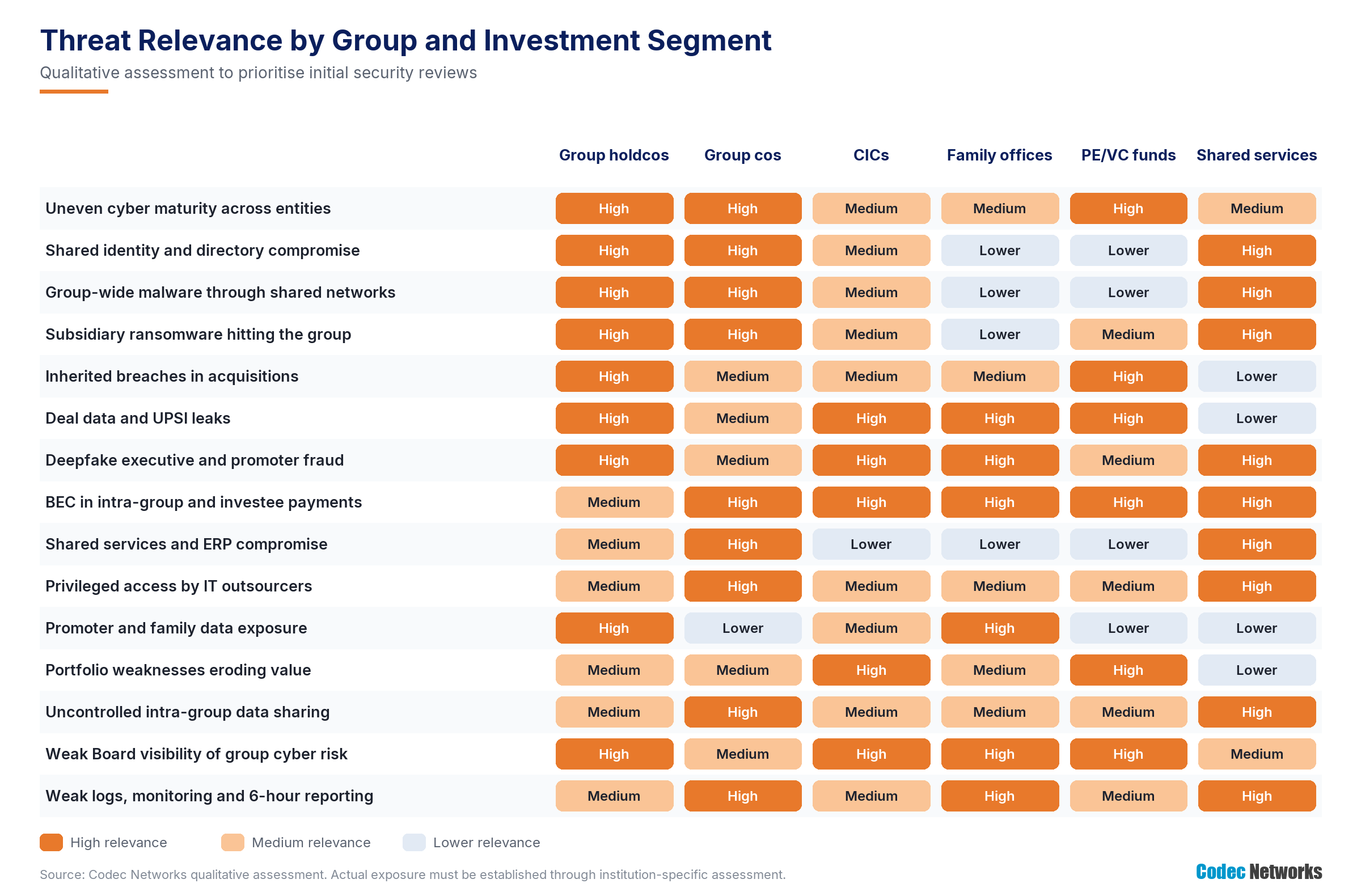
Figure 5: Qualitative threat relevance by group and investment segment (Codec Networks assessment).
4. Five priority threats in depth
4.1 Shared identity and the path from one company to all
Consolidated directories, single sign-on and shared email tenants make groups efficient but turn one privileged account into a key for every company. Directory trusts created during integrations, outsourcer accounts with standing admin rights and service accounts reused across entities let attackers move from a weak subsidiary to group domain controllers and ERP. NotPetya showed in 2017 how fast connected group networks fail together.
- Questions to test: Who holds administrative rights across more than one entity? Are admin tiers separated and protected with MFA and privileged access management? Which directory trusts exist and are they still needed? Could we isolate one company within hours? Would the SOC notice a subsidiary account using group admin tools?
- Relevant services: directory, trust and privileged access reviews, tiered administration design, segmentation and isolation planning, red team exercises from a subsidiary foothold and shared SOC use cases for cross-entity movement.
4.2 Inherited breaches and cyber due diligence
When a company is bought, its intruders, weaknesses and liabilities come with it. Marriott's acquisition of Starwood in 2016 brought a breach that dated from 2014 and was found only in 2018, and Verizon cut its price for Yahoo by US$350 million after breach disclosures. Financial and legal diligence rarely look for active compromise, and integrations often connect the target before anyone has.
- Questions to test: Do we run technical cyber diligence before signing on every material deal? Do we check for existing compromise before closing? Are cyber warranties, specific indemnities and conditions in the documents? Is the target kept separate until a security gate is passed? Is it monitored from Day 1?
- Relevant services: cyber due diligence, external exposure and leaked credential reviews, compromise assessments, inputs to warranties and indemnities, integration security gates and Day-1 and 100-day monitoring plans.
4.3 Deepfake impersonation and treasury fraud
Treasury desks, family offices and finance teams act on instructions from chairmen, CFOs and promoters, often urgently and confidentially. Cloned voices and faces now make those instructions convincing; in 2024 Arup confirmed that an employee transferred about US$25 million after a video call with deepfaked colleagues. Controls that rely on recognising a voice or face no longer work.
- Questions to test: Is every new payee and every urgent transfer confirmed by a call-back to a known number? Do transfers above a threshold need two independent approvers? Do staff have code words or procedures for confidential deals? Have we simulated a deepfake request? Would unusual payees or timing raise an alert?
- Relevant services: treasury and payment approval control testing, deepfake and business email compromise simulations, awareness for principals and staff, banking portal reviews and monitoring of payment anomalies.
4.4 Portfolio company weaknesses and value at exit
Funds and groups own companies at very different levels of maturity. A ransomware attack on an investee can halt operations, and a buyer's diligence can find unpatched remote access, missing backups or past incidents that reduce the price or delay the deal. LPs, lenders and insurers increasingly ask how the owner measures and improves portfolio cyber risk.
- Questions to test: Do we set a cyber baseline at entry for every investee? Do we score and compare portfolio companies each year? Are backups and recovery tested? Do investees have monitoring and an incident retainer? Could we produce an exit-ready evidence pack?
- Relevant services: portfolio baselines and benchmarking, investee VAPT and cloud reviews, backup and recovery testing, portfolio SOC, incident response retainers and exit readiness reviews.
4.5 Board visibility, disclosure and group reporting
Boards and risk management committees answer for cyber risk under the Companies Act and SEBI's LODR, and listed entities must disclose cyber incidents in quarterly governance reports. Yet many receive reports on the parent alone, or narrative assurances without comparable metrics. Incidents in a subsidiary, a shared-services centre or an outsourcer can then surprise the Board, delay CERT-In reporting and complicate disclosure.
- Questions to test: Does the Board see comparable metrics for every material entity? Are incidents in subsidiaries and suppliers escalated to the group within hours? Who decides on CERT-In reporting and stock exchange disclosure? Have directors rehearsed a group-wide incident? Are insurance limits matched to group scenarios?
- Relevant services: group maturity scoring, Board and risk committee dashboards, incident escalation and disclosure playbooks, crisis tabletop exercises and cyber insurance limit and aggregation reviews.
5. Impact on groups, investment firms and the companies they own
|
Player type |
Threats to prioritise |
Main impact |
|
Diversified groups and holdcos |
Shared identity compromise, group-wide malware, subsidiary ransomware |
Simultaneous outages, supply chain losses, value of holdings |
|
Core investment companies |
Weak visibility, treasury fraud, group company incidents |
Losses in investee value, regulatory and lender questions |
|
Family offices |
Deepfake and BEC fraud, family data exposure |
Direct losses, safety and privacy harm |
|
PE and VC firms |
Inherited breaches, portfolio weaknesses, deal data leaks |
Lower exit values, LP concern, CSCRF findings |
|
Portfolio and group companies |
Ransomware, cloud exposure, weak monitoring |
Operational losses, customer and regulatory action |
|
Shared-services centres and their employees |
Vendor admin abuse, ERP and HR data exposure |
Group-wide data incidents, payroll disruption, DPDP exposure |
6. How regulation turns incidents into business events
- CERT-In: incidents reported within six hours of noticing them by each body corporate concerned; logs kept for 180 days in India and available for investigation.
- SEBI and stock exchanges: cyber incidents in listed entities disclosed in quarterly governance reports and, where material, under event disclosure rules; risk committee oversight examined; UPSI leaks may lead to inquiries under the PIT Regulations.
- SEBI CSCRF: incidents at AIF and portfolio managers handled under the framework's reporting and response requirements for their category.
- RBI and sector regulators: incidents in regulated group companies reported under their own directions; CIC risk governance examined.
- DPDP Act: breach intimation and safeguards for personal data once provisions commence, entity by entity; data shared across the group traced to each data fiduciary.
- Buyers, lenders, LPs and insurers: warranty and indemnity claims, covenant questions, LP enquiries and insurance notifications follow incidents in group and portfolio companies.
|
Insight The most damaging group incidents have rarely started at the parent. They begin at a newly acquired subsidiary, an outsourcer's admin account, a treasury clerk on a convincing call or an investee nobody measured, and end as group-wide outages, inherited liabilities, lost transfers and lower exit values. One standard, one view and one SOC across every entity are the best defence. |
7. Questions every leadership team should ask
- If ransomware struck one subsidiary tonight, could it reach the rest of the group?
- Who holds administrative rights across more than one company, and are they protected?
- Do we check every target for existing compromise before closing?
- Could a convincing call from our chairman or CFO move money today?
- Does the Board see comparable cyber metrics for every material entity and investee?
- Could we detect, contain and report an incident within six hours in any group company?
Talk to Codec Networks
|
Contact Codec Networks Pvt. Ltd. New Delhi: 507, 5th Floor, New Delhi House, Barakhamba Road, Connaught Place, New Delhi – 110001 Gurugram: 707, 7th Floor, Silverton Tower, Golf Course Extension Road, Sector 50, Gurugram – 122018, Haryana Landline: 011 430 496 96 | 011 437 522 99 Mobile: +91 99716 76124 | +91 88007 88220 | +91 88003 31124 Email: mktg@codecnetworks.com Web: www.codecnetworks.com |
Note: Threat descriptions and relevance ratings are general guidance, not findings about any specific group, fund or company. Public incident references are summarised from official statements, regulator decisions and widely reported events, and no inference is drawn about the governance of any named organisation or its owners. Attack techniques are described only at the level needed to explain defences.