

Resources Categories

INDUSTRY FACT FILE · CONGLOMERATES, HOLDING COMPANIES & INVESTMENT GROUPS
Industry Overview: Conglomerates and Investment Groups in India
Who owns, governs, funds and serves India's business groups and investment firms, the shared systems they run, the rules that apply and why each segment needs its own security approach.
|
In this document 1. Why group and investment firm security matters now 2. The ecosystem at a glance 3. Categories of groups and investment organisations 4. The corporate, market, fund, cyber and data framework at a glance 5. Authorities, owners and ecosystem participants 6. Who buys cybersecurity inside a group or investment firm 7. Why each segment needs a different approach 8. How Codec Networks works with groups and investment firms |
|
Sector scope Sector: diversified groups and holding companies, core investment companies, family offices, PE/VC firms and portfolio companies, acquisition platforms and shared services. Primary service proposition: group cyber governance, M&A due diligence, shared SOC, portfolio assessments, Board reporting. |
1. Why group and investment firm security matters now
Much of Indian business is organised in groups. Diversified business groups run steel, power, consumer, financial, technology and infrastructure businesses through dozens or hundreds of companies, often held through a listed parent, an unlisted holding company or a core investment company registered with RBI. Promoter families increasingly manage their wealth through family offices, and private capital has become a permanent part of the ownership landscape: Bain & Company's India Private Equity Report 2026 put private equity and venture capital investment in India at about US$36 billion across some 1,700 deals in 2025, with exits of about US$34 billion. Each of these owners sits on top of a portfolio of companies that share brands, capital, people and, very often, technology. Group IT teams run a common directory, email and collaboration platform, ERP and treasury systems, and shared-services centres process finance, payroll and HR for many entities at once. That sharing is efficient, and it is also how a weakness in one company becomes an incident for all of them.
|
£1.9 bn UK impact of the 2025 JLR attack (CMC estimate) |
US$350 m Cut in Verizon's Yahoo price after breaches (2017) |
~US$36 bn PE-VC investment in India in 2025 (Bain) |
6 hours To report cyber incidents to CERT-In |
Group-wide incidents have shown how quickly this happens. When NotPetya spread in June 2017, the shipping group Maersk reinstalled about 45,000 PCs and 4,000 servers and estimated its cost at US$250–300 million, while Mondelez claimed more than US$100 million of losses from affected servers and laptops and then spent four years in a dispute with its insurer over a war exclusion before a settlement in 2022. In September 2025 a cyber attack forced Jaguar Land Rover to halt production at its UK plants for several weeks; the UK government announced a loan guarantee of up to £1.5 billion to support the company's supply chain, and the UK Cyber Monitoring Centre classed the event as Category 3 and estimated its UK economic impact at about £1.9 billion, affecting more than 5,000 UK organisations. One operating company's outage became a problem for suppliers, dealers, lenders, insurers and government at once.
Transactions add their own exposure. Marriott completed its acquisition of Starwood in 2016; attackers had been in Starwood's guest reservation systems since 2014, the breach was discovered in 2018, about 339 million guest records were affected, and in October 2020 the UK Information Commissioner fined Marriott £18.4 million. In February 2017 Verizon cut its price for Yahoo's operating business by US$350 million after Yahoo disclosed two large breaches, and the parties agreed how breach liabilities would be shared. Deal teams, family offices and treasury desks are also prime targets for impersonation: in 2024 the engineering firm Arup confirmed that an employee in Hong Kong had transferred about US$25 million after a video call in which the senior colleagues were deepfakes, and the FBI's Internet Crime Complaint Center recorded US$2.77 billion of business email compromise losses in 2024.
Indian law and regulation put this risk squarely in front of Boards. The Companies Act 2013 requires the Board's report to include a statement on the development and implementation of a risk management policy, asks audit committees to evaluate risk management systems and expects independent directors to satisfy themselves that those systems are robust. SEBI's LODR Regulation 21 requires the top 1,000 listed entities to have a risk management committee whose role specifically covers cyber security, and Regulation 27(2)(ba) requires cyber incidents to be disclosed in the quarterly corporate governance report. RBI's 2020 revision of the core investment company framework introduced a group risk management committee and chief risk officers for larger CICs; SEBI's Cybersecurity and Cyber Resilience Framework of August 2024 extends to AIF and portfolio managers; the SEBI insider trading regulations require tamper-resistant records of who holds price-sensitive deal information; and CERT-In's Directions require incidents to be reported within six hours. IBM's 2025 study put the average cost of a data breach in India at ₹22 crore, and the DPDP Act will govern personal data shared across group companies, with most DPDP Rules obligations applying from May 2027.
|
Key takeaway In a group or investment firm, cyber risk does not stay inside the company where it starts. Shared directories, ERP, treasury, shared services and acquisitions carry it across entities, and the Board, the risk committee, lenders, investors, insurers and regulators judge the group as a whole. One cyber standard, diligence before every deal, a shared SOC, measured portfolio companies and Board-ready reporting are now owner, investor and regulatory expectations, not optional extras. |
2. The ecosystem at a glance
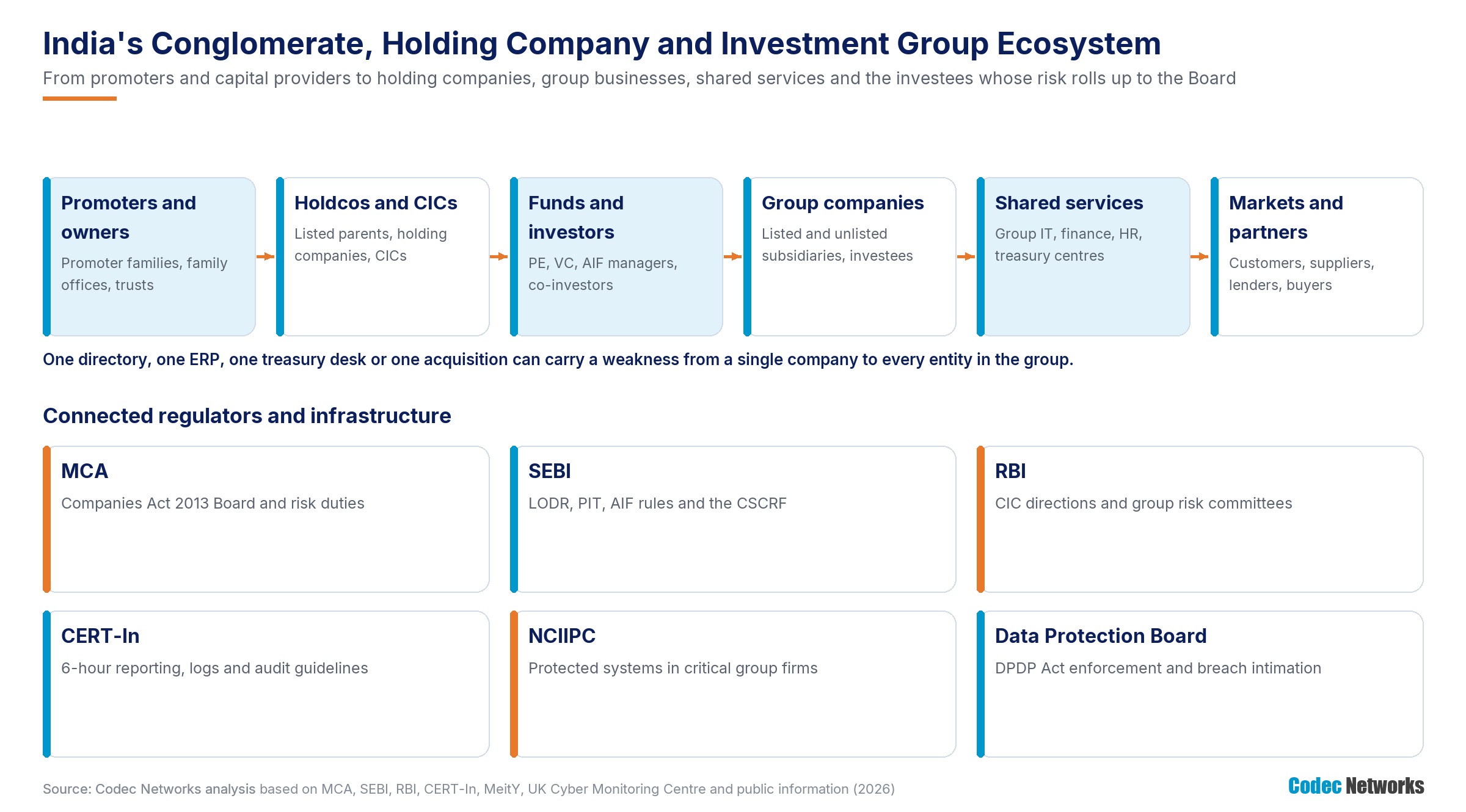
Figure 1: India's conglomerate, holding company and investment group ecosystem.
3. Categories of groups and investment organisations
|
Category |
Who they are |
Typical ownership |
Key regulatory basis |
|
Diversified business groups |
Promoter-led groups with businesses in several sectors, run through many listed and unlisted companies |
Promoter families, public shareholders |
Companies Act 2013; SEBI LODR for listed entities; sector regulators; CERT-In |
|
Listed and unlisted holding companies |
Parents that own and govern group companies, provide capital, brands and shared functions |
Promoters, listed holdcos, trusts |
Companies Act 2013; SEBI LODR where listed; RBI where a CIC; CERT-In |
|
Core investment companies |
NBFCs that hold mainly investments in group companies and are registered with RBI above set thresholds |
Promoter groups |
RBI CIC directions; Companies Act; CERT-In |
|
Family offices |
Single and multi-family offices managing investments, payments, property and affairs of promoter families |
Families, trusts, private companies |
Companies Act or trust law; SEBI rules where registered; IT Act; DPDP |
|
Private equity firms |
Buyout and growth investors managing funds with controlling or significant stakes in companies |
Fund managers, LPs |
SEBI AIF Regulations 2012; SEBI CSCRF; fund documents |
|
Venture capital firms and accelerators |
Funds and programmes investing in start-ups and early-stage companies |
Fund managers, LPs, corporates |
SEBI AIF Regulations 2012; SEBI CSCRF; investment agreements |
|
Portfolio and group companies |
Operating businesses owned by a group, holdco or fund, from start-ups to listed companies |
Group, fund and public owners |
Sector regulation; Companies Act; SEBI LODR where listed; CERT-In; DPDP |
|
Acquisition platforms and shared-services centres |
Roll-up vehicles and group centres for IT, finance, HR, payroll, procurement and treasury |
Groups and funds |
Contracts with group entities; CERT-In; DPDP; IT Act |
4. The corporate, market, fund, cyber and data framework at a glance
|
Instrument or expectation |
What it means for groups and investment firms |
|
Companies Act 2013 |
Board's report statement on a risk management policy (Section 134(3)(n)); audit committee evaluation of internal financial controls and risk management systems (Section 177); independent directors' duty to satisfy themselves that risk management systems are robust (Schedule IV) |
|
SEBI LODR Regulation 21 (top 1,000 listed entities) |
A risk management committee with at least one independent director, meeting at least twice a year, whose role specifically covers cyber security; applicable to the listed parent and to listed group companies |
|
SEBI LODR Regulation 27(2)(ba) |
Cyber security incidents and breaches, and related losses, disclosed in the quarterly corporate governance report filed with the stock exchanges |
|
SEBI (Prohibition of Insider Trading) Regulations 2015 |
Structured digital database of who shared and received unpublished price-sensitive information, with time stamps and audit trails; internal controls to prevent misuse and procedures for inquiries into leaks |
|
SEBI CSCRF (20 August 2024) and later clarifications |
Cyber security and resilience requirements for SEBI-regulated entities, including AIF managers and portfolio managers, scaled by category with a self-certification tier for smaller entities |
|
RBI Core Investment Companies directions (revised August 2020) |
Group risk management committee for the group's CIC, independent directors, a chief risk officer for CICs above ₹5,000 crore of assets; RBI's 2023 IT governance direction for NBFCs excludes CICs, so cyber oversight sits in group risk governance |
|
CERT-In Directions (28 April 2022) and audit guidelines (25 July 2025) |
Incidents reported within six hours; ICT logs kept for 180 days in India; clocks synchronised; risk-based independent audits, including OT and ICS environments in industrial group companies |
|
IT Act 2000 and NCIIPC |
Offences such as unauthorised access and identity theft; reasonable security practices for sensitive data; protected systems notified under Section 70 in group companies in critical sectors |
|
DPDP Act 2023 and Rules 2025 |
Each group company that decides why and how personal data is processed is a data fiduciary; notice, consent or other lawful basis for intra-group sharing, safeguards and breach intimation; most obligations from May 2027 |
|
Transaction documents, lender covenants and insurance |
Cyber and data warranties, specific indemnities, information covenants and policy conditions that bind group companies, funds and investees |
|
How these apply Companies Act duties follow each company; LODR duties follow each listed entity; RBI's CIC directions follow registration; SEBI's AIF, portfolio manager and CSCRF requirements follow the regulated manager; CERT-In's Directions apply to service providers, intermediaries, data centres and body corporates; DPDP applies to each data fiduciary. A holding company's oversight does not replace a subsidiary's own duties. Confirm against the official instruments and your agreements. |
5. Authorities, owners and ecosystem participants
- The Ministry of Corporate Affairs administers the Companies Act 2013 and Board, audit committee and disclosure duties, while SEBI and the stock exchanges regulate listed entities, insider trading, AIFs, portfolio managers and the CSCRF.
- RBI registers and regulates core investment companies and the NBFCs, banks and payment businesses inside many groups, and sector regulators such as IRDAI, PFRDA, TRAI and CERC oversee group companies in their sectors.
- CERT-In receives incident reports and issues advisories and audit guidelines; NCIIPC protects notified critical information infrastructure in group companies in power, banking, telecom, transport and other critical sectors; MeitY frames IT and data policy, and the Data Protection Board enforces the DPDP Act.
- Promoters, holding companies, CICs, family offices and fund managers set strategy and capital allocation; Boards, audit and risk management committees and independent directors oversee risk; limited partners and lenders expect evidence.
- Group and portfolio companies, acquisition platforms and shared-services centres run the operations, and customers, suppliers, dealers and employees depend on them.
- Investment bankers, law firms, accountants, virtual data room providers, IT outsourcers, managed service providers and cyber insurers sit inside almost every deal and shared service, and their weaknesses become the group's incidents.
6. Who buys cybersecurity inside a group or investment firm
|
Stakeholder |
What they care about |
What they buy |
|
Board, chairman and promoters |
Group reputation, value of holdings, investor and lender confidence |
Board briefings, group maturity assessments, crisis exercises |
|
Risk management and audit committees |
Assurance that cyber risk is identified, owned and reported across entities |
Group cyber risk reviews, independent audits, dashboards |
|
Group CIO and group CISO |
One standard, shared directories, ERP, cloud and SOC that cover every entity |
Group standard, identity reviews, shared SOC, VAPT |
|
Group CFO and treasury |
Payment integrity, deepfake and email fraud, insurance limits |
Treasury control testing, BEC simulations, insurance reviews |
|
Head of M&A, corporate development or deal partners |
No inherited breach, price protection, clean integration |
Cyber due diligence, compromise assessments, integration plans |
|
Fund operating partners and portfolio heads |
Investee resilience, value creation, exit readiness |
Portfolio baselines, benchmarking, portfolio SOC |
|
Family office heads and principals |
Privacy and safety of the family, payment approvals, advisers' access |
Personal and office security reviews, payment controls, awareness |
7. Why each segment needs a different approach
|
Organisation type |
Highest-consequence risk |
Starting point for assurance |
|
Diversified groups and holding companies |
Ransomware or wiper malware spreading through shared directories and ERP to many companies |
Group cyber standard, directory and trust review, shared SOC |
|
Core investment companies |
Weak visibility of cyber risk in group companies that drives the CIC's own exposure |
Group risk reporting, maturity scoring, independent audits |
|
Family offices |
Deepfake and email fraud against principals and staff, exposure of family data |
Payment control testing, awareness, privacy and device reviews |
|
PE and VC firms |
Unmeasured portfolio weaknesses and inherited breaches that cut value at exit |
Cyber due diligence, portfolio baselines, CSCRF review of the manager |
|
Portfolio and group companies |
Uneven controls, weak backups and slow detection |
VAPT, cloud and backup reviews, managed SOC |
|
Acquisition platforms and shared-services centres |
Rushed integrations and privileged vendor access across many entities |
Integration security gates, PAM review, data minimisation |
8. How Codec Networks works with groups and investment firms
Codec Networks is a CERT-In empanelled information security auditing organisation, empanelled with NICSI for application audit and compliance services (start-up category), and certified to ISO 9001:2015, ISO/IEC 27001:2022 and ISO/IEC 20000-1:2018. For groups and investment firms we design group cyber standards and governance models that set roles for the holding company and each subsidiary; score the maturity of every group and portfolio company against one baseline; review shared directories, trust relationships, privileged access and cloud tenants; carry out cyber due diligence before signing and compromise assessments before closing, with inputs to warranties, indemnities and Day-1 and 100-day integration plans; test data rooms, deal team devices and treasury and payment approval controls; run deepfake and business email compromise simulations for treasury, family office and deal teams; assess shared-services centres, IT outsourcers and managed service providers; carry out CERT-In empanelled audits and reviews against SEBI's CSCRF for fund and portfolio managers; build DPDP programmes for personal data shared across group companies; operate a shared 24x7 SOC across holding company, group and portfolio companies; review cyber insurance limits and conditions; prepare Board and risk committee dashboards and crisis exercises; and provide incident response and forensics for ransomware, payment fraud and inherited breaches. Pre-acquisition testing is carried out only with the target's consent and under agreed rules. Each proposal confirms auditor eligibility and independence against CERT-In's and the client's requirements. Codec Networks does not provide legal, investment, valuation or insurance advice.
Talk to Codec Networks
|
Contact Codec Networks Pvt. Ltd. New Delhi: 507, 5th Floor, New Delhi House, Barakhamba Road, Connaught Place, New Delhi – 110001 Gurugram: 707, 7th Floor, Silverton Tower, Golf Course Extension Road, Sector 50, Gurugram – 122018, Haryana Landline: 011 430 496 96 | 011 437 522 99 Mobile: +91 99716 76124 | +91 88007 88220 | +91 88003 31124 Email: mktg@codecnetworks.com Web: www.codecnetworks.com |
Note: This document is general industry guidance based on public information available as of October 2026. It is not legal, regulatory, investment, tax, transaction or insurance advice. Obligations differ by entity (diversified group company, listed or unlisted holding company, core investment company, family office, alternative investment fund or portfolio manager, portfolio company or shared-services centre), by listing status, registrations and regulatory category, by fund documents, transaction agreements, lender covenants and insurance policies, and by the data each entity handles; confirm them against the official MCA, SEBI, stock exchange, RBI, CERT-In, NCIIPC, MeitY and Data Protection Board instruments and your agreements. Pre-acquisition testing is described only as authorised work with the consent of the target and in agreed conditions. Incident references are summarised from official statements, regulator decisions and widely reported events, and no inference is drawn about the governance of any named organisation or its owners.