

Resources Categories
INDUSTRY FACT FILE · CLOUD, DATA CENTRES & HOSTING
Threat Landscape: Top Cyber Threats Facing Cloud, Data Centre and Hosting Providers
The 18 most relevant cyber threats, attacks and industry challenges for cloud providers, colocation operators, managed hosting and VPS providers.
|
In this document 1. The threat picture in numbers 2. Top 18 threats, attacks and challenges 3. Threat relevance by provider segment 4. Five priority threats in depth 5. Impact on infrastructure providers and their customers 6. How regulation turns incidents into business events 7. Questions every leadership team should ask |
1. The threat picture in numbers
|
6 hours To report incidents to CERT-In |
Feb 2023 ESXiArgs ransomware hit thousands of exposed hypervisors worldwide |
Jul 2024 A faulty security update showed how fast outages cascade |
May 2027 Most DPDP obligations take effect |
Infrastructure providers face attacks on the layers customers cannot see: hypervisors, management planes, out-of-band hardware management and facility systems. Their platforms are also abused by criminals renting servers to host phishing, malware and attack tools.
The ESXiArgs ransomware campaign of February 2023 encrypted thousands of internet-exposed hypervisors, and large outages—from a 2021 data centre fire in Strasbourg to the July 2024 faulty security-software update—showed how a single event can affect many customers at once.
2. Top 18 threats, attacks and challenges
The list below is a practical assessment framework, not a statistical ranking. Priority varies by business model, technology exposure and existing controls.
|
# |
Threat / attack / challenge |
Typical scenario |
Most exposed |
Potential impact |
|
1 |
Hypervisor and management-plane attacks |
Exploitation of exposed virtualisation management |
Managed hosting, VPS, clouds |
Mass customer encryption |
|
2 |
Control-plane and console takeover |
Stolen admin or customer credentials |
Clouds and hosting portals |
Resource abuse and data theft |
|
3 |
Exposed BMC/IPMI interfaces |
Out-of-band management reachable or default-credentialed |
Hosting, VPS, GPU clouds |
Below-OS compromise |
|
4 |
Ransomware across hosted estates |
Encryption of customer VMs and backups |
Managed hosting |
Multi-customer outages |
|
5 |
Customer misconfiguration fallout |
Public storage or open services on the platform |
Clouds |
Data exposure and disputes |
|
6 |
Platform abuse |
Servers rented for phishing, malware or attacks |
VPS providers |
Reputation and legal exposure |
|
7 |
DDoS attacks |
Floods against customers or platform |
All providers |
Outages and SLA penalties |
|
8 |
Facility BMS and OT compromise |
Remote manipulation of cooling or power |
Colocation operators |
Physical outages |
|
9 |
Physical intrusion and insiders |
Unauthorised access to halls or racks |
Colocation, edge sites |
Theft and tampering |
|
10 |
Supply-chain and firmware risk |
Compromised hardware, firmware or updates |
All providers |
Persistent compromise |
|
11 |
Backup compromise |
Backups encrypted or deleted |
Hosting and DR providers |
Unrecoverable data |
|
12 |
Support and remote-hands social engineering |
Impostors request access or changes |
Colocation and hosting |
Unauthorised access |
|
13 |
Cross-tenant isolation failure |
Flaws allowing access across customers |
Clouds and VPS |
Multi-customer breaches |
|
14 |
Cascading outages |
Faulty changes or dependencies spread failure |
Large clouds |
Wide disruption |
|
15 |
Resource abuse and cryptomining |
Stolen accounts used for compute |
GPU and cloud providers |
Financial loss |
|
16 |
Weak subscriber records |
Inability to meet CERT-In record duties |
VPS and hosting providers |
Regulatory exposure |
|
17 |
Weak detection and response |
Limited platform monitoring |
Smaller providers |
Missed 6-hour reporting |
|
18 |
DR and recovery failure |
Untested failover |
All providers |
Extended outages |
3. Threat relevance by provider segment
The matrix is a qualitative guide for prioritising the first round of security reviews.
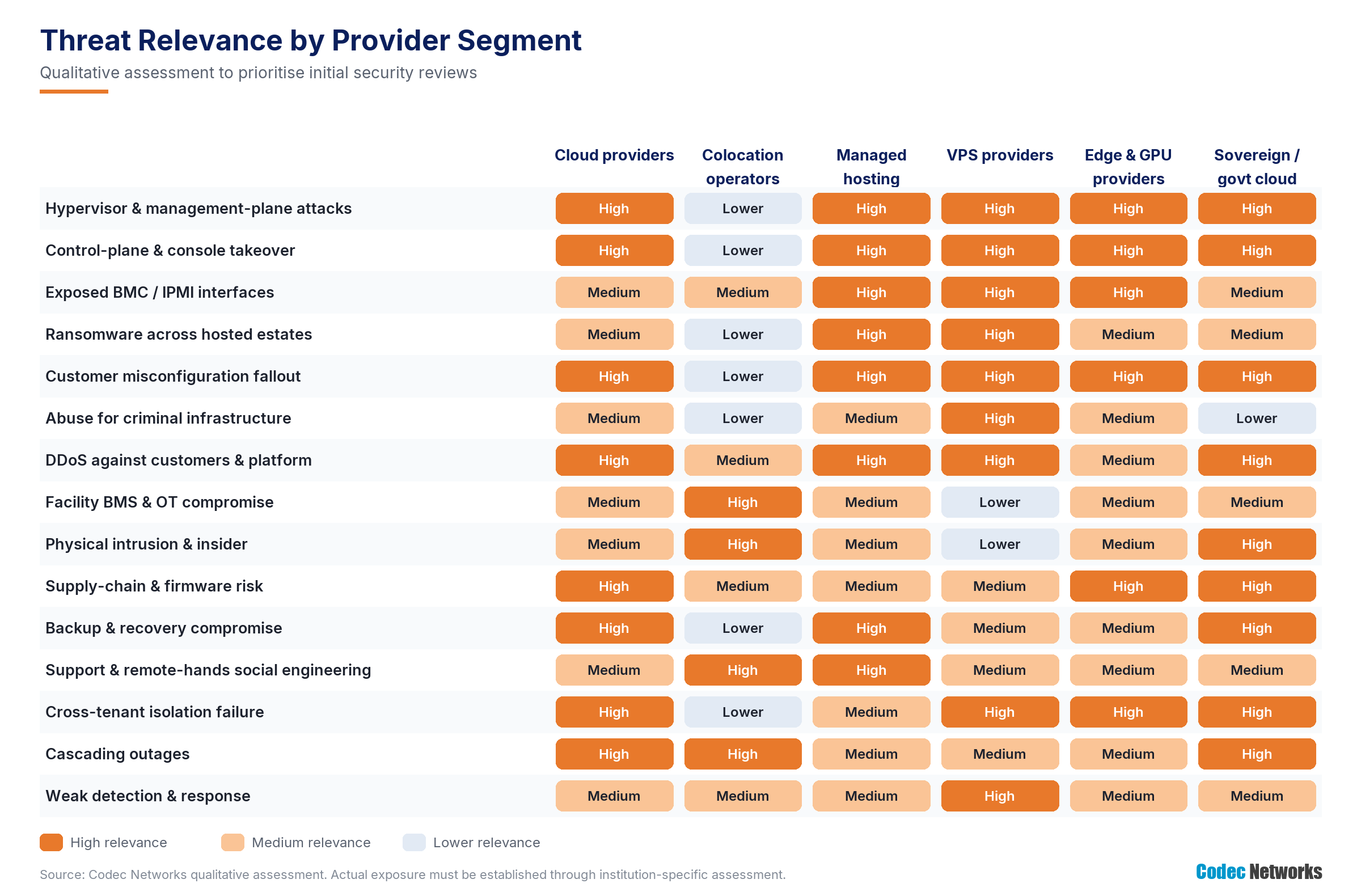
Figure 5: Qualitative threat relevance by provider segment (Codec Networks assessment).
4. Five priority threats in depth
4.1 Hypervisor and management-plane attacks
Ransomware operators increasingly encrypt virtual machines at the hypervisor, bypassing guest-level security. Exposed or unpatched management interfaces are the usual entry point.
- Questions to test: Are management planes unreachable from the internet? Are hypervisors patched promptly? Are backups outside the hypervisor's administrative domain?
- Relevant services: virtualisation security review, management-plane VAPT, SOC monitoring, backup testing.
4.2 Out-of-band hardware management
BMC and IPMI interfaces give control below the operating system. Default credentials or shared networks allow firmware tampering and disk wiping.
- Questions to test: Is there a dedicated, isolated out-of-band network? Are BMC credentials unique and firmware current? Is BMC access logged?
- Relevant services: BMC and IPMI testing, firmware review, network segmentation review.
4.3 Platform abuse and subscriber records
Criminals rent servers with fake identities to host phishing and attack infrastructure. CERT-In requires providers to keep validated subscriber records for five years.
- Questions to test: Is customer identity verified at onboarding? Are records retained as required? Is abuse detected and acted on quickly?
- Relevant services: onboarding and records review, abuse-process assessment, SOC use cases.
4.4 Facility OT
Building management, cooling and power systems are often remotely supported by vendors. Manipulating them can cause physical outages across halls.
- Questions to test: Are BMS and facility OT segmented from corporate and customer networks? Is vendor remote access brokered and monitored?
- Relevant services: facility OT assessment, vendor access review, OT monitoring.
4.5 Detection and the 6-hour clock
CERT-In requires reporting within six hours of noticing an incident, and customers need rapid notice to protect their own workloads.
- Questions to test: Are management-plane, control-plane and facility logs monitored 24x7? Is there a multi-customer notification playbook?
- Relevant services: managed SOC, playbooks, tabletop exercises, IR retainer.
5. Impact on infrastructure providers and their customers
|
Player type |
Threats to prioritise |
Main impact |
|
Cloud providers |
Control-plane takeover, isolation failure |
Multi-tenant breaches and regulator scrutiny |
|
Colocation operators |
Facility OT, physical intrusion |
Outages across customer racks |
|
Managed hosting |
Hypervisor ransomware, backup loss |
Mass customer outages |
|
VPS providers |
Platform abuse, weak records |
Legal and regulatory exposure |
|
Customers |
Inherited platform weaknesses |
Outages, data loss and compliance issues |
6. How regulation turns incidents into business events
- CERT-In: incidents reported within six hours; providers must also keep logs, synchronise clocks and maintain subscriber records.
- Customers: SLAs and contracts trigger credits, notifications, audits and possible termination.
- Customer regulators: BFSI and insurance customers may need to report provider incidents to RBI, SEBI or IRDAI; empanelled services may face STQC or MeitY review.
- Privacy: customers as data fiduciaries must intimate personal data breaches once DPDP breach provisions commence in May 2027.
- Law enforcement: abuse cases bring requests for subscriber information.
|
Insight Customers can only secure what sits above the provider's layer. Hypervisors, out-of-band management and facility systems deserve the strongest controls because every customer depends on them. |
7. Questions every leadership team should ask
- Are hypervisor and management interfaces unreachable from the internet?
- Is out-of-band management on an isolated network with unique credentials?
- Would backups survive an attacker with hypervisor admin rights?
- Are we meeting CERT-In's subscriber-record, logging and clock-synchronisation duties?
- Are facility BMS and power systems segmented and vendor access monitored?
- Could we report an incident to CERT-In within six hours and notify every affected customer?
Talk to Codec Networks
|
Contact Codec Networks Pvt. Ltd. New Delhi: 507, 5th Floor, New Delhi House, Barakhamba Road, Connaught Place, New Delhi – 110001 Gurugram: 707, 7th Floor, Silverton Tower, Golf Course Extension Road, Sector 50, Gurugram – 122018, Haryana Landline: 011 430 496 96 | 011 437 522 99 Mobile: +91 99716 76124 | +91 88007 88220 | +91 88003 31124 Email: mktg@codecnetworks.com Web: www.codecnetworks.com |
Note: Threat descriptions and relevance ratings are general guidance, not findings about any specific organisation. Public incident references are summarised from widely reported events.