

Resources Categories
INDUSTRY FACT FILE · CHEMICALS, FERTILIZERS & PROCESS INDUSTRIES
Threat Landscape: Top Cyber Threats Facing Chemicals, Fertilizers and Process Industries
The 18 most relevant cyber threats, attacks and industry challenges for fertilizer producers, chemical makers, CDMOs, agrochemical companies and process operators, and the impact each one has on plants, safety, revenue and customers.
|
In this document 1. The threat picture in numbers 2. Top 18 threats, attacks and challenges 3. Threat relevance by chemical and fertilizer segment 4. Five priority threats in depth 5. Impact on chemical and fertilizer companies, their customers and farmers 6. How regulation turns incidents into business events 7. Questions every leadership team should ask |
1. The threat picture in numbers
|
2017 TRITON targeted a petrochemical plant's safety instrumented system |
Dec 2020 Clop ransomware encrypted ~1,000 devices and halted Symrise |
US$4.4 m Ransom paid by Brenntag after 150 GB of data was stolen (2021) |
6 hours To report incidents to CERT-In |
Chemical and fertilizer companies attract ransomware groups because continuous plants and seasonal supply cannot stop without immediate loss; state-backed actors because of strategic fertilizer and chemical capacity and the chance to cause physical harm; competitors and insiders because formulations and process know-how are valuable; and fraudsters because dealer networks move large seasonal payments. The attack surface spans legacy DCS and safety systems, vendor remote access, turnaround contractors, ERP and subsidy integrations, formulation systems and dealer portals.
Landmark incidents show the pattern. TRITON (2017) targeted the safety instrumented system of a petrochemical plant; LockerGoga (2019) hit chemical makers Hexion and Momentive alongside Norsk Hydro; Clop (2020) encrypted about 1,000 devices at Symrise, which halted production; Brenntag (2021) paid US$4.4 million after data theft. In India, the Visakhapatnam styrene release (2020) and the Bhopal legacy keep process safety at the centre of every Board's agenda.
2. Top 18 threats, attacks and challenges
The list below is a practical assessment framework, not a statistical ranking. Priority varies by business model, technology exposure and existing controls.
|
# |
Threat / attack / challenge |
Typical scenario |
Most exposed |
Potential impact |
|
1 |
Ransomware halting production |
ERP, historians, engineering and operator stations encrypted |
All companies |
Lost production, unsafe restarts, recovery costs |
|
2 |
Safety system and set-point tampering |
Malicious changes to SIS logic, interlocks or set-points |
Fertilizer, bulk and specialty plants |
Safety and environmental hazards |
|
3 |
Vendor and contractor remote access abuse |
Standing VPNs and shared vendor accounts hijacked |
All plants |
Direct path to the DCS |
|
4 |
Flat IT/OT networks |
No separation between office IT and control networks |
Most plants |
Office malware reaching the DCS |
|
5 |
Legacy DCS, PLCs and HMIs |
Decades-old controllers and unpatched operator stations |
All plants |
Easy exploitation, no vendor fixes |
|
6 |
ERP, subsidy and billing disruption |
ERP or integration outage stalls dispatch, PoS reconciliation and claims |
Fertilizer producers, dealers |
Supply and cash-flow crisis in season |
|
7 |
Formulation and process IP theft |
Recipes, parameters and dossiers copied out |
Specialty, agrochemicals, CDMOs |
Lost competitive advantage |
|
8 |
Nation-state espionage and sabotage |
Persistent intrusions into strategic chemical and fertilizer capacity |
PSUs, large plants |
Strategic loss, physical risk |
|
9 |
Phishing and credential theft |
Staff, engineers and vendor accounts targeted |
All companies |
Initial access |
|
10 |
Business email compromise |
Fraudulent supplier and dealer payment changes |
All companies |
Direct financial loss |
|
11 |
Dealer portal and distribution fraud |
Portal account takeover, diverted stock or payments |
Fertilizer, agrochemicals, paints |
Revenue loss, dealer disputes |
|
12 |
Removable media and engineering laptops |
Infected devices during turnarounds and vendor visits |
All plants |
OT infection |
|
13 |
Falsified quality and compliance data |
Manipulated LIMS, batch or regulatory records |
CDMOs, agrochemicals, exporters |
Customer, regulator and export consequences |
|
14 |
Cloud, analytics and IIoT exposure |
Internet-facing gateways and dashboards bridging to OT |
Digital plant programmes |
Bridge from internet to the plant |
|
15 |
Insider misuse |
Employees or contractors abuse access to systems or data |
All companies |
Theft, sabotage, fraud |
|
16 |
Logistics and tank-farm manipulation |
Altered gauging, loading or tanker data |
Bulk chemicals, gases, fertilizers |
Overfill risk, inventory loss |
|
17 |
Weak OT detection and response |
No visibility into plant networks or remote sessions |
Most plants |
Long dwell time; missed 6-hour reporting |
|
18 |
Backup and recovery failure |
No tested backups of DCS configurations, logic or ERP |
All companies |
Weeks of downtime, unsafe restarts |
3. Threat relevance by chemical and fertilizer segment
The matrix is a qualitative guide for prioritising the first round of security reviews.
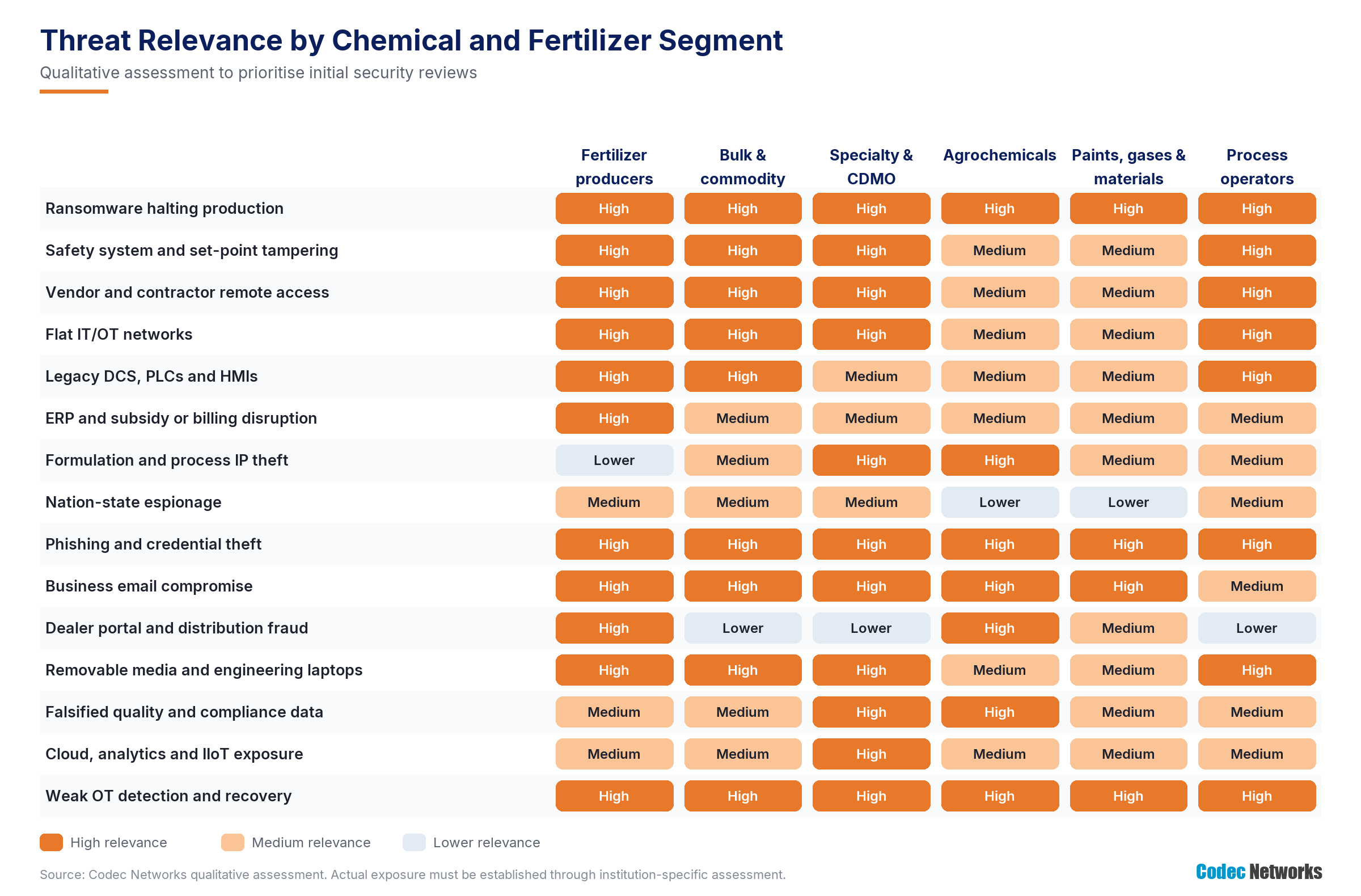
Figure 5: Qualitative threat relevance by chemical and fertilizer segment (Codec Networks assessment).
4. Five priority threats in depth
4.1 Safety systems and set-points
TRITON showed attackers will target the safety instrumented system itself. More commonly, a hijacked vendor session or an infected engineering workstation allows set-point or logic changes that the SIS must then catch.
- Questions to test: Are SIS networks isolated from engineering and IT? Are controllers in run mode with key control? Are set-point and logic changes monitored and reviewed? Is cyber risk inside process safety management?
- Relevant services: SIS security review, engineering workstation controls, OT monitoring, cyber in PSM.
4.2 Vendors, contractors and turnarounds
Automation vendors keep standing remote access and share credentials; turnarounds bring hundreds of contractors and USB media into the plant.
- Questions to test: Which vendors can reach the DCS and is their access brokered and recorded? Are contractor devices scanned and segmented? Is media controlled? Are accounts removed after work?
- Relevant services: remote access brokering, third-party access programme, scanning kiosks, access recertification.
4.3 Ransomware and the seasonal business
Symrise, Hexion and Momentive show that ransomware stops chemical companies. For fertilizer producers, an ERP or integration outage in sowing season stalls dispatch, PoS reconciliation and subsidy claims—even if the plant runs.
- Questions to test: Can the plant and dispatch run without ERP? Are ERP, integration and DCS configuration backups immutable and tested? Is there a manual reconciliation playbook?
- Relevant services: segmentation, backup and recovery testing, continuity playbooks, EDR and SOC.
4.4 Formulations, LIMS and data integrity
Specialty and agrochemical companies live on recipes and regulatory data; CDMOs on customer confidentiality and quality integrity.
- Questions to test: Is formulation data classified and access-limited? Are bulk exports and personal cloud uploads monitored? Is LIMS protected against unauthorised change?
- Relevant services: data classification, DLP, access reviews, LIMS integrity controls, forensic readiness.
4.5 Detection, reporting and the 6-hour clock
CERT-In requires reporting within six hours; listed companies disclose quarterly; safety regulators expect incident investigation. Plant networks are usually unmonitored.
- Questions to test: Are IT and OT monitored 24x7? Do we see remote sessions and engineering activity? Is there a playbook combining safety decisions, containment, CERT-In reporting and disclosure?
- Relevant services: IT/OT SOC, playbooks, joint drills with operations and safety teams.
5. Impact on chemical and fertilizer companies, their customers and farmers
|
Player type |
Threats to prioritise |
Main impact |
|
Fertilizer producers |
Ransomware, subsidy disruption, SIS tampering |
Supply shortfall in season, cash-flow crisis, safety risk |
|
Bulk and specialty chemical makers |
Safety tampering, vendor access abuse, IP theft |
Unsafe events, production loss, lost advantage |
|
Agrochemical and paint companies |
Dealer fraud, data theft, batch plant outages |
Revenue loss, dealer disputes, DPDP breaches |
|
CDMOs and process operators |
Customer data and quality integrity failures |
Lost contracts, regulatory consequences |
|
Farmers, dealers and communities |
Supply disruption, data exposure, releases |
Crop and livelihood impact, personal harm |
6. How regulation turns incidents into business events
- CERT-In: incidents reported within six hours of noticing them.
- Safety regulators: incidents affecting control or safety systems that cause process upsets or releases trigger investigation under the Factories Act, MSIHC and Chemical Accidents Rules.
- Department of Fertilizers: disruption of PoS or subsidy data affects claims and may require engagement under the DBT scheme.
- NCIIPC: incidents affecting notified protected systems require coordination.
- SEBI LODR: listed companies disclose cyber incidents quarterly.
- DPDP and customers: farmer, dealer and employee data incidents trigger breach intimation from May 2027; customer contracts require notification.
|
Insight The most dangerous chemical and fertilizer incidents cross boundaries—from a vendor into the DCS, from the DCS into the safety system, and from ERP into the subsidy chain. Strong boundaries, tested recovery and plant-floor visibility are the best defence. |
7. Questions every leadership team should ask
- Could a vendor's or contractor's compromised account reach our DCS or safety system?
- Are our safety instrumented systems isolated and their engineering workstations monitored?
- If ERP went dark in season, could we dispatch, reconcile PoS data and claim subsidy?
- Could a leaver or contractor walk out with our formulations?
- Do we have offline backups of DCS configurations and a tested, safe restart plan?
- Could we detect, contain and report an incident within six hours while keeping the plant safe?
Talk to Codec Networks
|
Contact Codec Networks Pvt. Ltd. New Delhi: 507, 5th Floor, New Delhi House, Barakhamba Road, Connaught Place, New Delhi – 110001 Gurugram: 707, 7th Floor, Silverton Tower, Golf Course Extension Road, Sector 50, Gurugram – 122018, Haryana Landline: 011 430 496 96 | 011 437 522 99 Mobile: +91 99716 76124 | +91 88007 88220 | +91 88003 31124 Email: mktg@codecnetworks.com Web: www.codecnetworks.com |
Note: Threat descriptions and relevance ratings are general guidance, not findings about any specific organisation. Public incident references are summarised from widely reported events and company disclosures.