

Resources Categories
INDUSTRY FACT FILE · CAPITAL MARKETS
Threat Landscape: Top Cyber Threats Facing Capital Market Entities
The 18 most relevant cyber threats, attacks and industry challenges for exchanges, clearing corporations, depositories, brokers, DPs and other intermediaries in India.
|
In this document 1. The threat picture in numbers 2. Top 18 threats, attacks and challenges 3. Threat relevance by capital markets segment 4. Five priority threats in depth 5. Impact on market participants and investors 6. How regulation turns incidents into business events 7. Questions every leadership team should ask |
1. The threat picture in numbers
|
18.59 cr Demat accounts at CDSL (30 June 2026) |
₹19,813 cr Reported cyber-fraud losses in 2025, all channels (I4C data) |
6 hours To report cyber incidents to SEBI and CERT-In |
36% Share of 2025 cyber-fraud complaints linked to investment fraud (I4C data, as reported) |
The rapid growth of retail investing has made the securities market a prime target for fraudsters. Reports based on Indian Cybercrime Coordination Centre (I4C) data indicate that investment frauds accounted for around 36% of cyber-fraud complaints in 2025, often using fake trading apps, impersonated brokers and social-media 'stock tip' groups.
At the same time, market infrastructure and intermediaries face ransomware, DDoS and supply-chain threats that can disrupt trading and settlement. SEBI's CSCRF requires regulated entities to detect, respond to and report such incidents within six hours.
2. Top 18 threats, attacks and challenges
The list below is a practical assessment framework, not a statistical ranking. Priority varies by business model, technology exposure and existing controls.
|
# |
Threat / attack / challenge |
Typical scenario |
Most exposed |
Potential impact |
|
1 |
Trading account takeover |
Phished credentials and OTPs used to log in and trade or withdraw |
Brokers and their clients |
Investor losses, complaints, exchange inquiries |
|
2 |
Fake trading apps and investment scams |
Look-alike apps, impersonated brokers and fraudulent tip groups |
Brokers' brands and retail investors |
Investor harm and reputational damage |
|
3 |
DDoS and availability attacks |
Floods against trading platforms, APIs and exchange connectivity |
Exchanges and brokers |
Trading disruption on high-volume days |
|
4 |
API abuse and algo manipulation |
Abuse of trading APIs; faulty or malicious algo strategies |
Brokers, exchanges |
Erroneous orders, losses, market disruption |
|
5 |
Ransomware and data extortion |
Encryption of back-office, RTA or DP systems and theft of data |
Brokers, DPs, RTAs, KRAs |
Service outages, data exposure, corporate-action disruption |
|
6 |
Insider and privileged misuse |
Abuse of administrator or back-office access to data or holdings |
All participants |
Unauthorised transfers, data theft |
|
7 |
Unauthorised securities transfers and pledges |
Stolen back-office credentials used to move or pledge securities |
DPs, custodians, depositories |
Investor losses and depository action |
|
8 |
Phishing and business email compromise |
Impersonation of executives, clients or counterparties |
All participants |
Fraudulent payments and credential theft |
|
9 |
Third-party and vendor compromise |
Breach of trading-platform, back-office or cloud vendors |
Brokers and DPs relying on vendors |
Compromise across many REs |
|
10 |
Software supply-chain compromise |
Malicious updates in trading or back-office software |
Users of common market software |
Widespread exposure |
|
11 |
Cloud misconfiguration |
Public storage of KYC data, excessive permissions |
Brokers and intermediaries using cloud |
Large-scale investor data exposure |
|
12 |
Investor data leakage |
Exposure of KYC, holdings and transaction data |
Brokers, DPs, RTAs, KRAs |
DPDP exposure and targeting of investors by scammers |
|
13 |
Settlement and file tampering |
Alteration of settlement, payout or corporate-action files |
Clearing members, RTAs |
Wrongful payouts and reconciliation breaks |
|
14 |
Market data and surveillance tampering |
Manipulation of data feeds or surveillance systems |
Exchanges and data vendors |
Market integrity concerns |
|
15 |
Weak detection and response |
Incomplete logging and monitoring at smaller REs |
Small and Mid-size REs |
Missed 6-hour reporting |
|
16 |
Deepfake and AI-enabled fraud |
Impersonation of executives or advisers; AI-generated tip videos |
Brokers and investors |
Fraud and brand damage |
|
17 |
Mule accounts in the securities market |
Demat and trading accounts used to route illicit funds |
Brokers and DPs |
AML exposure and regulatory action |
|
18 |
Backup and recovery failure |
Recovery objectives not met after an incident |
All participants, especially MIIs and QREs |
Extended outages and supervisory action |
3. Threat relevance by capital markets segment
The matrix is a qualitative guide for prioritising the first round of security reviews.
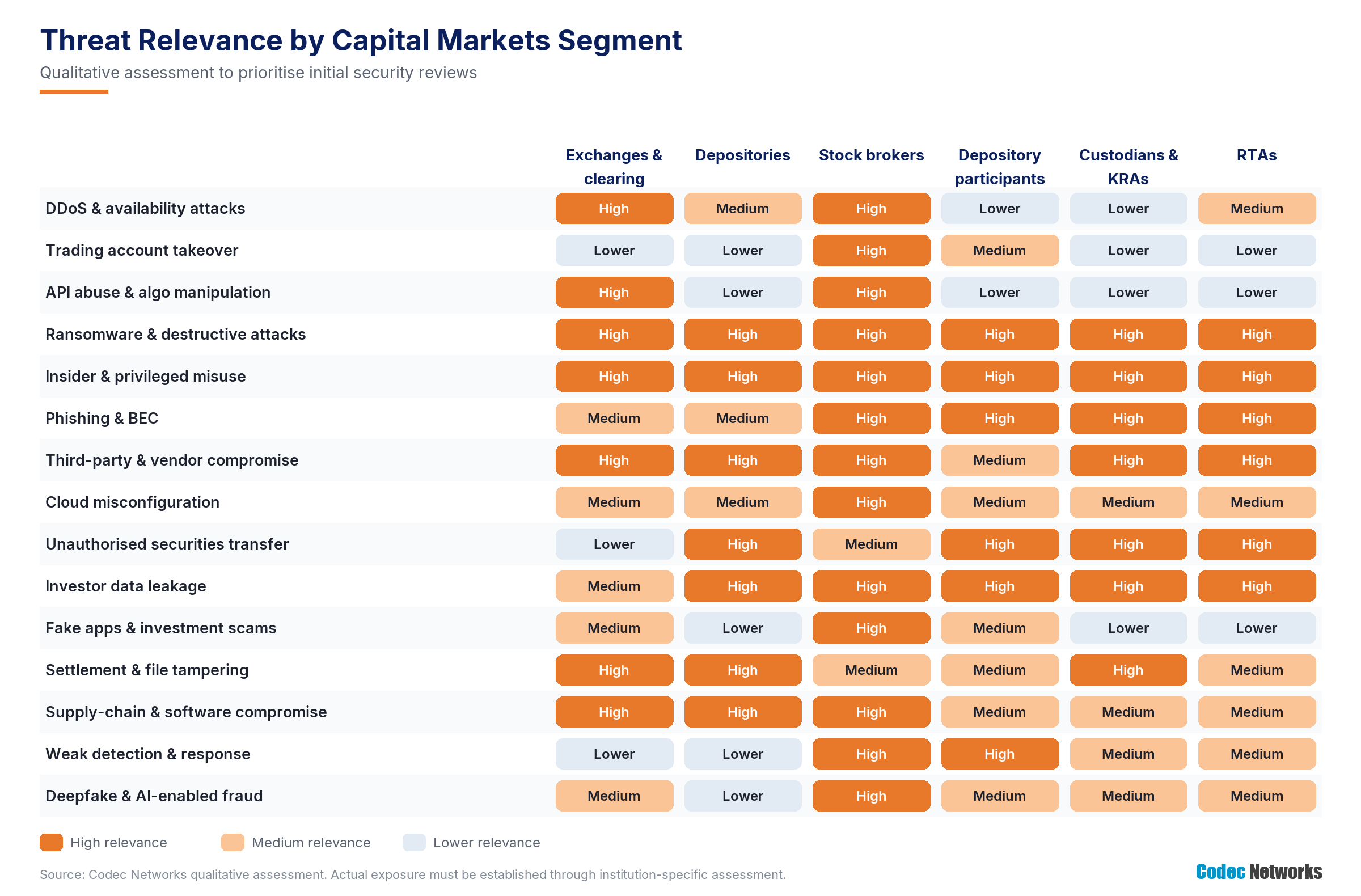
Figure 5: Qualitative threat relevance by capital markets segment (Codec Networks assessment).
4. Five priority threats in depth
4.1 Trading account takeover and fake apps
Fraudsters phish investors with fake 'KYC update' or 'account blocked' messages, steal credentials and OTPs, and use accounts for unauthorised trades. Fake apps and impersonated brokers also lure investors into scams that damage legitimate brands.
- Questions to test: Are new-device logins and unusual trades challenged? Do investors receive alerts on every trade and transfer? Is the brand monitored for fake apps and sites?
- Relevant services: trading app and API testing, authentication review, anti-phishing and fake-app takedown, surveillance alert review.
4.2 DDoS and platform availability
Trading platforms must be available during market hours; outages on high-volume days harm investors and attract regulatory scrutiny. MIIs and Qualified REs face clarified recovery objectives for critical systems under CSCRF.
- Questions to test: Has DDoS protection been tested? Are capacity and failover validated against peak loads? Are recovery objectives tested end to end?
- Relevant services: resilience and architecture assessment, authorised availability testing, DR drill observation.
4.3 Ransomware at brokers, DPs and RTAs
Back-office and registry systems hold investor records and process corporate actions. Ransomware can halt services and expose data at critical moments such as record dates.
- Questions to test: Are investor databases segmented and backed up offline? Is EDR monitored 24x7? Has a ransomware scenario been rehearsed with the SEBI reporting step?
- Relevant services: managed SOC, ransomware simulation, backup and recovery testing, incident response.
4.4 Unauthorised transfers and back-office misuse
Compromised or misused back-office accounts at DPs and custodians can move or pledge investors' securities. Strong authentication, maker-checker and investor alerts are essential.
- Questions to test: Is MFA enforced for back-office users? Are pledges and off-market transfers subject to maker-checker? Are investors alerted immediately?
- Relevant services: privileged-access audit, maker-checker testing, SOC monitoring of back-office activity.
4.5 Third-party and supply-chain risk
Many brokers and DPs rely on common trading, back-office and cloud vendors. A single vendor compromise can affect many regulated entities at once. CSCRF expects REs to manage third-party risk.
- Questions to test: Which vendors have access to critical systems? When were their controls last assessed? Are software updates verified?
- Relevant services: third-party risk management, vendor assessments, supply-chain security testing.
5. Impact on market participants and investors
|
Player type |
Threats to prioritise |
Main impact |
|
Exchanges and clearing corporations |
DDoS, supply chain, insider misuse |
Market-wide disruption and loss of confidence |
|
Depositories |
Insider misuse, unauthorised transfers |
Systemic impact on investor holdings |
|
Stock brokers |
Account takeover, fake apps, DDoS, ransomware |
Client losses, complaints, exchange and SEBI action |
|
Depository participants |
Back-office misuse, ransomware |
Investor losses and depository action |
|
RTAs and KRAs |
Ransomware, data leakage |
Issuer and investor harm, DPDP exposure |
|
Technology vendors |
Supply-chain compromise |
Simultaneous impact on many REs |
6. How regulation turns incidents into business events
- SEBI: cyber incidents reported within six hours of detection under CSCRF, with follow-up reporting and root-cause analysis.
- CERT-In: specified incidents reported within six hours; ICT logs retained for 180 days in India.
- MIIs: exchanges and depositories must be informed promptly where market operations are affected.
- Privacy: once DPDP breach provisions commence in May 2027, personal data breaches must be intimated to the Data Protection Board, with a detailed report within 72 hours.
- Audits: incidents feed into the next CSCRF cyber audit and VAPT cycle.
|
Insight In capital markets, small entities can create big incidents: one broker's compromised API or one RTA's ransomware can ripple across investors and issuers. CSCRF's graded controls exist so that every link meets a minimum standard. |
7. Questions every leadership team should ask
- Do we know our CSCRF category and the audit, VAPT and SOC obligations that come with it?
- Could we detect and report an incident to SEBI and CERT-In within six hours?
- Would we stop an unauthorised pledge or off-market transfer before it completes?
- Are fake apps or impersonators using our brand today?
- Have we tested our platforms against DDoS and our recovery objectives end to end?
- Which vendors could compromise us, and when were they last assessed?
Talk to Codec Networks
|
Contact Codec Networks Pvt. Ltd. New Delhi: 507, 5th Floor, New Delhi House, Barakhamba Road, Connaught Place, New Delhi – 110001 Gurugram: 707, 7th Floor, Silverton Tower, Golf Course Extension Road, Sector 50, Gurugram – 122018, Haryana Landline: 011 430 496 96 | 011 437 522 99 Mobile: +91 99716 76124 | +91 88007 88220 | +91 88003 31124 Email: mktg@codecnetworks.com Web: www.codecnetworks.com |
Note: Threat descriptions and relevance ratings are general guidance, not findings about any specific entity. I4C figures cover all channels and are as reported in public sources. Confirm regulatory obligations against SEBI's current circulars.