

Resources Categories
INDUSTRY FACT FILE · BANKING
Threat Landscape: Top Cyber Threats Facing Banks
The 18 most relevant cyber threats, attacks and industry challenges for banks in India, and the impact each one has on banks and their customers.
|
In this document 1. The threat picture in numbers 2. Top 18 threats, attacks and challenges 3. Threat relevance by bank segment 4. Five priority threats in depth 5. Impact on banks and their stakeholders 6. How regulation turns incidents into supervisory events 7. Questions every bank's leadership should ask |
1. The threat picture in numbers
|
₹48,021 cr Frauds reported by banks and FIs in FY26 (RBI) |
₹19,813 cr Reported cyber-fraud losses in 2025, all channels (I4C data) |
29 banks Using RBIH's MuleHunter.AI (July 2026) |
6 hours To report cyber incidents to RBI on DAKSH |
RBI's Annual Report for 2025-26 shows banks and financial institutions reported 10,114 frauds of ₹1 lakh and above involving ₹48,021 crore; advances-related frauds accounted for the largest share by value. Reports based on Indian Cybercrime Coordination Centre (I4C) data put cyber-fraud losses across all channels at about ₹19,813 crore in 2025. The industry response includes RBI Innovation Hub's MuleHunter.AI, which the Government told Parliament in July 2026 had been adopted by 29 banks, and the Digital Payments Intelligence Platform, then in a pilot with seven banks.
2. Top 18 threats, attacks and challenges
The list below is a practical assessment framework, not a statistical ranking. Priority varies by bank type, technology estate and existing controls.
|
# |
Threat / attack / challenge |
Typical scenario |
Banks most exposed |
Potential impact |
|
1 |
Account takeover and credential compromise |
SIM swap, OTP interception, credential stuffing or banking malware gives an attacker control of a customer's account |
Retail and MSME customers across all banks |
Customer losses, reimbursement under the customer-protection framework, complaints |
|
2 |
Phishing, vishing and business email compromise |
Fake customer-care numbers, impersonation of bank staff or executives, fraudulent payment instructions |
All banks, treasury and corporate banking teams |
Fraudulent transfers, credential theft, reputational damage |
|
3 |
Mule accounts |
Accounts opened with borrowed, rented or synthetic identities to receive and move fraud proceeds |
All banks, especially digital-first and inclusion-focused banks |
Freeze requests, supervisory scrutiny of KYC, FIU-IND reporting failures |
|
4 |
Ransomware and data extortion |
Encryption of servers and branches, deletion of backups and theft of data |
All banks; co-operative banks with weaker baselines |
Channel and branch outages, recovery costs, data exposure |
|
5 |
Web, mobile and API attacks |
Broken authorisation, insecure APIs and business-logic flaws in digital channels and partner integrations |
Private banks, SFBs, payments banks, fintech partners |
Data exposure, fraudulent transactions, partner fallout |
|
6 |
Legacy and unpatched systems |
Unsupported operating systems, old applications and delayed patches leave exploitable weaknesses |
Public sector banks, co-operative banks, RRBs |
Repeated compromise, lateral movement, emergency remediation |
|
7 |
Privileged access and insider misuse |
Misuse of administrator, DBA or vendor accounts to alter limits, data or settlement |
All banks |
Fraud, data theft, control bypass |
|
8 |
Third-party and ATM switch compromise |
A shared service provider, vendor or managed service is breached and used to reach the bank |
Banks relying on shared ATM switches, CBS providers and managed services |
Card fraud cash-outs, outages, outsourcing-control findings |
|
9 |
SWIFT and high-value payment fraud |
Compromised payment operators or interfaces used to send fraudulent high-value transfers |
Banks using SWIFT and RTGS |
Large direct losses, correspondent-bank concerns |
|
10 |
Cloud and SaaS misconfiguration |
Public storage, excessive permissions, exposed management interfaces |
Banks adopting cloud for channels, analytics and collaboration |
Data exposure, unauthorised access |
|
11 |
DDoS and availability attacks |
Floods against internet banking, UPI and payment interfaces |
Large and digital-first banks |
Failed transactions, customer complaints, reportable outages |
|
12 |
AI-enabled impersonation and deepfakes |
Synthetic voice and video used against KYC, staff and executives |
All banks, especially treasury and customer service |
Fraudulent approvals and onboarding, loss of trust in verification |
|
13 |
Data leakage and privacy failures |
Over-collection, weak access, exports and partner sharing expose customer data |
All banks |
DPDP obligations from May 2027, complaints, regulatory action |
|
14 |
Weak detection and slow response |
Missing logs, untuned alerts and unclear escalation delay detection beyond reporting windows |
Banks without mature CSOC capability |
Missed 6-hour DAKSH and CERT-In reporting, larger impact |
|
15 |
Backup and recovery failure |
Backups reachable by attackers or never restored under realistic conditions |
All banks |
Extended downtime, permanent data loss |
|
16 |
Software supply-chain compromise |
A compromised update, library or development tool introduces malicious code |
Banks using third-party core, channel and security software |
Wide exposure, delayed releases |
|
17 |
Loan and advances fraud with cyber elements |
Forged documents, manipulated data in loan systems, collusion with insiders or partners |
All lending banks |
Large credit losses; advances fraud was the largest RBI fraud category by value in FY26 |
|
18 |
Fake apps, websites and brand abuse |
Look-alike domains and rogue apps impersonating the bank |
All banks with digital channels |
Customer harm, takedown costs, reputational damage |
3. Threat relevance by bank segment
Different bank types experience the same threat with different intensity. The matrix is a qualitative guide for prioritising the first round of security reviews.
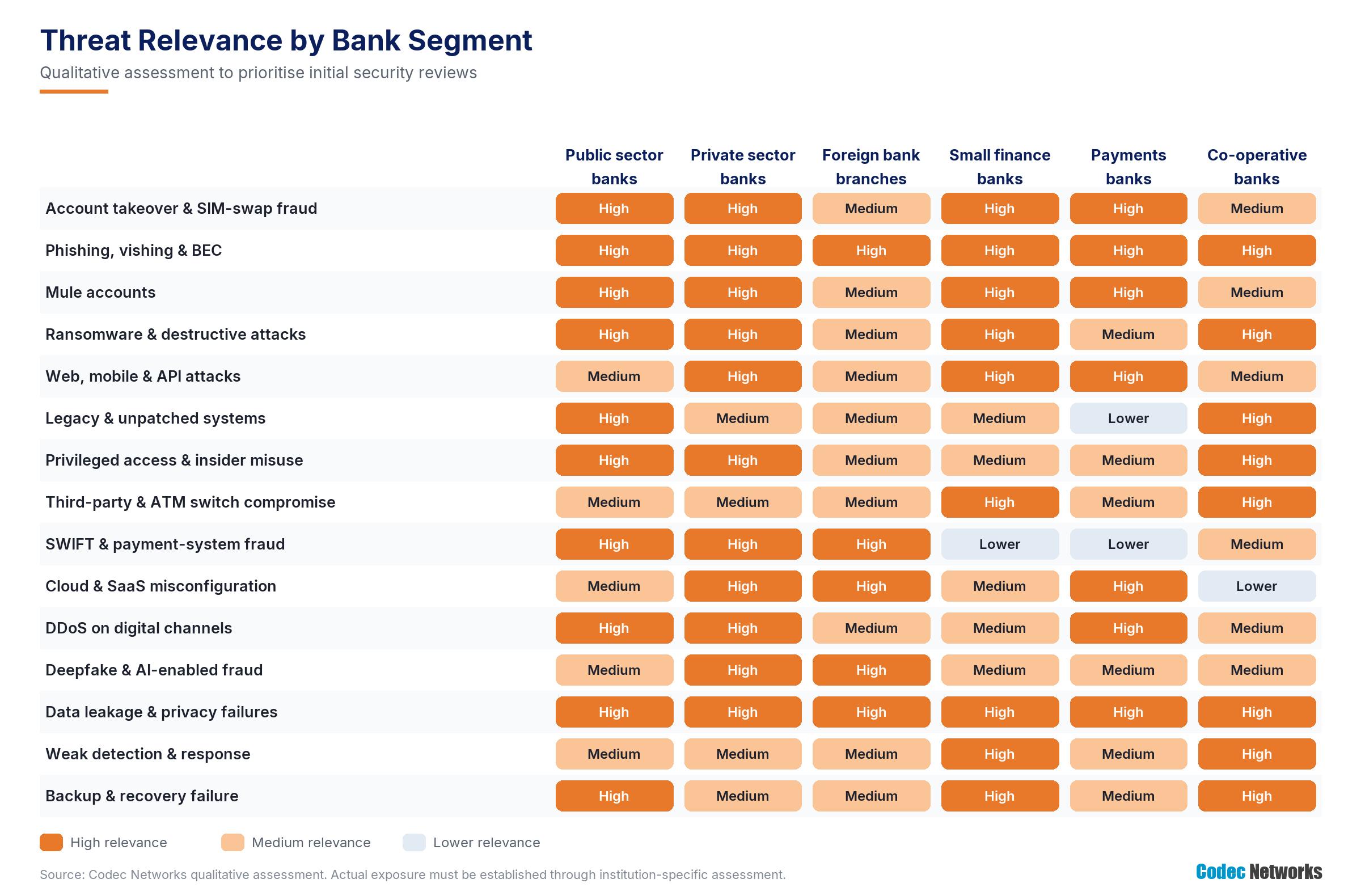
Figure 5: Qualitative threat relevance by bank segment (Codec Networks assessment).
4. Five priority threats in depth
4.1 Account takeover and mule accounts
Account takeover and mule accounts are two halves of the same fraud chain: one steals the money, the other moves it. Attackers exploit SIM swaps, OTP sharing under pressure, malware and remote-access apps; the proceeds flow through accounts opened with rented or synthetic identities and are moved out within minutes over UPI and IMPS. RBI's 2026 Directions expect risk-based transaction monitoring across channels and customer notification through alternate channels for payments above a customer-set value.
- Questions to test: Do onboarding and V-CIP controls detect synthetic and rented identities? Are dormant and new accounts subject to velocity and pass-through rules? Are SIM-change and device signals used in risk scoring?
- Relevant services: mobile app and authentication testing, mule-detection use cases in the CSOC, fraud-scenario simulation, forensic investigation.
4.2 Ransomware
Ransomware remains the threat most likely to stop a bank. Attackers enter through phishing, exposed remote access or vulnerable systems, escalate to domain administrator, delete backups and encrypt servers. RBI's 2026 Directions require DR drills for critical systems at least half-yearly, with DR operating for at least a full working day, and a documented Cyber Crisis Management Plan.
- Questions to test: Are backups isolated and restorable? Is EDR deployed and monitored on every endpoint and server? Has the crisis plan, including 6-hour reporting, been rehearsed?
- Relevant services: ransomware simulation, backup security testing, EDR/XDR validation, DR drill observation, incident response retainer.
4.3 Third-party and ATM switch compromise
Banks rely on shared ATM switch providers, core banking vendors, data-centre operators, cloud providers and fintech partners. RBI's 2026 commercial bank Direction specifies baseline controls that third-party ATM switch service providers must implement, requires those controls in contracts, and extends audit and RBI inspection rights to IT and cyber third-party arrangements not already covered by the outsourcing directions.
- Questions to test: Do contracts contain the baseline controls and audit rights? Are privileged actions at the provider logged and alerted to the bank? When were the provider's controls last independently tested?
- Relevant services: third-party risk management, ATM switch provider assessments, contract security review, CSOC monitoring of provider activity.
4.4 Digital channel and API attacks
Internet banking, mobile banking and partner APIs are where most data-exposure findings occur. Broken object-level authorisation, excessive data in API responses and leaked partner credentials are common. The 2026 Directions require application security testing throughout the lifecycle—explicitly not limited to the OWASP Top 10—and VA at least six-monthly and PT at least annually for customer-facing DMZ systems.
- Questions to test: Is every partner API inventoried, minimised and tested? Are partner credentials scoped, rotated and monitored? Are business-logic flaws tested, not only technical vulnerabilities?
- Relevant services: web, mobile and API testing, secure code review, DevSecOps integration, partner API assurance.
4.5 Weak detection and the 6-hour clock
A bank that cannot see an incident cannot report it. RBI's 2026 Directions require cyber incidents to be reported on the DAKSH platform within six hours of detection and require a CSOC with round-the-clock Level 1 monitoring and deeper Level 2 and Level 3 capabilities. CERT-In's Directions separately require reporting within six hours and retention of ICT logs for 180 days in India.
- Questions to test: Are all critical systems feeding the SIEM? Are detection use cases tested? Is there a 2 a.m. escalation path that ends with a DAKSH submission?
- Relevant services: managed or co-managed CSOC, SIEM use-case tuning, incident playbooks, tabletop exercises.
5. Impact on banks and their stakeholders
|
Stakeholder |
How cyber incidents affect them |
|
Customers |
Loss of funds, data exposure, inability to transact, loss of trust |
|
The bank |
Fraud losses, reimbursement, recovery costs, supervisory action, reputational damage |
|
Board and senior management |
Accountability under RBI's 2026 Directions; scrutiny of governance and risk oversight |
|
Partners and correspondents |
Suspended integrations, correspondent-bank concerns, contract disputes |
|
The financial system |
Contagion through shared rails, shared service providers and inter-bank exposure |
6. How regulation turns incidents into supervisory events
- Reporting clocks: cyber incidents to RBI on DAKSH within six hours of detection; specified incidents to CERT-In within six hours.
- Evidence: ICT logs retained for 180 days in India under CERT-In's Directions; incident analysis and root cause expected by supervisors.
- Customer liability: from 1 January 2027, RBI's revised framework for fraudulent electronic banking transactions places the burden of proving customer liability on banks.
- Privacy: once DPDP breach provisions commence in May 2027, personal data breaches must be intimated to the Data Protection Board, with a detailed report within 72 hours.
- Governance: under the 2026 Directions, the CISO reviews cyber risk with the Board, Risk Management Committee or ITSC at least quarterly.
|
Insight The most damaging bank incidents are chains: a phished vendor account, an unmonitored limit change and a weekend reconciliation gap. Assessments should test the chain end to end, across the bank and its third parties. |
7. Questions every bank's leadership should ask
- Which critical systems and customer-facing DMZ systems have not had VA in the last six months or PT in the last year?
- Could we detect, triage and report a material incident to RBI within six hours—tonight?
- Which third parties, including ATM switch and core providers, could hurt us most, and when were their controls last tested?
- How quickly would we spot a mule account or an unusual high-value transfer?
- When did we last run DR for a full working day and restore from backup?
- Does the Board receive cyber risk indicators that show control effectiveness, not just activity?
Talk to Codec Networks
|
Contact Codec Networks Pvt. Ltd. New Delhi: 507, 5th Floor, New Delhi House, Barakhamba Road, Connaught Place, New Delhi – 110001 Gurugram: 707, 7th Floor, Silverton Tower, Golf Course Extension Road, Sector 50, Gurugram – 122018, Haryana Landline: 011 430 496 96 | 011 437 522 99 Mobile: +91 99716 76124 | +91 88007 88220 | +91 88003 31124 Email: mktg@codecnetworks.com Web: www.codecnetworks.com |
Note: Threat descriptions and relevance ratings are general guidance, not findings about any specific bank. RBI fraud figures relate to frauds of ₹1 lakh and above reported in 2025-26, which may include frauds that occurred earlier; I4C figures cover all channels. Confirm regulatory obligations against official instruments.