

Resources Categories
INDUSTRY FACT FILE · BANKING
Industry Overview: The Banking Sector in India
The types of banks and industry players, how they are owned and supervised, who buys cybersecurity inside them, and why each needs a distinct approach.
|
In this document 1. Why banking cybersecurity matters now 2. The banking ecosystem at a glance 3. Categories of banks and industry players 4. Government, public-sector and private ownership 5. Who buys cybersecurity inside a bank 6. Why each bank type needs a different approach 7. How Codec Networks works with banks |
|
Sector scope Sector: Banking — public and private sector banks, foreign bank branches, small finance banks, payments banks and co-operative banks. Primary service proposition: regulatory assurance, VAPT, SOC and resilience. |
1. Why banking cybersecurity matters now
Banks hold the country's deposits, run its payment systems and extend most of its formal credit. Every one of those activities now runs on digital channels, shared payment rails and third-party technology. That makes banks the most valuable target in the economy—for fraud rings, ransomware groups and nation-state actors alike.
|
₹48,021 cr Frauds reported by banks and FIs in FY26 (RBI Annual Report) |
6 hours To report cyber incidents to RBI on DAKSH |
29 banks Using RBIH's MuleHunter.AI (July 2026) |
31 Jul 2026 RBI's new cybersecurity Directions for banks |
On 31 July 2026 the Reserve Bank of India (RBI) issued a new set of cybersecurity Directions—the Cybersecurity, Technology: Risk, Resilience and Assurance Framework—separately for commercial banks, small finance banks, payments banks and urban co-operative banks, among others. They took effect immediately and repealed the earlier cybersecurity and IT governance instructions for these entities. For every bank, cybersecurity is now a Board-level, continuously supervised obligation.
|
Key takeaway Banks are judged on three things at once: the safety of customer money, the availability of their channels and their standing with the supervisor. Each one depends on demonstrable cybersecurity. |
2. The banking ecosystem at a glance
India's banking system includes several categories of banks with different licences, ownership models and supervisors. All of them connect to shared payment rails, technology providers and partner ecosystems—so a weakness in one place can travel across the system.
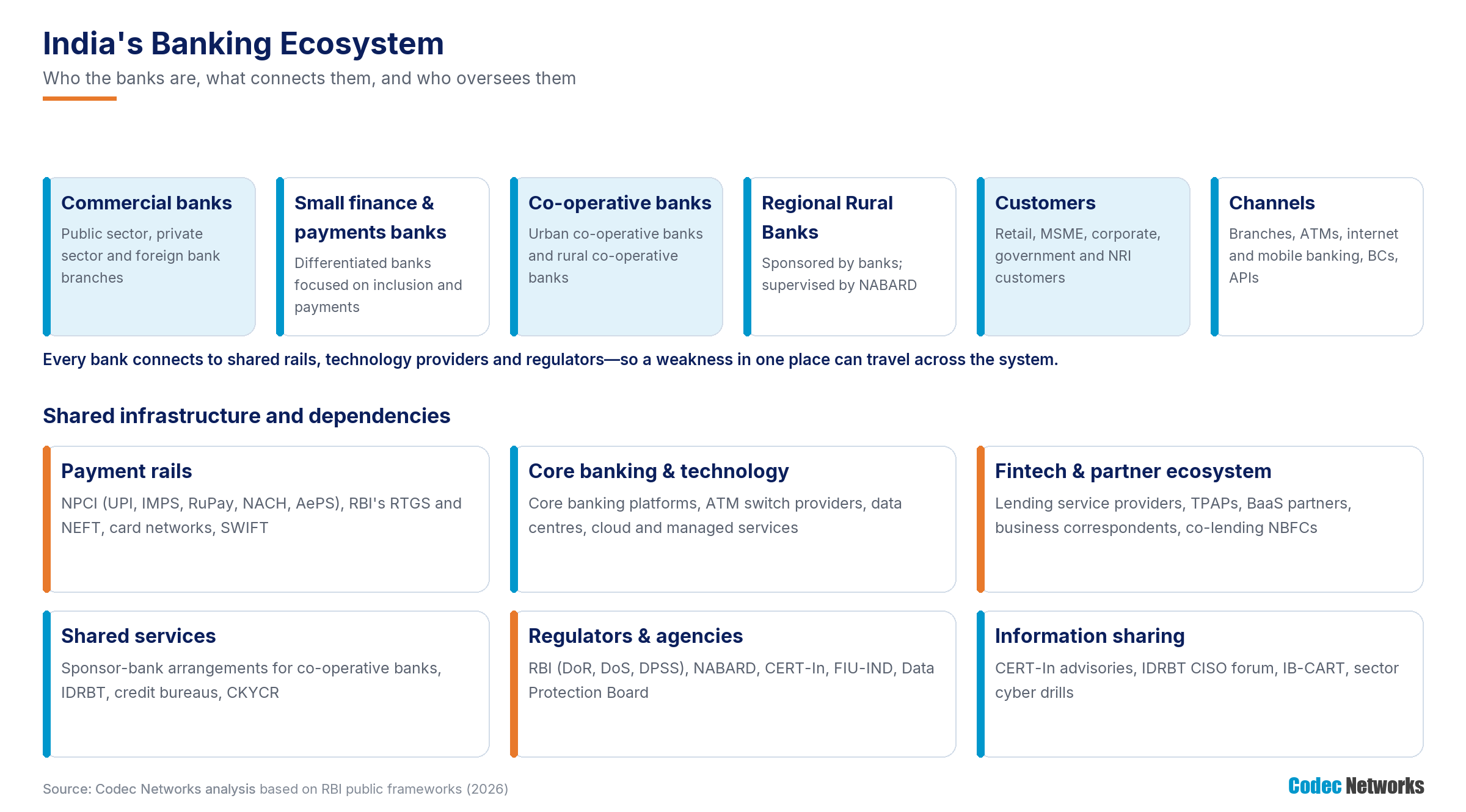
Figure 1: The Indian banking ecosystem — bank categories, customers, channels and shared infrastructure.
3. Categories of banks and industry players
The table summarises the main categories of banks, their typical ownership and the primary regulatory basis for their cybersecurity obligations.
|
Bank category |
Who they are |
Typical ownership |
Cybersecurity framework (as of October 2026) |
|
Public sector banks |
Twelve public sector banks, including the State Bank of India, with very large branch and customer networks |
Government of India majority-owned |
RBI Commercial Banks – Cybersecurity, Technology: Risk, Resilience and Assurance Framework Directions, 2026 |
|
Private sector banks |
Domestic private banks, from large universal banks to smaller regional banks |
Private shareholders; many listed |
RBI Commercial Banks Directions, 2026 |
|
Foreign bank branches and subsidiaries |
International banks operating in India through branches or wholly owned subsidiaries |
Foreign parent banks |
RBI Commercial Banks Directions, 2026 — foreign bank branches follow a 'comply or explain' approach for specified chapters |
|
Small finance banks |
Banks focused on financial inclusion, small businesses and underserved customers |
Private promoters; many converted from microfinance or NBFC businesses |
RBI Small Finance Banks Directions, 2026 (issued the same day) |
|
Payments banks |
Banks that accept limited deposits and provide payments and remittance services, without lending |
Telecom, technology, postal and financial groups |
RBI Payments Banks Directions, 2026 (issued the same day) |
|
Urban co-operative banks |
Co-operative banks serving urban and semi-urban communities |
Member-owned co-operative societies |
RBI Urban Co-operative Banks Directions, 2026 — graded into four levels by digital depth |
|
Rural co-operative banks |
State co-operative banks and district central co-operative banks |
Member-owned; state-level co-operative structures |
Supervised by NABARD; follow the cybersecurity framework applicable to them |
|
Regional Rural Banks |
Rural banks jointly owned by the Government of India, state governments and sponsor banks; consolidated to 28 under the 'One State, One RRB' amalgamation in 2025 |
Government and sponsor banks |
Supervised by NABARD; follow the cybersecurity framework applicable to them |
|
Local Area Banks |
Small private banks operating in limited geographies |
Private promoters |
RBI Local Area Banks supervisory directions |
|
Banking technology providers |
Core banking, ATM switch, card processing, data-centre, cloud and fintech partners |
Private Indian and international technology companies |
Not directly licensed; governed through banks' outsourcing and third-party requirements, including baseline controls for ATM switch providers |
|
Bank versus bank-like institutions NBFCs, housing finance companies, fintech lenders and payment companies are covered in separate Codec Networks industry fact files. Banks frequently partner with them through co-lending, business correspondent, sponsor-bank and banking-as-a-service arrangements—which brings their security into the bank's own risk perimeter. |
4. Government, public-sector and private ownership
4.1 Government and public-sector participants
- Public sector banks are majority-owned by the Government of India and serve government business, welfare transfers and a large share of rural and semi-urban customers.
- Regional Rural Banks are jointly owned by the Government of India, state governments and sponsor banks. Following the 'One State, One RRB' amalgamation effective in 2025, there are 28 RRBs.
- India Post Payments Bank is a payments bank owned by the Department of Posts, Government of India.
- Development and refinancing institutions such as NABARD, SIDBI, EXIM Bank and NHB are All India Financial Institutions; RBI issued a separate 2026 cybersecurity Direction for them.
- Government departments and PSUs are major corporate customers whose collections, payroll and disbursements run through bank platforms.
4.2 Corporate and enterprise banks
Private sector banks, foreign banks, small finance banks and payments banks are corporate enterprises with shareholders, Boards and, in many cases, stock-exchange listings. Their security needs scale with balance-sheet size, digital-channel volume, number of fintech and co-lending partnerships and the complexity of their technology estate.
|
Segment |
Characteristics |
Typical cybersecurity priorities |
|
Large public and private sector banks |
Very large customer bases, many channels, complex legacy and modern systems side by side |
Board and ITSC governance, 24x7 CSOC, red teaming, third-party assurance, crisis management |
|
Mid-sized private banks |
Rapid digital growth, fintech partnerships, lean security teams relative to scale |
Digital channel and API security, managed SOC, regulatory evidence |
|
Foreign bank branches |
Group security standards with local Indian obligations |
Local gap assessment, data localisation, comply-or-explain documentation |
|
Small finance and payments banks |
Digital-first, inclusion-focused, high transaction volumes, outsourced technology |
Mobile and API testing, fraud and mule monitoring, vendor risk |
|
Co-operative banks |
Resource constraints, sponsor-bank or shared-service dependence, legacy systems |
Graded baseline controls, shared SOC, backup and recovery, awareness |
5. Who buys cybersecurity inside a bank
Under RBI's 2026 Directions for commercial banks, the Board oversees technology and cyber risk; an IT Strategy Committee of at least three directors, chaired by an independent director with substantial IT experience, meets at least quarterly; and a CISO at General Manager or equivalent level reports to the Executive Director overseeing risk management—not to the Head of IT.
|
Stakeholder |
What they care about |
What they buy |
|
Board and IT Strategy Committee |
Material cyber risk, supervisory standing, resilience |
Board advisory, risk dashboards, crisis exercises |
|
Audit Committee of the Board |
Independent IS audit and assurance |
IS audit support, control testing, evidence reviews |
|
CISO and information security team |
Control effectiveness, monitoring, vulnerability closure |
VAPT, CSOC, threat hunting, red teaming |
|
CIO / CTO and digital banking heads |
Channel availability, secure change, modernisation |
Application and API testing, DevSecOps, cloud reviews |
|
Chief Risk Officer and fraud risk |
Fraud losses, mule accounts, operational risk |
Fraud-scenario testing, mule analytics, investigations |
|
Compliance and Principal Officer |
RBI, CERT-In, FIU-IND obligations |
Regulatory gap assessments, reporting readiness |
|
Data protection lead |
DPDP readiness, customer data handling |
Privacy programme, DLP, data-flow mapping |
|
Vendor management and procurement |
Third-party and outsourcing risk |
Vendor assessments, ATM switch and cloud provider reviews |
6. Why each bank type needs a different approach
|
Bank type |
Highest-consequence risk |
Starting point for assurance |
|
Public sector bank |
Ransomware and outages across a large legacy estate; insider and privileged misuse |
Resilience and DR testing, privileged-access audit, CSOC maturity review |
|
Private sector bank |
Account takeover, API exposure through fintech partners, rapid change |
Digital channel and API testing, DevSecOps, partner assurance |
|
Foreign bank branch |
Gaps between group controls and Indian requirements |
Local control-gap assessment and comply-or-explain documentation |
|
Small finance bank |
Mule accounts, mobile fraud, outsourced technology |
Mobile app testing, fraud monitoring, vendor risk assessment |
|
Payments bank |
High-volume digital payments and agent-network fraud |
Payment interface testing, device and authentication review |
|
Co-operative bank |
Weak baseline controls, shared-service dependence, backup failures |
Graded baseline assessment, backup and recovery testing, shared SOC |
7. How Codec Networks works with banks
Codec Networks is a CERT-In empanelled information security auditing organisation certified to ISO 9001:2015, ISO/IEC 27001:2022 and ISO/IEC 20000-1:2018. For banks, our work combines four strands:
- Regulatory assurance: gap assessments against RBI's 2026 Directions, IS audit support, PCI DSS, SWIFT CSP and ISO 27001 readiness, and Board and ITSC reporting.
- VAPT: vulnerability assessment at least every six months and penetration testing at least annually for critical and customer-facing systems, plus application, API and source code testing.
- SOC: a managed or co-managed CSOC with Level 1–3 analysts, SIEM, EDR/XDR, fraud-signal correlation and anti-phishing and rogue-app monitoring.
- Resilience: ransomware readiness, backup and DR testing, Cyber Crisis Management Plans, tabletop exercises and forensic incident response.
Talk to Codec Networks
|
Contact Codec Networks Pvt. Ltd. New Delhi: 507, 5th Floor, New Delhi House, Barakhamba Road, Connaught Place, New Delhi – 110001 Gurugram: 707, 7th Floor, Silverton Tower, Golf Course Extension Road, Sector 50, Gurugram – 122018, Haryana Landline: 011 430 496 96 | 011 437 522 99 Mobile: +91 99716 76124 | +91 88007 88220 | +91 88003 31124 Email: mktg@codecnetworks.com Web: www.codecnetworks.com |
Note: This document is general industry guidance based on public information available as of October 2026, including RBI, NABARD, CERT-In and MeitY publications. Requirements differ by bank category; confirm obligations against the current official Directions before making compliance decisions. Fraud statistics relate to frauds of ₹1 lakh and above reported to RBI.