

Resources Categories
INDUSTRY FACT FILE · ASSET MANAGEMENT
Threat Landscape: Top Cyber Threats Facing Asset and Investment Managers
The 18 most relevant cyber threats, attacks and industry challenges for mutual funds, AMCs, portfolio managers, AIFs, advisers and wealth platforms in India.
|
In this document 1. The threat picture in numbers 2. Top 18 threats, attacks and challenges 3. Threat relevance by asset management segment 4. Five priority threats in depth 5. Impact on managers and investors 6. How regulation turns incidents into business events 7. Questions every leadership team should ask |
1. The threat picture in numbers
|
₹82.22 lakh cr MF industry AUM at stake (AMFI, June 2026) |
27.86 cr Mutual fund folios to protect (June 2026) |
36% Share of 2025 cyber-fraud complaints linked to investment fraud (I4C data, as reported) |
6 hours To report cyber incidents to SEBI and CERT-In |
Investment-related fraud is the largest category of cyber-fraud complaints in India; reports based on I4C data indicate around 36% of 2025 complaints related to investment fraud. Asset managers face both direct attacks on their systems and scams that misuse their brands and fund managers' identities.
Because investor data and transactions flow through AMCs, RTAs, distributors, platforms and fund accountants, a weakness at any partner can expose investors.
2. Top 18 threats, attacks and challenges
The list below is a practical assessment framework, not a statistical ranking. Priority varies by business model, technology exposure and existing controls.
|
# |
Threat / attack / challenge |
Typical scenario |
Most exposed |
Potential impact |
|
1 |
Redemption and bank-mandate fraud |
Contact details or bank mandates changed, followed by redemption |
AMCs, RTAs, platforms |
Investor losses, compensation, complaints |
|
2 |
Investor account takeover |
Phished credentials and OTPs used on apps and portals |
AMCs and wealth platforms |
Unauthorised transactions and data exposure |
|
3 |
Front-running and order leakage |
Dealers or insiders leak or trade ahead of fund orders |
AMCs, PMS, AIFs |
SEBI action, penalties and reputational damage |
|
4 |
Ransomware and data extortion |
Encryption of AMC, RTA or fund accountant systems |
AMCs and service providers |
Investor service disruption and data exposure |
|
5 |
Phishing and business email compromise |
Impersonation of executives, distributors or investors |
All managers, especially PMS and AIFs |
Fraudulent payments and capital-call diversion |
|
6 |
Investor data leakage |
Exposure of KYC, folio and holdings data |
AMCs, RTAs, platforms, distributors |
DPDP exposure and targeted scams |
|
7 |
Third-party and RTA compromise |
Breach at an RTA, custodian, fund accountant or vendor |
AMCs relying on service providers |
Multi-fund impact |
|
8 |
NAV and pricing data tampering |
Manipulated pricing feeds or fund accounting data |
AMCs and fund accountants |
Incorrect NAVs, compensation and restatement |
|
9 |
Distributor and platform API abuse |
Weak authorisation in partner APIs exposes folios |
AMCs and platforms |
Mass data exposure |
|
10 |
Fake apps and impersonation scams |
Fake apps, websites and groups using fund brands |
AMCs and advisers |
Investor harm and brand damage |
|
11 |
Deepfake fund managers |
AI-generated videos promoting fake schemes |
AMCs, PMS, advisers |
Investor harm and brand damage |
|
12 |
Insider misuse of investor data |
Staff or vendor access used to export investor records |
AMCs, RTAs, call centres |
Data theft and complaints |
|
13 |
Cloud misconfiguration |
Exposed storage or excessive permissions |
Managers adopting cloud |
Data exposure |
|
14 |
Supply-chain compromise |
Malicious updates in fund or investor-servicing software |
Users of common industry software |
Widespread exposure |
|
15 |
Weak detection and response |
Limited monitoring at smaller managers |
PMS, AIF managers, advisers |
Missed 6-hour reporting |
|
16 |
Backup and recovery failure |
Recovery not achieved within objectives |
AMCs and service providers |
Extended outages |
|
17 |
Unauthorised trading in client portfolios |
Compromised PMS or broker access used to trade |
Portfolio managers |
Client losses and disputes |
|
18 |
Data room and deal-data theft |
Theft of LP, deal or portfolio-company data |
AIF managers |
Confidentiality breaches |
3. Threat relevance by asset management segment
The matrix is a qualitative guide for prioritising the first round of security reviews.
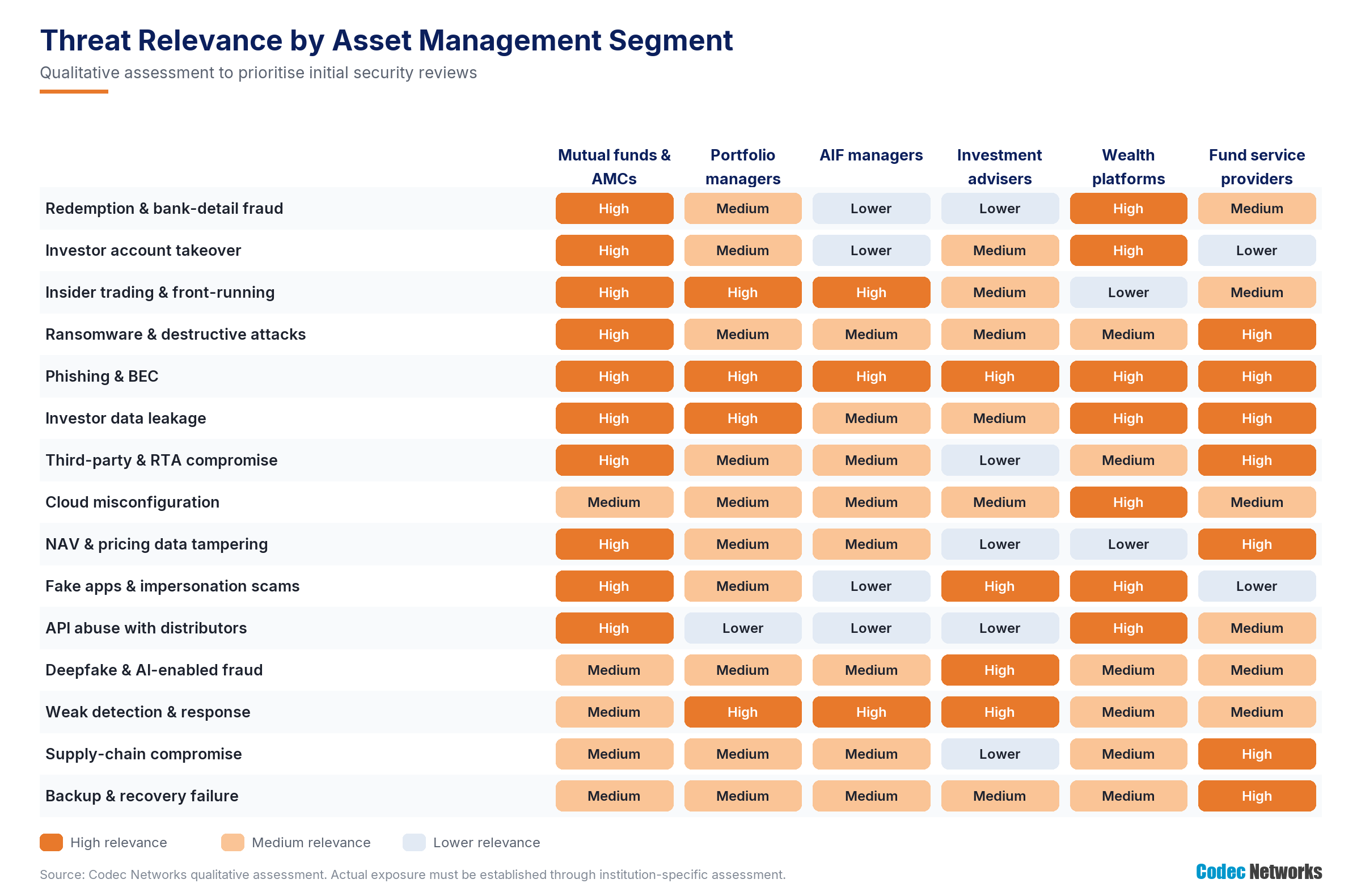
Figure 5: Qualitative threat relevance by asset management segment (Codec Networks assessment).
4. Five priority threats in depth
4.1 Redemption and bank-mandate fraud
Fraudsters use leaked personal data and SIM swaps to change contact details and bank mandates, then redeem units. Because AMCs and RTAs share responsibility for these transactions, controls must work across both.
- Questions to test: Are there cooling periods and alerts on old and new channels after contact or bank changes? Are high-value redemptions verified? Are SIM-change signals used?
- Relevant services: redemption and bank-change flow testing, IAM & MFA bypass testing, SOC fraud use cases.
4.2 Front-running and order leakage
Leakage of fund orders or price-sensitive information from dealing desks can lead to front-running, SEBI action and reputational damage.
- Questions to test: Are dealing rooms controlled (recorded lines, device restrictions)? Is DLP deployed on research and dealing systems? Are employee and associate trades surveilled?
- Relevant services: dealing-room controls review, DLP review, insider threat simulation, surveillance analytics.
4.3 Third-party and RTA risk
RTAs, custodians, fund accountants and vendors process investor and fund data for many AMCs. CSCRF expects REs to manage third-party risk, and a single provider breach can affect many funds.
- Questions to test: When were key providers last assessed? Do contracts include security, incident-notification and audit clauses? Are data flows minimised?
- Relevant services: third-party risk management, vendor and RTA assessments, contract security review.
4.4 NAV and pricing integrity
Fund accounting depends on pricing feeds and custodian data. Compromised feeds or credentials can produce incorrect NAVs that investors transact on.
- Questions to test: Are feeds authenticated and validated against tolerances? Are price overrides logged and approved?
- Relevant services: integrity controls review, vendor assessment, system audit.
4.5 Impersonation and deepfake scams
Scammers increasingly use fake apps, social-media groups and deepfake videos of fund managers to lure investors into fraudulent schemes.
- Questions to test: Is the brand monitored across social media and app stores? How quickly can fakes be taken down? Do investors know official channels?
- Relevant services: brand and social-media monitoring, takedown support, investor awareness, deepfake simulation.
5. Impact on managers and investors
|
Player type |
Threats to prioritise |
Main impact |
|
AMCs and mutual funds |
Redemption fraud, front-running, RTA risk, ransomware |
Investor losses, SEBI action, reputational damage |
|
Portfolio managers |
BEC, account compromise, unauthorised trading |
Client losses and disputes |
|
AIF managers |
BEC on capital calls, deal-data theft |
LP trust and confidentiality |
|
Investment advisers |
Impersonation and account compromise |
Client harm and brand damage |
|
Wealth platforms |
Account takeover, API abuse, fake apps |
Investor losses, partner disputes |
|
Fund service providers |
Ransomware, data tampering |
Multi-fund disruption |
6. How regulation turns incidents into business events
- SEBI: cyber incidents reported within six hours under CSCRF, with follow-up reporting and root-cause analysis.
- CERT-In: specified incidents reported within six hours; ICT logs kept for 180 days in India.
- Trustees: significant incidents are reported to trustees and Boards.
- Privacy: once DPDP breach provisions commence in May 2027, personal data breaches must be intimated to the Data Protection Board, with a detailed report within 72 hours.
- Investors: compensation and communication obligations can follow incorrect NAVs or unauthorised redemptions.
|
Insight In asset management, the weakest link is often a partner: an RTA, a distributor API or a pricing vendor. Assurance programmes must follow investor data and transactions across the whole chain. |
7. Questions every leadership team should ask
- Do we know our CSCRF category and meet its audit, VAPT and SOC obligations?
- Would we stop a redemption after a fraudulent bank-mandate change?
- Could order information leave our dealing desk without detection?
- When were our RTA, custodian and fund accountant last assessed?
- Is our brand being used in fake apps or deepfake videos today?
- Could we report an incident to SEBI and CERT-In within six hours?
Talk to Codec Networks
|
Contact Codec Networks Pvt. Ltd. New Delhi: 507, 5th Floor, New Delhi House, Barakhamba Road, Connaught Place, New Delhi – 110001 Gurugram: 707, 7th Floor, Silverton Tower, Golf Course Extension Road, Sector 50, Gurugram – 122018, Haryana Landline: 011 430 496 96 | 011 437 522 99 Mobile: +91 99716 76124 | +91 88007 88220 | +91 88003 31124 Email: mktg@codecnetworks.com Web: www.codecnetworks.com |
Note: Threat descriptions and relevance ratings are general guidance, not findings about any specific entity. I4C figures cover all channels and are as reported in public sources. Confirm obligations against SEBI's current circulars.