A. Service Scope and Client Fit
A1We already have an ERM function. What does Codec Networks add?
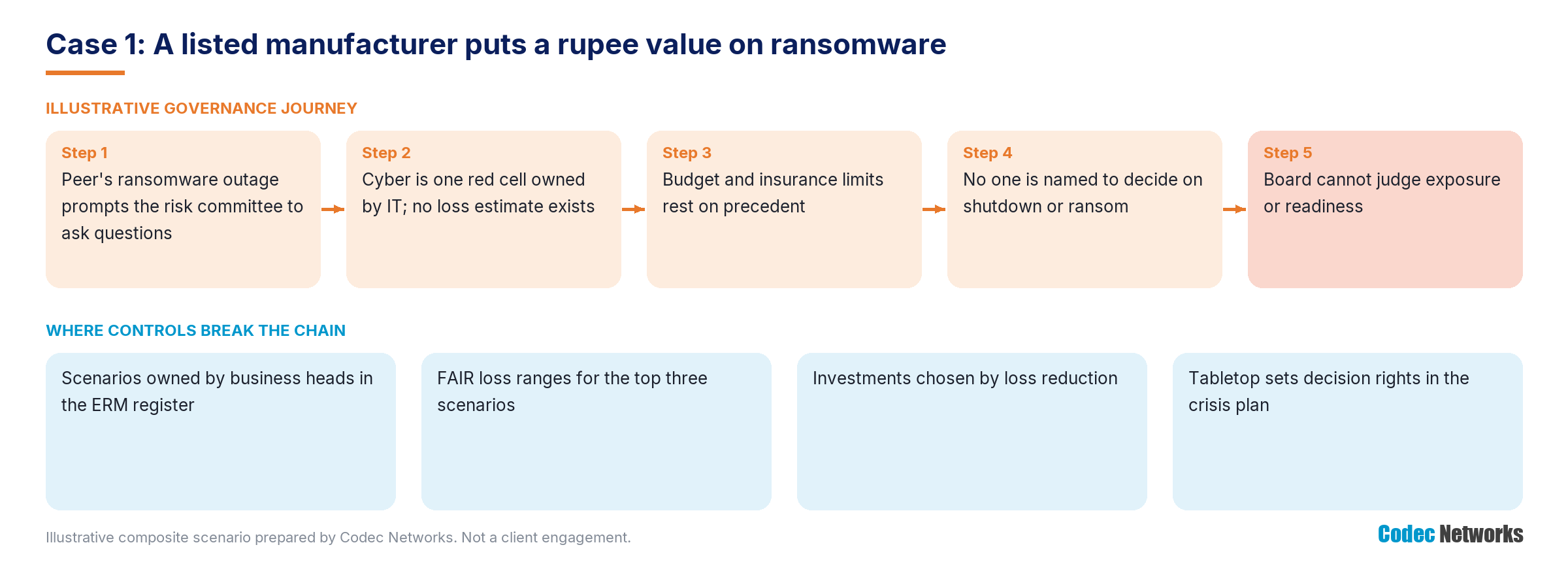
Most ERM teams record cyber as a single line owned by IT. Codec Networks breaks it into business scenarios, rates them on your enterprise scale, assigns business owners and links them to KRIs, so your existing ERM process can manage cyber like any other risk.
A2Is strategic risk advisory only for listed companies?
No. Listed companies have specific duties, but any organisation whose owners, lenders, insurers or customers ask about cyber oversight benefits. Codec Networks' Basic level suits mid-sized and family-owned businesses.
A3How is this different from GRC services?
GRC builds and audits controls against standards such as ISO 27001. Strategic risk advisory helps leadership decide: which risks to accept, what they could cost, which deals to sign and how to respond in a crisis. Many clients use both, sharing one evidence base.
A4We are a private equity fund. Can you cover our whole portfolio?
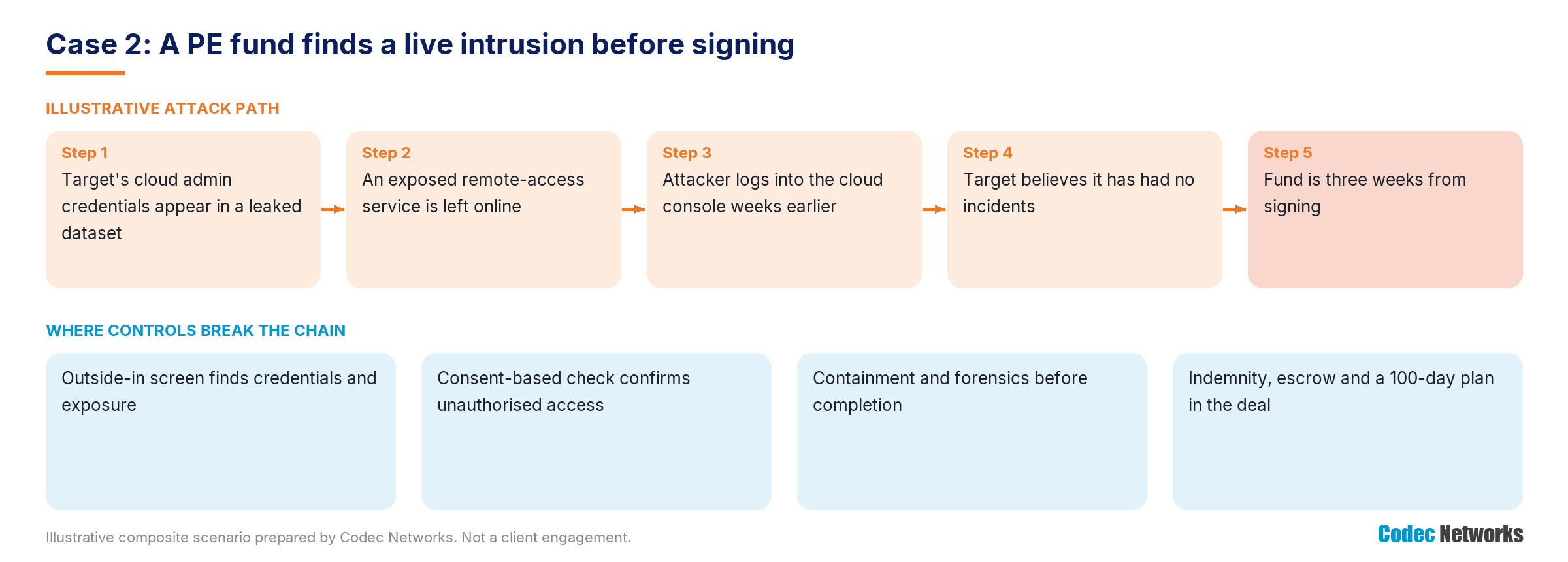
Yes. Codec Networks provides pre-investment due diligence for each deal and a repeatable checklist and dashboard for portfolio companies, so the fund sees cyber risk across holdings in one view.
A5Can you assess an AI programme before we launch it?
Yes. Codec Networks reviews the use case, data, model risks, governance and privacy against ISO/IEC 42001 and the NIST AI RMF, sets go-live criteria and reports residual risk to your steering committee.
A6We are not a crypto company but plan to tokenise assets. Is Web3 audit relevant?
Yes. Tokenisation brings smart contract, custody and regulatory questions even for traditional businesses. Codec Networks reviews the model, the code, the keys and the governance before value is at stake.
A7Who should take part in a Board tabletop exercise?
Usually the chair or a nominated director, the CEO, CFO, General Counsel, CISO, CRO, communications head and key business leaders. Codec Networks agrees the participant list with the sponsor so the right decision-makers are in the room.
A8Can Codec Networks help after a real incident?
Yes. Codec Networks' incident response and forensics teams can support you, and the playbooks and decision rights built in war-games are the starting point for the response.
B. Standards, Laws and Regulatory Alignment
B1Which standard do you use for ERM?
ISO 31000:2018 for the risk management framework and process, ISO/IEC 27005:2022 for information security risk, and NIST IR 8286 Rev. 1, published in December 2025, for linking cyber risk registers to enterprise risk management.
B2Does SEBI require our risk committee to look at cyber?
As general information: SEBI's LODR Regulation 21, as amended in May 2021, requires the top 1,000 listed entities by market capitalisation to have a risk management committee whose role specifically covers cyber security. Your company secretary should confirm how it applies to you.
B3What is FAIR and is it an accepted method?
FAIR (Factor Analysis of Information Risk) is a model for estimating the frequency and size of loss events, published by The Open Group as its Risk Taxonomy (O-RT) and Risk Analysis (O-RA) standards. It is widely used by risk teams and insurers.
B4Which rules apply to our AI programme in India?
India's AI Governance Guidelines, released by MeitY in November 2025, set principles for responsible AI under existing laws rather than a separate AI statute. The DPDP Act, sector rules and contracts still apply. Codec Networks maps these for your programme, for client information.
B5Does the EU AI Act affect Indian companies?
It can, if you place AI systems on the EU market or their output is used in the EU. Its prohibitions and general-purpose AI duties already apply, and the high-risk timelines were revised in 2026. Codec Networks checks applicability as part of the transformation review.
B6What obligations apply to virtual digital asset businesses?
As general information: a March 2023 notification brought VDA service providers within the Prevention of Money-laundering Act, with registration and reporting to FIU-IND, and the Income-tax Act taxes VDA income and requires TDS on transfers. Codec Networks reviews these in Web3 audits; legal advice should confirm them.
B7Is a cyber crisis management plan expected of banks?
As general information: RBI's Cyber Security Framework in Banks (RBI/2015-16/418, 2016) expects banks to have a cyber crisis management plan. Codec Networks' exercises test whether that plan works in practice.
B8Do US disclosure rules matter to us?
If you are an SEC registrant, the SEC's 2023 rules require disclosure of material cyber incidents on Form 8-K within four business days and annual disclosure of risk management and governance. Codec Networks' Board reporting and exercises cover these decision points.
C. Engagement Approach and Delivery
C1How does an engagement start?
With a scoping call and a short interview with the sponsor, usually the CFO, CRO or company secretary. Codec Networks then agrees the scope, plan, participants and reporting cadence before work begins.
C2How much director time do you need?
Very little: one interview for reporting needs, a briefing session and, for exercises, a half-day tabletop. Most work is done with management.
C3Where does the data for CRQ come from?
From your incident history, downtime records, financial data, insurance policies and security tools, supplemented by industry benchmarks and calibrated expert estimates where your own data is thin.
C4How do you keep deal information confidential?
Deal work is handled under NDAs and Codec Networks' ISO/IEC 27001:2022 certified ISMS, with need-to-know access and clean-team arrangements where the transaction requires them.
C5Will you test the target company's systems?
Only with the target's consent and in agreed conditions. Without consent, Codec Networks relies on outside-in screening, document review and management interviews.
C6Can a war-game disrupt our live systems?
Tabletops and war-games use simulated injects and do not touch live systems. Technical ransomware simulations run only in agreed systems, with safeguards and written approval.
C7How do you make exercise scenarios realistic?
Scenarios are built from real incidents in your sector and from your own dependencies, such as critical vendors, plants or payment systems, with injects for regulators, media and customers.
C8What happens after an exercise?
Codec Networks debriefs participants, records decision gaps, updates the crisis plan and playbooks, and tracks actions to closure before the next exercise.
D. Commercials, Timelines and Effort
D1How is pricing decided?
By the level you choose (Basic, Medium or Advanced) and by scope drivers such as entities, scenarios, deal size, programme phases, code size or exercise participants. Document 7 gives indicative bands; a written proposal confirms them after scoping.
D2How quickly can you screen a deal target?
An outside-in screen typically takes one to two weeks. A full due diligence typically takes three to six weeks, depending on data-room access and the deal timeline.
D3How is due diligence priced?
Per transaction, sized to the target and the depth required, from an outside-in screen to a full assessment with a 100-day plan.
D4How long does a CRQ engagement take?
Typically four to eight weeks for three to eight scenarios, depending on how quickly data can be gathered and calibrated.
D5Can we pay for Board reporting monthly?
Yes. Board reporting at the Advanced level is offered as a retainer that covers quarterly packs, briefings and updates.
D6Do bundles cost less?
Yes. The Board Risk Starter, Risk to Rupees and Board Resilience Programme bundles are priced below the sum of their parts because workshops, scenarios and data are reused.
D7Are travel and third-party tools included?
No. Fees exclude GST, travel and third-party costs such as specialist tools or data. Proposals list them separately.
D8What if a deal timeline changes?
Codec Networks re-plans the phases with the deal team and confirms any change to effort or fee in writing before continuing.
E. Board Reporting, Evidence and Ongoing Support
E1What will the Board actually see?
A one-page view each quarter: top cyber risks against appetite, KRIs and trends, loss estimates where available, incidents, exercise findings and the decisions required.
E2How do loss estimates appear in the Board pack?
As ranges of annual loss exposure for each top scenario, with the main assumptions and the effect of planned controls, so directors can compare options.
E3Can the outputs support our cyber insurance renewal?
Yes. CRQ results show exposure against policy limits and retentions, and the evidence gathered helps answer underwriting questions.
E4How do you keep the register current?
Through quarterly updates under a retainer, triggered reviews after major incidents, deals or transformations, and an annual framework review.
E5Can Codec Networks brief new directors?
Yes. Director briefings cover the threat landscape, the company's top cyber risks, oversight duties and their role during a crisis.
E6What records show the Board's oversight?
Approved risk appetite, quarterly packs, minutes of risk committee discussions, exercise reports and closure of actions together form a record of oversight.
E7Do you support portfolio companies after an investment?
Yes. Codec Networks tracks the 100-day plan, repeats the checklist periodically and keeps the fund's portfolio cyber dashboard current.
E8How often should we run exercises?
Most organisations run at least one Board tabletop a year and a multi-team war-game every one to two years, with extra exercises after major changes. Codec Networks plans this in an annual programme.